Nicpro Mechanical Carpenter Pencils are the first pick for your carpentry kit, because the 45mm elongated tip marks inside small holes and tight spots a regular carpenter pencil cannot reach. A crisp mark is where every accurate cut starts, so the best carpentry tools to add early are the ones that help you mark, hold and cut with less guesswork.
The five picks below cover marking, clamping, copying profiles and cutting. You’ll find a pencil set, two clamp sets, a contour gauge for trim and flooring, and a Japanese pull saw for flush cuts. Each product’s details come from its maker, with notes on what buyers repeat and where each tool falls short.
As an Amazon Associate we earn from qualifying purchases.
How we picked: from products sold on Amazon for this need, compared by what their makers state and what buyers report in their reviews.
The Picks at a Glance
Product | Best for | Item weight | Color | Style | Buyer rating | |
|---|---|---|---|---|---|---|
Nicpro Mechanical Carpenter Pencils | marking in tight spots | — | Black,Red | Modern | 4.7 of 5 (11,716 reviews) | |
WETOLS Corner Clamp Set | box and frame assembly | 13.44 ounces | Orange | Adjustable | 4.3 of 5 (3,917 reviews) | |
Saker 10-Inch Contour Gauge | fitting trim and flooring | 13.7 ounces | Orange | 10 in | 4.6 of 5 (22,770 reviews) | |
RUITOOL 6-Inch Ryoba Pull Saw | flush and finish cuts | 0.11 kg | — | — | 4.6 of 5 (6,553 reviews) | |
HORUSDY 8-Pack Bar Clamps | glue-ups and general holding | 2449 g | 8pcs 150 lb 6″&12″ Orange | 8pcs 150 lb 6″&12″ | 4.7 of 5 (1,246 reviews) |
Buyer ratings as shown on Amazon on November 23, 2026; they change.
Nicpro Mechanical Carpenter Pencils: Best for marking in tight spots
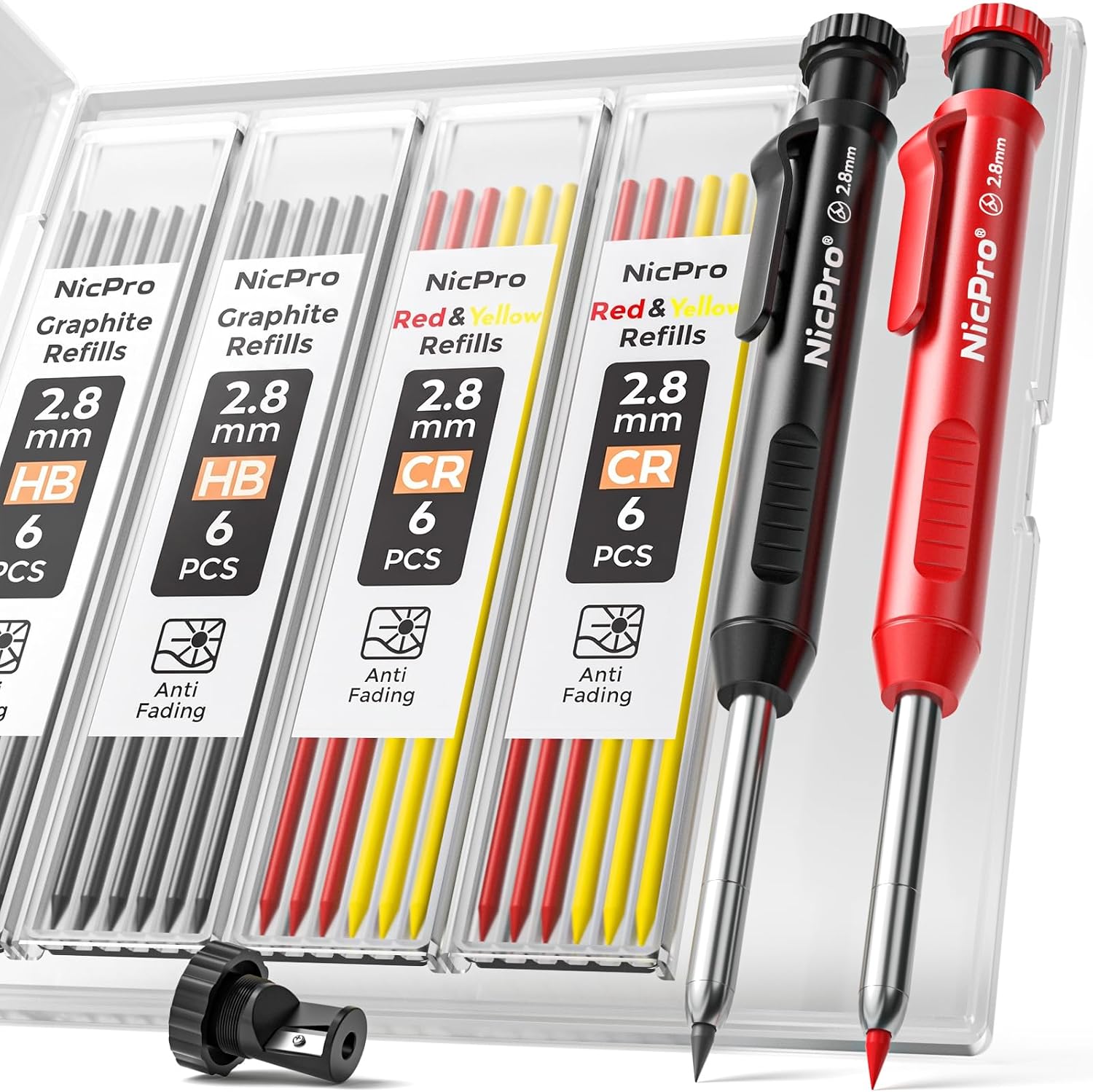
Nicpro’s mechanical pencil set suits anyone who marks cuts in awkward places, like the back of a cabinet opening or a drilled hole. Its 45mm elongated tip reaches into small holes and tight areas where a flat carpenter pencil cannot go.
The maker includes 2 pencils, 26 refills of 2.8 mm lead, 1 replaceable sharpener and a plastic storage box. With that many refills you can mark a whole project, or several, before you buy more lead, and the box keeps everything together in a tool bag.
The sharpener screws into the top of the pencil, so it won’t get lost. You can bring the point back on a ladder or in a crawl space without hunting for a loose sharpener. The 2.8 mm lead is thick and strong, so it resists breaking when you press hard on rough lumber. The pencils also mark metal, plastic, wood and paper, which helps when a project mixes materials, such as setting hardware on a door.
Pros
The 45mm tip reaches into holes and tight spots
The built-in sharpener stays with the pencil
Buyers say the thick lead lasts a long time and resists breaking
Buyers like having different lead colors for clear, precise marks
Cons
The pencils take 2.8 mm refills, so you need to restock that size when the 26 included refills run out
If your marking happens on open boards and your bigger problem is copying an odd shape onto trim or flooring, the Saker 10-Inch Contour Gauge is the better pick.
WETOLS Corner Clamp Set: Best for box and frame assembly

The WETOLS set is for you if you build boxes, small cabinets, drawers or picture frames and need a second pair of hands to keep corners square. You get four clamps that hold boards at 90 degrees for both corners and T-joints. That covers all four corners of a box at once, so you can square the whole assembly before you drive a screw or let glue set.
The clamps fit boards from 3/16 in to 3/4 in thick. That range takes thin plywood drawer bottoms, 1/2 in box stock and standard 3/4 in shelving or cabinet panels, which covers most shop furniture and storage projects. Spring tension keeps the boards in place while you screw or glue them, and each clamp works with one hand. In practice, your free hand stays on the drill or glue bottle while the clamp keeps the joint closed.
The body is polyamide, a tough nylon-type plastic. It is light, and plastic jaws are less likely to dent soft woods like pine than bare metal would be. Each clamp measures 3.3 x 2.8 x 1.5 inches, so the set takes up little room in a drawer or tool bag.
Pros
Four clamps let you square a full box in one setup
One-handed use frees your other hand for fastening
Buyers say they work well for nesting boxes and small shelf projects
Buyers find them good value for the money
Cons
Boards thicker than 3/4 in will not fit, so 2x lumber and thick slabs are out
Buyers report the clamps are much smaller than they expected and do not always hold pieces securely
Some buyers find the springs stiff and awkward to open
If your project is a wide panel glue-up or thicker stock, the HORUSDY 8-Pack Bar Clamps are the better fit.
Saker 10-Inch Contour Gauge: Best for fitting trim and flooring

The Saker 10-inch contour gauge is the pick for anyone fitting trim, flooring or tile around shapes that a tape measure can’t capture. The maker designs it to copy the profiles of pipes, moldings, baseboards and door frames, and to fit tile, laminate and carpet. Pressing it against an odd shape gives you a template you can trace onto your material.
Picture laying laminate in a bathroom: instead of guessing at the curve of a toilet flange or a door casing, you press the teeth against it and transfer that outline straight to the plank. An adjustable lock holds the teeth in place once you’ve captured the shape, so the profile doesn’t shift while you carry it to the board. That matters most when you walk across the room or set the gauge down before marking.
If the lock feels loose or the prongs stick, a tension screw on the opposite side sets the tightness, using the included mini wrench or a screwdriver: clockwise for a tighter hold, counterclockwise for smoother sliding. The body is ABS plastic and weighs 13.7 ounces. Plastic won’t rust, so the gauge can sit in a damp garage or basement toolbox.
Pros
Copies pipes, moldings and baseboards for clean scribed cuts
The lock holds the profile while you mark
Buyers say it is simple to use and helps them cut accurately around fixtures and door frames
The tension screw lets you set the tightness to suit you
Cons
The 10-inch width limits it to smaller profiles, so a wide crown molding or long stair edge needs more than one pass
Some buyers feel it isn’t good value for the money
If your job is assembling boxes or frames rather than fitting edges, the WETOLS corner clamps are the better buy.
RUITOOL 6-Inch Ryoba Pull Saw: Best for flush and finish cuts

The RUITOOL 6-inch Ryoba is the pick if you need to trim a dowel, plug or tenon flush with a surface, or make small, clean finish cuts. The maker lists a 6-inch double-edged blade sized for flush and finish cuts, with a fine-tooth side and a coarser side on the same saw.
The blade is SK5 high-carbon steel, and the teeth are hardened to HRC60-63. In plain terms, that is a hard tooth, so it should hold its edge through many small cuts before it feels dull. The blade is also flexible, which lets you bend it slightly and lay it flat against a surface when you cut off a protruding peg.
One edge has 17 TPI (teeth per inch) for hardwood, and the other has 14 TPI for softwood. More teeth leave a smoother cut in dense woods like oak or maple, while fewer, larger teeth clear chips faster in pine. You flip the saw instead of switching tools. The teeth are ground on three sides for faster chip removal and smoother cutting. The handle is beechwood, and the whole saw weighs 0.11 kg, so it is easy to control with one hand.
Pros
Double edge covers hardwood and softwood
Hard SK5 teeth at HRC60-63
Buyers say it makes clean cuts on small projects and needs little effort
Lifetime warranty
Cons
Some buyers find it smaller than they expected.
The 6-inch blade is slow for long rips or thick stock, since each stroke covers little wood.
If most of your cutting is long boards or thick framing lumber, plan on a longer saw or a power saw for those jobs and keep this one for detail work.
HORUSDY 8-Pack Bar Clamps: Best for glue-ups and general holding

This set is for you if you glue up panels, boxes or small assemblies and want plenty of clamps on hand without buying them one at a time. You get eight pieces: four 6-inch bar clamps, two 12-inch bar clamps and two 6-inch spring clamps. That mix covers quick holds on small parts and wider glue-ups with the same kit.
The maker lists openings up to 11-9/64 inches on the 6-inch clamps and up to 17-21/64 inches on the 12-inch clamps. In practice, the short clamps handle face frames, drawer sides and small repairs, while the longer pair reaches across a narrow shelf or a glued-up board about 17 inches wide. The spring clamps are handy for holding a fence, a template or a part while glue tacks.
The body is nylon and the bar is hardened steel, built for frequent use on a job site. Nylon keeps each clamp light, which matters when you are placing several clamps across a wet glue joint. A red quick-change button lets you pull the jaws, flip them and reinstall them so the clamp pushes outward as a spreader. That helps when you need to press apart a racked frame or loosen a joint. The pads are flexible and non-slip, which helps the clamp hold without sliding on smooth stock.
Pros
Eight clamps in three styles in one set
Converts to a spreader with the quick-change button
Non-slip pads that grip smooth wood
Quick-release design for fast setup and removal
Cons
The 150-pound load limit is light for heavy glue-ups, such as thick tabletops or wide hardwood panels
The longest opening tops out around 17 inches, so long panels need longer clamps
If your main job is joining boards at a square corner for boxes or frames, the WETOLS Corner Clamp Set fits that task better.
How do you pick carpentry tools for your projects?
Pick tools by working backward from the projects you actually plan. Framing a shed, fitting baseboard and building a small bookshelf each need a different first buy, so list your next two or three jobs before you shop.
Framing is mostly long, straight cuts in softwood, which is where power saws earn their place later. Trim and flooring work is about copying odd shapes and making clean finish cuts. Furniture and boxes depend on holding parts square while glue or screws set.
Mark and measure first
Accurate layout comes before any cut, because a saw only follows the line you draw. A carpenter pencil with thick lead holds up on rough lumber, and colored leads let you tell a cut line from a reference mark. For trim, a contour gauge copies the profile of a molding, pipe or baseboard so you can trace it onto the piece you are cutting.
Size clamps to your boards
Every clamp has a range of stock it fits, so compare it to the boards you use most. A corner clamp sized for 3/4 in plywood will hold cabinet sides, while a wide tabletop glue-up needs bar clamps with a longer opening. Measure your typical board thickness and the widest assembly you expect, then buy clamps that cover both.
Choose saw teeth by wood type
Tooth count, listed as TPI (teeth per inch), sets how a hand saw cuts. On a double-edge pull saw, the finer side is for hardwood and the coarser side is for softwood. For example, use the finer teeth on oak trim and the coarser teeth on a pine stud.
Power saws come after the basics are in place. Circular saws and miter saws show up on most carpentry tool lists for cutting and shaping [1], and they make sense once framing or lots of repeated crosscuts are part of your work [2].
Which carpentry tool to buy first
The Nicpro Mechanical Carpenter Pencils are the first pick, because every cut, joint and glue-up starts with a mark you can trust. The set gives you 2 pencils and 26 refills of 2.8 mm lead, so you can mark through a whole project without running out. The red and black leads also make it easy to tell a cut line from a reference line.
Your next step is to name the project you are tooling up for, such as a set of picture frames, a run of new baseboard or a small shelf. Write down the cuts and joints it needs, then add the clamp, gauge or saw that handles that job.

