The Adoric 0-6 Inch is the first pick for household and DIY measuring: it covers 0 to 6 inches, measures in 4 modes and switches between inches and millimeters with one button. That range handles most dowels, bolts, board thicknesses and hardware around the house, and the unit switch saves you converting metric parts by hand.
Every pick here does the same four jobs with two sets of jaws and a probe: inside and outside diameter, depth and step. So you can check a drilled hole, a pipe’s outside, a mortise’s depth and a rabbet’s shoulder with one tool.
As an Amazon Associate we earn from qualifying purchases.
How we picked: from products sold on Amazon for this need, compared by what their makers state and what buyers report in their reviews.
The Picks at a Glance
Product | Best for | Material | Material type | Measurement accuracy | Buyer rating | |
|---|---|---|---|---|---|---|
Adoric 0-6 Inch | household DIY measuring | Plastic | Plastic | ±0.2mm/±0.01” | 4.5 of 5 (38,289 reviews) | |
HARDELL 12 Inch | measuring longer parts | Stainless Steel | Stainless Steel | ±0.04mm/0.0015″ | 4.5 of 5 (1,702 reviews) | |
NEIKO 01407A | working in fractions | Stainless Steel | Stainless Steel | 0.001” / 0.02 mm | 4.4 of 5 (19,427 reviews) | |
HARDELL 6 Inch Rechargeable | skipping battery swaps | Metal | Metal | ±0.001″/0.02mm | 4.7 of 5 (377 reviews) | |
Starrett Electronic Slide Caliper | machinists | Stainless Steel | Stainless Steel | 0-6” (+/- .001”), 0 -150mm (+/- 0.02mm) | 4.5 of 5 (381 reviews) |
Buyer ratings as shown on Amazon on November 17, 2026; they change.
Adoric 0-6 Inch: Best for household DIY measuring

The Adoric 0-6 Inch is the first pick for household and DIY measuring, like checking a bolt diameter, a dowel or the depth of a drilled hole. It covers 0 to 6 inches with 0.01 inch resolution, and the maker pitches it for household and DIY measurement.
The maker lists accuracy of +/- 0.01 inch, which is fine for sizing hardware, matching a drill bit or checking board thickness, where a hundredth of an inch rarely changes your cut. It reads in inside, outside, depth and step modes using two sets of jaws and a probe, so one tool handles a pipe’s inner diameter, a screw’s outer diameter and the depth of a mortise. One button switches between inch and millimeter, handy when a project plan or a hardware part uses metric sizes.
The body is plastic carbon fiber composite and the caliper weighs 0.07 kg, so it drops easily into an apron pocket or a kitchen drawer. You can set zero at any point on the scale with one button, which lets you measure the difference between two parts directly. It shuts off after 5 minutes without use to save its single LR44 battery.
Pros
Four measuring modes in one tool
Light and easy to carry
Buyers say it is simple to use and the large display is easy to read
Buyers note extra batteries come in the box
Cons
Buyers report the plastic body feels flimsy and can break if dropped
Its +/- 0.01 inch accuracy is coarser than the steel picks, such as the NEIKO 01407A at 0.001” / 0.02 mm, which limits fine joinery or 3D printing work
Some buyers say the battery can fall out
If you need tighter accuracy or a metal body for shop use, look at the NEIKO 01407A or the HARDELL 6 Inch instead.
HARDELL 12 Inch: Best for measuring longer parts
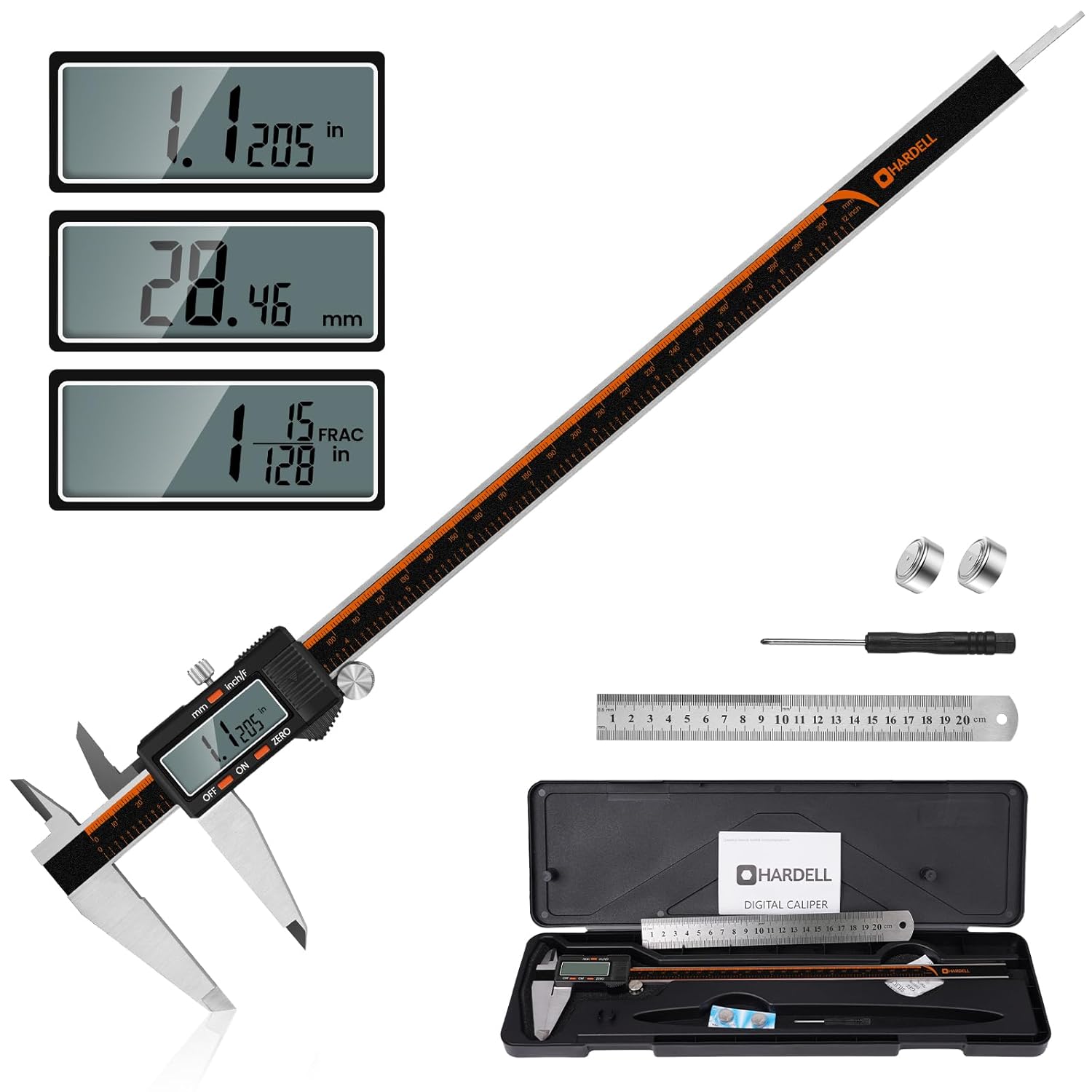
The HARDELL 12 Inch is the pick for measuring parts that a 6 inch caliper cannot span, such as wide boards, long dowels or the width of a cabinet face frame. The maker lists a 0-12 inch (300mm) range, ±0.0015 inch accuracy and 0.0005 inch resolution. You get twice the reach of a standard caliper and still keep fine readings.
The body is stainless steel, waterproof and rustproof. That suits a garage or shop where a damp rag, coolant or humid air would mark a cheaper tool, and the sturdy frame is meant to cut down on wear for a longer service life. A knurled thumb roller moves the jaw smoothly, and a locking screw holds it in position. In daily use you can set the jaw to a size with your thumb, lock it, and carry that setting to the next part without it drifting.
The caliper switches between inches, millimeters and fractions with one button, and it shuts off after 5 minutes of non-use to save power. It runs on 2 LR44 batteries, which are included, and comes in a case that resists pressure, shock and drops. The case matters here because a long tool rattling loose in a drawer is easy to knock out of true.
Pros
0-12 inch range for longer stock
Stainless steel that resists water and rust
Buyers say the jaw slides smoothly along the beam without catching
Buyers find the large display clear and easy to read
Cons
A 12 inch tool is bulkier to carry in a tool belt or apron pocket and takes more drawer space than a 6 inch model.
It needs 2 LR44 batteries where the Adoric needs 1, so you have one more cell to replace.
If most of what you measure fits within 6 inches, such as screws, drill bits or board thickness, the lighter Adoric 0-6 Inch is the easier tool to keep at hand.
NEIKO 01407A: Best for working in fractions

The NEIKO 01407A is the pick for woodworkers who read plans in fractions. One quick-change button cycles the display through inch, fraction and millimeter modes. When you measure a board and the plan calls for 3/4 in stock, you can read the fraction straight off the screen without converting decimals in your head.
The maker lists a 0 to 6 in (0 to 150 mm) range with an accuracy of 0.001 in and fraction resolution of 1/128 in. Six inches covers board thickness, dado depth, dowel diameter and hardware sizing. The 1/128 in steps are finer than any mark on a tape measure, so you can tell whether a groove is a hair under or over its target. That 0.001 in accuracy is ten times tighter than the Adoric’s ±0.01 in, which matters when you are fitting joints or setting a blade height.
The body is polished stainless steel with a knurled thumb roller and locking screw, and the caliper resists splashes and dust. In a shop, that means sawdust and a damp hand won’t stop it, and the lock holds a reading while you carry the tool to the saw to transfer a setting. It also measures inside, outside, depth and step, has an extra-large LCD, and comes in a hard case with one LR44 battery included.
Pros
Fraction mode with 1/128 in resolution, made for woodworking plans
Stainless steel body that resists splashes and dust
Buyers say it feels sturdy and solid, and is easier to use than a ruler or tape
Buyers also report accurate readings and good value for the money
Cons
Some buyers report it stopped working after a few months of use
Buyers complain the battery drains quickly, so keep spare LR44 cells nearby
If you measure stock longer than 6 in, the HARDELL 12 Inch is the better fit.
HARDELL 6 Inch Rechargeable: Best for skipping battery swaps

The HARDELL 6 Inch is the pick if you are tired of hunting for coin-cell batteries, because it charges over USB-C. The maker says a 20-minute charge fills it and gives up to 4 months of continuous use. It suits hobbyists who measure small parts often and want a backlit screen for dim garages.
The maker also says a 2-minute charge is enough to get you measuring again. So a dead caliper costs you a short wait at the bench instead of a trip to the store. Charge it with a 5V adapter and a USB-C cable: adapters over 7V can damage the circuits, and Type-C to C cables may fail to charge. In practice, a plain USB-A to USB-C cable and a phone charger are the safe pairing.
It covers 0 to 6 inches with ±0.001 in accuracy and 0.0005 in resolution. That is fine enough to check thread sizes, 3D printing layers and other hobby parts. Press the LIGHT button to light the LCD. The backlight shuts off after 5 seconds, and the caliper turns itself off after 5 minutes without use, which stretches each charge. It switches between inch, mm and fraction readings, and the all-metal body holds its accuracy near magnetic interference from tools such as electric drills.
Pros
USB-C charging replaces battery swaps, a point buyers repeat often.
Buyers say the large numbers and blue backlight are easy to read.
The all-metal body feels solid, according to buyers.
Readings switch between inch, mm and fractions.
Cons
You have to remember to recharge it, which matters if it sits in a drawer for months between jobs.
It is picky about chargers, so an adapter over 7V or a Type-C to C cable can leave you unable to charge it.
If you would rather drop in a spare LR44 battery than keep track of charging, the NEIKO 01407A offers the same 0.001” / 0.02 mm accuracy on regular batteries.
Starrett Electronic Slide Caliper: Best for machinists

The Starrett Electronic Slide Caliper is the pick for machinists and anyone doing close-tolerance metal or precision work. It covers 0-6 inches and reads to 0.0005 inch, so you can see differences finer than a thousandth when you check a shaft, a bearing seat or a drilled hole. Its measuring surfaces are hardened stainless steel, which holds up to daily shop use and resists corrosion.
The maker lists accuracy of +/- .001 inch across the full 0-6 inch range, which is the figure to trust when you size a part. Resolution is how finely the display reads, while accuracy is how close that reading is to the true size. The large, high-contrast LCD is easy to read at a glance, which helps when you are holding a part at bench height under shop lights.
The caliper turns off after 30 minutes without slide movement. A one-second push of the in/mm or zero on/off button, or any movement of the slide, brings the display back with no loss of position. In practice, you can set zero, step away to the lathe or the phone, and pick up where you left off without re-zeroing.
Pros
Reads to 0.0005 inch, with +/- .001 inch accuracy
Large, high-contrast LCD
Wakes with its origin intact after auto-off
Hardened stainless steel measuring surfaces
Cons
It takes one nonstandard battery, so you cannot just grab an LR44 from a drawer like you can with the NEIKO or Adoric
At 11.2 ounces it is a fairly heavy 6 inch tool to carry in an apron pocket
If you mostly measure board thickness and work in fractions, the NEIKO 01407A fits woodworking better.
What to look for in a digital caliper
Decide on range first, because it sets the size of the tool you carry around the shop. A 0-6 inch caliper covers most DIY and woodworking jobs, like checking board thickness, dowel diameters or screw shanks. If you regularly measure longer stock or wide parts, a 0-12 inch model reaches twice as far.
Accuracy and resolution sound alike but mean different things. Resolution is the smallest step the display shows, while accuracy is how close that reading is to the true size. For example, a caliper can show 0.0005 in steps yet be accurate only to ±0.0015 in, so the last digit on the screen is not a promise of precision.
Units matter more than you might expect in a woodshop. Most calipers switch between inch and mm with one button. Some add a fraction mode, which reads down to 1/128 in, so you can match a reading straight to your tape measure or drill bit index without converting decimals.
Body material affects durability. Stainless steel bodies resist rust and wear, while plastic composite models are lighter and easier to carry. Most run on LR44 button batteries, and some recharge over USB-C. A large or backlit display is easier to read in a dim garage.
Digital caliper questions
What is the difference between resolution and accuracy?
Resolution is the smallest step the screen can show, and accuracy is how close that reading is to the true size. A caliper can display finer steps than it can actually measure. The Starrett reads to 0.0005 inch, yet its accuracy over 0-6 inches is +/- .001 inch. In practice, trust the accuracy figure when you decide whether a reading is good enough, and treat the last digit on the screen as a hint, not a promise.
Is a 6 inch caliper enough for woodworking?
For most shop jobs, a 6 inch caliper covers what you measure: board thickness, dowel and drill bit diameters, mortise depth and the step on a rabbet. Several of the picks measure inside, outside, depth and step from the same tool. A 6 inch model is also small enough to keep in an apron pocket. You only need more reach when you check stock wider than 6 inches.
Why zero the caliper before measuring?
Zeroing makes sure the reading starts from the closed jaws, so dirt, drift or a bumped slide doesn’t creep into every measurement. If readings look off, slide the jaws to the “0” end of the scale and press the zero button. You can also zero at any point on the scale and start a new measurement from there, which is handy for comparing two parts directly. For example, close the jaws on a tenon, zero, then measure the mortise to see the gap.
Picking your caliper
Adoric is the first pick for household DIY: its 0-6 inch range and inch/mm switching cover the measuring most homeowners do, like checking a drill bit, a bolt or the thickness of a board. It reads to 0.01 inch, which is plenty for fitting hardware and too coarse for fine machining work.
Before you compare anything else, decide how long the parts you measure are. If nearly everything you work with fits inside 6 inches, a 6 inch caliper keeps the tool small and easy to grab. If you regularly measure wider stock, start your shortlist with the 12 inch HARDELL, which reaches 0-12 inches.