The SKIL SR211601 is the first pick for most DIYers: it runs at 13,000 orbits per minute (OPM) and catches dust in a clear cyclonic box you can see filling up. That top speed means quicker stock removal on everyday jobs, and the clear box shows you when it’s time to empty it. It’s corded, so if you’d rather work without a cord, another pick will fit you better.
The DEWALT picks cover cordless work and direct hookups to DEWALT dust extractors. The Bosch traps fine dust with a micro filter and comes with a vacuum adapter.
All five are random orbital sanders. The pad spins while it moves in small orbits, so the scratch pattern is less regular than with a plain orbital sander, and you get fewer visible swirl marks. That makes them a good choice for furniture, cabinets and trim. Bosch even adds pad dampening built to cut swirl marks on flat and contoured surfaces.
As an Amazon Associate we earn from qualifying purchases.
How we picked: from products sold on Amazon for this need, compared by what their makers state and what buyers report in their reviews.
The Picks at a Glance
Product | Best for | Amperage capacity | Item dimensions l x w x h | Maximum rotational speed | Buyer rating | |
|---|---|---|---|---|---|---|
SKIL SR211601 | everyday DIY sanding | 2.8 A | 7.87″L x 4.8″W x 5.51″H | 13000 rpm | 4.5 of 5 (7,753 reviews) | |
DEWALT DWE6423 | shop vac hookups | 3 A | 10.25″L x 5.44″W x 6.38″H | 12000 rpm | 4.6 of 5 (3,690 reviews) | |
Bosch ROS20VSC | swirl-free finishing | 2.5 A | 9″L x 5″W x 6″H | 12000 rpm | 4.6 of 5 (5,015 reviews) | |
DEWALT DWE6421K | one-speed general sanding | 3 A | 10.08″L x 7.23″W x 6.24″H | 12000 rpm | 4.7 of 5 (5,621 reviews) | |
DEWALT 20V MAX DCW210B | cordless work | 1 A | 8.81″L x 6.38″W x 5.75″H | 12000 rpm | 4.7 of 5 (14,037 reviews) |
Buyer ratings as shown on Amazon on November 7, 2026; they change.
SKIL SR211601: Best for everyday DIY sanding

The SKIL SR211601 suits homeowners and hobbyists who sand a bit of everything, from a dresser top to a drywall patch, and want a simple corded tool that keeps dust contained. The maker lists a 2.8 amp motor running at 13,000 orbits per minute, a transparent cyclonic dust box and variable speed control. That mix covers most weekend jobs without extra accessories.
Variable speed lets you slow down on softer materials or thin veneer so you don’t sand through or leave marks. The X-flow dust collector uses cyclone force to pull dust into a clear container, so you can see when it’s getting full and empty it before suction drops off.
Comfort gets attention too. A soft rubber grip and a counterweight that offsets vibration reduce hand fatigue, so a long session on a set of cabinet doors is easier on your wrist. Its compact size helps you reach tight spaces like the inside corners of a bookshelf, and the dust-sealed on/off switch keeps grit from gumming up the control. It weighs 3.4 pounds and runs on standard 120V household power.
Pros
Clear, easy-to-empty cyclonic dust box
Buyers say it works well on drywall and gives good value for the money
Buyers also report it feels well made with plenty of power
Cons
Buyers report the dust box does not catch all of the sanding dust, so plan on a mask and some cleanup
Some buyers say their unit broke down after about a month of use
Its 2.8 amp motor is smaller than the 3 A motors on the DEWALT DWE6423 and DWE6421K
If you want to hook your sander straight to a dust extractor, the DEWALT DWE6423 is the better fit.
DEWALT DWE6423: Best for shop vac hookups

The DEWALT DWE6423 is the pick if you sand with a dust extractor or shop vac. Its dust port fits directly to the DWV010 or DWV012 dust collectors, so you skip hunting for adapters.
The variable speed matters when you switch between jobs. You can run it fast to strip an old deck board, then turn it down for thin veneer or a painted edge you don’t want to burn through. If your vacuum uses 1-1/4 in. hoses instead of a DEWALT collector, the DWV9000 Universal Quick Connector links the port to it. Without a vacuum, you still have the one-handed locking dust bag that comes in the box.
Several design details aim at comfort and longevity. A separate counterweight reduces vibration, which helps your hand during a long session on a tabletop. The dust-sealed switch keeps fine dust out for longer switch life, and the shorter height puts your palm closer to the workpiece for better control. A rubber overmold covers the key grip areas.
Pros
Direct fit to DWV010 and DWV012 dust collectors
Buyers say dust collection works well and keeps the work area clean
Buyers report quick, simple sanding sheet changes and plenty of power for its size
Cons
Buyers complain that no carrying bag is included, so you’ll need your own case for job sites
Some buyers report units that stopped working within two years of use
Its 12000 rpm top speed is lower than the SKIL’s 13000 rpm, which matters if you want the fastest bare-wood removal
If you don’t plan to hook up a vacuum and want a smaller sander for everyday projects, the SKIL SR211601 is a better fit.
Bosch ROS20VSC: Best for swirl-free finishing

The Bosch ROS20VSC is the pick if you care most about a clean, swirl-free surface before stain or paint. The maker builds it with a pad dampening system designed to eliminate swirl marks on both flat and contoured surfaces. That makes it a good fit for tabletops, cabinet doors and curved chair parts, where stray circles show up badly under a finish.
The maker also gives it a micro filter system that traps particles as small as 1/2 micron in diameter. In daily use, that means less fine dust settling on your bench and in the air. The dust canister shows the dust level and detaches easily. You can see when it is full and empty it before suction drops.
The 2.5 amp motor runs at a no-load speed of 7,500-12,000 OPM with variable speed control. The low end helps on softer wood or thin veneer, and the top speed handles general stock removal. Discs attach with a hook-and-loop system that works like Velcro, so you can swap grits in seconds without clamps. The kit includes a dampening ring, dust canister, vacuum adapter and carrying bag.
Pros
Pad dampening aimed at swirl-free finishes
Fine-dust micro filter with a see-the-level canister
Buyers say it runs remarkably quietly
Buyers report the dust collector captures sanding dust well
Cons
Buyers complain that some units break down early, even after the first use
Its 2.5 amp motor is the smallest of the corded picks, below the SKIL’s 2.8 A and the DEWALT models’ 3 A, which matters if you plan long sessions of heavy stock removal.
If you want more power for heavy sanding, the DEWALT DWE6423 is the better fit.
DEWALT DWE6421K: Best for one-speed general sanding
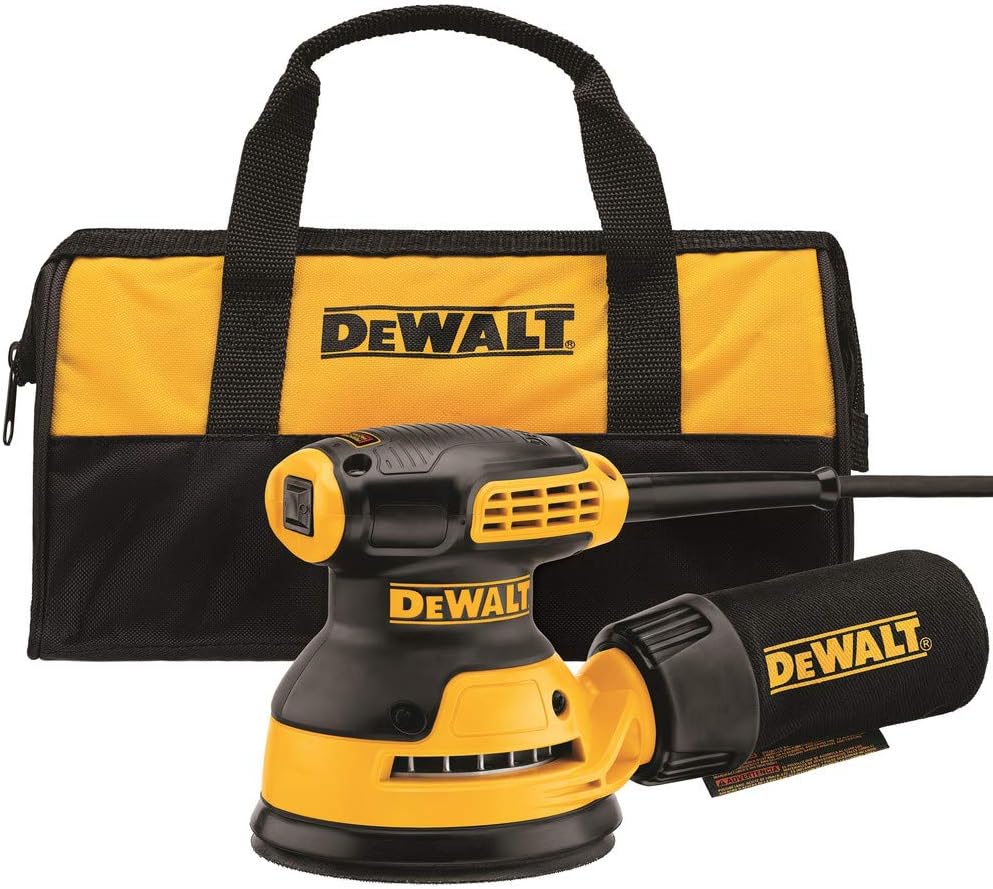
The DEWALT DWE6421K suits you if you want one steady speed for everyday sanding and don’t need to dial it down. It pairs a 3 amp motor with a fixed 12,000 OPM pad speed, so you plug it in and go without fiddling with settings. That makes it a simple choice for stripping old finish off a bench, smoothing a plywood shelf, or prepping trim for paint.
OPM means orbits per minute, or how fast the pad moves. The kit comes with a one-handed locking dust bag and a carrying bag, so you can snap the bag on or off without setting the sander down, and you have one place to store everything.
A dust-sealed switch keeps sanding dust out of the trigger, which the maker says helps the switch last longer. A separate counterweight cuts vibration, so your hands tire less during a long session on a tabletop. If you’d rather hook up a shop vac than empty a bag, the port fits DEWALT’s DWV010 or DWV012 dust collectors directly, and other vacuums with 1-1/4 in. hoses connect through the DWV9000 Universal Quick Connector. It also carries a 3 year limited warranty.
Pros
Simple one-speed operation with a 3 amp motor
Buyers say it runs with very little vibration and feels easy to handle
Buyers report the dust collection picks up a large amount of sanding dust
Works with a shop vac through the dust port
Cons
Some buyers say it wears out sooner than they expected
No variable speed, so it’s less suited to delicate work or softer materials where a slower pad helps you avoid sanding through
DEWALT 20V MAX DCW210B: Best for cordless work

The DEWALT DCW210B is the pick if you want to sand without a cord trailing behind you, especially if you already own DEWALT 20V MAX batteries. It runs on 20 volts of lithium-ion battery power with a brushless motor and variable speed from 8,000 to 12,000 OPM. At 2.5 pounds, it is lighter than the corded picks here, which run 3.4 to 3.5 pounds.
The maker says the brushless motor is built for runtime and efficiency. On a battery tool, that means more of each charge goes into sanding. The speed dial lets you match the speed to the job. For example, you can slow down on thin veneer and turn it up to strip old finish on a deck rail.
The sanding pad is a replaceable 8-hole hook-and-loop pad, part number DWE64233. Hook-and-loop discs press on and peel off, so you can swap grits in seconds. When the pad’s grip wears out, you replace the pad instead of the whole sander. A low-profile height puts your hand close to the work for more control. The dust bag locks on with one hand. The dust port fits DEWALT DWV010 or DWV012 dust collectors directly.
Pros
No cord to snag on furniture edges or ladders
Buyers say the speed control works well across a useful range
Buyers call it well built and quick to finish jobs
Dust-sealed switch and texturized rubber grip
Cons
Sold as a tool only, so you need a 20V MAX battery and charger. That adds cost if you don’t already have them.
Buyers report it can drain a battery quickly, sometimes in about fifteen minutes, so long sanding sessions need spare batteries.
Buyers say the dust bag does not catch sanding dust very well.
If you don’t already use DEWALT batteries and mostly sand near an outlet, the corded SKIL SR211601 is a better fit.
How do you choose a palm sander for your projects
Start with the power source, because it decides which tools you can choose from. A corded sander like the SKIL SR211601 runs on standard 120-volt household current, so it never stops mid-job for a recharge. The DEWALT 20V MAX DCW210B is battery powered and sold as a tool only, which makes the most sense if you already own DEWALT 20V MAX batteries. Buyers like having no cord in the way, but some report it can drain a battery in about fifteen minutes.
Next, look at speed. Most palm sanders top out around 12,000 to 13,000 OPM (orbits per minute). A variable-speed model such as the DEWALT DWE6423, adjustable from 8,000 to 12,000 OPM, lets you slow down for thin veneer or softer materials and speed up for rough stock.
Dust collection varies more than you might expect. You can pick from a clear cyclonic box you empty by hand, a locking cloth bag, or a micro filter that traps particles as small as 1/2 micron. For the cleanest shop, look for a port that fits 1-1/4 in. vacuum hoses through the DWV9000 Universal Quick Connector.
Finally, think about comfort over a long session. A counterweight reduces vibration, a shorter body puts your hand closer to the work, and rubber overmold improves grip. Hook-and-loop pads let you swap discs in seconds, much like Velcro.
Questions buyers ask about palm sanders
What’s the difference between a random orbital and a plain orbital palm sander?
A random orbital sander moves its pad in an irregular pattern instead of the same small loop every pass, so it leaves fewer swirl marks you’d have to sand out later. All five picks in this roundup are random orbit models. For example, the Bosch ROS20VSC adds a pad dampening system to cut swirl marks on both flat and contoured surfaces. That matters when you’re prepping a tabletop or cabinet door for stain, because swirls show up once the finish goes on.
Does a higher OPM always mean faster sanding?
No. OPM (orbits per minute) tells you how fast the pad moves, but a top speed isn’t always the right speed. Variable speed control lets you match the speed to the material and the job. In practice, you’d turn the speed down for thin veneer or soft paint and run it at full speed to flatten rough pine. A fixed-speed sander can’t make that change, so a high OPM figure only helps when you actually want full speed.
Can you connect a palm sander to a shop vac?
Yes, on many models. On the DEWALT sanders, the dust port fits the DWV010 or DWV012 dust extractors directly. To attach it to other vacuums with 1-1/4 in. hoses, use the DWV9000 Universal Quick Connector. Hooking up a vacuum pulls dust away as you sand, which keeps your work area and lungs cleaner than a bag or box alone.
Which sander to pick first
SKIL SR211601 is the first pick for most DIYers, because it pairs a corded 120-volt motor with variable speed and a clear dust box you can empty without guessing how full it is. That mix handles furniture, trim and drywall touch-ups without asking you to buy extra accessories.
Before you compare speeds or dust ports, decide whether you want a cord or a battery. If you already own DEWALT 20V MAX tools, the DCW210B adds cordless sanding to your kit, but it ships as a bare tool, so you supply the battery and charger. If you have no battery platform, a corded sander like the SKIL lets you plug in and start sanding.