The SKIL SR211601 is the first pick for most home DIYers: it runs at 13,000 orbits per minute, has variable speed, and catches dust in a transparent cyclonic box you can see filling up. That speed keeps a best orbital sander moving through rough boards quickly, and variable speed lets you slow down on thin veneer or softwood.
All five picks here are 5-inch random orbital sanders aimed at smoothing and finishing wood, so the same sanding discs work across them. The difference is how you work: plugged into a shop vacuum, on a battery away from an outlet, or with a big spread of grits for wood and metal.
The four other picks cover jobsite, cordless and many-grit needs, followed by what to look for when you choose.
As an Amazon Associate we earn from qualifying purchases.
How we picked: from products sold on Amazon for this need, compared by what their makers state and what buyers report in their reviews.
The Picks at a Glance
Product | Best for | Amperage capacity | Maximum rotational speed | Item dimensions l x w x h | Buyer rating | |
|---|---|---|---|---|---|---|
SKIL SR211601 | home DIY projects | 2.8 A | 13000 rpm | 7.87″L x 4.8″W x 5.51″H | 4.5 of 5 (7,752 reviews) | |
DEWALT DWE6423 | shop vacuum users | 3 A | 12000 rpm | 10.25″L x 5.44″W x 6.38″H | 4.6 of 5 (3,690 reviews) | |
DEWALT DCW210B | cord-free sanding | 1 A | 12000 rpm | 8.81″L x 6.38″W x 5.75″H | 4.7 of 5 (14,037 reviews) | |
DEKOPRO 5-inch sander | wood and metal finishing | 2.5 A | 13000 rpm | — | 4.4 of 5 (2,862 reviews) | |
DEWALT DWE6421K | steady single-speed sanding | 3 A | 12000 rpm | 10.08″L x 7.23″W x 6.24″H | 4.7 of 5 (5,621 reviews) |
Buyer ratings as shown on Amazon on November 7, 2026; they change.
SKIL SR211601: Best for home DIY projects

The SKIL SR211601 suits homeowners and DIYers who sand a mix of projects, from a refinished side table to patched trim. The maker lists a 2.8 amp motor running at 13,000 orbits per minute, with variable speed control for different materials. That combination lets you move quickly through bare pine, then slow down for a veneered tabletop where too much speed could burn through.
Dust goes into a cyclonic X-flow collector with a transparent, easy-to-empty container. Because you can see the fill level, you know when to empty it before suction drops, and you avoid shaking out a cloth bag. The on/off switch is dust sealed, so fine sanding dust is less likely to work into it over time.
For comfort, a counterweight balance cuts vibration and a soft rubber grip cushions your hand, so longer sessions are less tiring. The compact size helps you reach tight spots like the inside of a drawer box or the corners of a cabinet face frame. At 3.4 pounds, it is light enough to hold against a vertical surface for a while.
Pros
Variable speed for both rough sanding and delicate finish work
The see-through dust box shows when it is full
Counterweight and rubber grip ease hand fatigue
Buyers say it has plenty of power and gives good value, with some noting it works well on drywall
Cons
Buyers report the dust box does not catch all the sanding dust, so plan on a mask and some cleanup
Some buyers say their unit broke down after about a month of use
The 2.8 amp motor draws less power than the 3 A DEWALT DWE6423 and DWE6421K
If you want to hook your sander straight to a shop vacuum for cleaner dust control, the DEWALT DWE6423 fits better.
DEWALT DWE6423: Best for shop vacuum users

The DEWALT DWE6423 is the pick if you already own a shop vacuum or dust extractor and want a variable-speed corded sander that hooks straight up to it. Its dust port fits the DWV010 or DWV012 dust collectors directly, and a 3-amp motor spins the pad at 8,000 to 12,000 OPM.
The dial range gives you real control in daily work. If your vacuum uses a 1-1/4 in. hose instead of a DEWALT collector, the maker names the DWV9000 Universal Quick Connector as the part that joins them. A one-handed locking dust bag comes in the box, so you can still collect dust when the vacuum is across the shop.
The DWE6423 also has a dust-sealed switch that keeps fine dust out, which matters on long sanding sessions where dust builds up inside a switch. A separate counterweight cuts vibration, so your hands tire less over an afternoon of cabinet doors. The shorter height puts your palm closer to the workpiece, which makes the sander easier to keep flat. It weighs 3.4 pounds and takes 5-inch discs.
Pros
Direct fit to DWV010 and DWV012 dust collectors
Buyers say dust collection works well and keeps the work area clean
Buyers find sanding sheet changes quick and simple
Buyers report plenty of power for its size
Cons
Buyers complain that no carrying bag comes with it, so you need your own storage.
Some buyers report units that stopped working within two years.
Its 12,000 OPM top speed is lower than the 13,000 of the SKIL and DEKOPRO picks, so coarse stock removal runs a little slower.
If you don’t own a vacuum and want a faster top speed with a built-in dust box, the SKIL SR211601 fits better.
DEWALT DCW210B: Best for cord-free sanding

The DEWALT DCW210B is the pick if you want to sand without dragging a cord across your project. It runs on DEWALT’s 20V MAX batteries and uses a brushless motor, which the maker says adds runtime and efficiency. It weighs 2.5 pounds, lighter than the 3.4-pound SKIL and DWE6423 picks, so your arm tires less when you sand a tabletop or cabinet side.
The maker lists variable speed from 8,000 to 12,000 OPM (orbits per minute). In practice, you can slow down for thin veneer or a finish coat and speed up to strip old paint from a door. The pad is a replaceable 8-hole hook-and-loop pad, part DWE64233, so paper changes take seconds, and a worn pad can be swapped out instead of replacing the whole sander.
A low-profile height keeps your hand close to the work for better control. A dust-sealed switch protects against dust getting inside. Dust goes into a one-handed locking dust bag, and the port fits DWV010 or DWV012 dust collectors directly. This model is sold as tool only, so the box holds the sander and a dust bag, with no battery or charger.
Pros
No cord to snag on edges or knock tools off the bench
Buyers say the speed control works well across a useful range
Buyers call it well built and worth the money
Light at 2.5 pounds
Cons
Buyers report it can drain a battery quickly, sometimes in about fifteen minutes, so plan on spare batteries for big jobs
Buyers say the dust bag misses a lot of sanding dust
Tool only, so buyers without 20V MAX batteries pay extra for a battery and charger
If you sand for long stretches and want vacuum-ready dust control without battery swaps, the corded DEWALT DWE6423 fits better.
DEKOPRO 5-inch sander: Best for wood and metal finishing

The DEKOPRO 5-inch sander suits you if you finish both wood and metal and want a full set of grits in the box. The maker lists a 2.5 amp motor, six speeds and 16 sanding discs, and rates it for sanding or polishing wood and metal.
The motor reaches up to 14,000 RPM, and you pick from 6 variable speeds. In practice, you can run a low speed for a light scuff between paint coats and a high speed for stripping rough boards. Having six steps gives you finer control than a single fixed speed when you move from pine to a metal part.
The 16 included discs range from 60 to 1000 grit, which covers coarse, medium and fine sanding. That means you can start a project out of the box: 60 grit for removing old finish, 120 for general smoothing, and 400 or 1000 for polishing metal. The hook-and-loop pad lets you swap discs fast, and a detachable dust bag collects debris. A rubber grip and counterweight design reduce hand vibration, which helps during longer sessions.
Pros
Six speeds for matching wood or metal work
A 60 to 1000 grit disc set comes in the box
Buyers say it is easy to use and feels solidly built
Buyers call it good value for the money
Cons
Buyers report the dust collection misses dust and the container does not stay attached well, so you may need extra cleanup or a mask.
Some buyers say the motor burned out quickly after first use.
Its 2.5 amp motor has less power than the SKIL’s 2.8 A and the 3 A DEWALT corded picks, which matters on heavy stock removal.
If you mostly sand wood at home and want reliable dust pickup, the SKIL SR211601 is a better fit.
DEWALT DWE6421K: Best for steady single-speed sanding
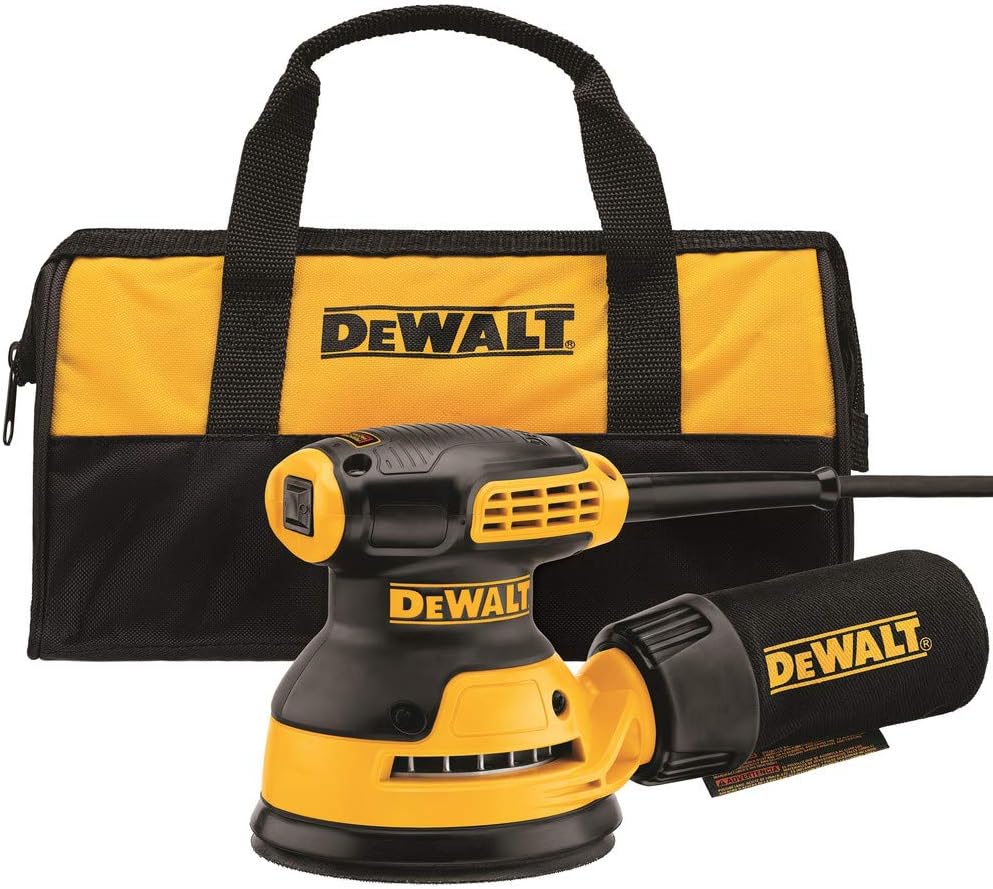
The DEWALT DWE6421K is the pick for you if you want a corded sander that runs at one steady speed and keeps its dust contained. It has a 3.0 amp motor that spins the pad at a fixed 12,000 OPM (orbits per minute), and the kit adds a carrying bag and a locking dust bag. It suits furniture refinishing, cabinet doors and general house projects where you sand bare wood at full speed.
DEWALT designed the switch to be dust-sealed so less dust gets inside, which is meant to make the switch last longer. That matters on a sander, because fine dust is what usually wears out switches first. The dust bag locks on with one hand, so you can empty it and snap it back without setting the sander down.
The dust port fits the DWV010 or DWV012 dust collectors directly. For other vacuums with 1-1/4 in. hoses, you need the DWV9000 Universal Quick Connector, so budget for that adapter if you plan to run a shop vacuum. A shorter height puts your hand closer to the work for better control, and a separate counterweight reduces vibration on long sessions. Rubber over-mold covers the spots where you grip it. It comes with a 3 year limited warranty.
Pros
The dust-sealed switch is built for longer life in dusty work
Buyers say it runs with very little vibration and is easy to handle
Buyers report that the dust collection picks up a large amount of sanding dust
Cons
Some buyers say it wore out sooner than they expected
It has a single speed, so you can’t slow it down for veneer, thin finishes or other delicate surfaces
Shop vacuums with 1-1/4 in. hoses need a separate adapter
If you need to slow the pad down for delicate work, the variable-speed DEWALT DWE6423 is the better fit.
What to look for in an orbital sander
Start with the power source, then look at speed control, dust handling, comfort and pads. Those five things shape how a sander feels on a Saturday project far more than small spec differences.
Corded or cordless comes down to runtime versus freedom. A corded model such as the SKIL SR211601 runs on 120 volts, so it keeps going as long as you do. A cordless sander frees you from the cord, but buyers report it can drain a battery in about fifteen minutes. For a big tabletop, that means swapping batteries; for touch-ups around the house, it rarely matters.
Variable speed lets you match the speed to the job, with 8,000 to 12,000 OPM on some models. In practice you slow down for thin veneer or paint and speed up to level rough pine.
Dust collection comes in three forms:
A cloth dust bag, often with a one-handed lock
A transparent dust box you can see filling and empty easily
A vacuum port that fits DEWALT DWV010 or DWV012 dust collectors, or 1-1/4 in. hoses with the DWV9000 Universal Quick Connector
A vacuum keeps your shop cleanest, since buyers say bags and boxes miss some dust.
A low profile puts your hand closer to the surface for precise sanding, and a counterweight cuts vibration so your hand tires less.
Hook-and-loop pads let you swap paper in seconds. Higher grit numbers give a finer finish [1], so a kit spanning 60 to 1000 grit covers rough shaping through polishing.
The sander to start with
SKIL SR211601 is the first pick for home DIYers. It runs on a standard 120-volt outlet and weighs 3.4 pounds, so you can plug it in anywhere in the house and hold it through a long sanding session without tiring quickly. Its 1-year limited warranty covers the first year of weekend projects.
Your next step is to decide between corded and cordless before you compare anything else. If you sand near an outlet most of the time, a corded model keeps running as long as you need it. If you want to work on a deck or in a yard away from power, the DEWALT DCW210B frees you from the cord, but buyers report it can drain a battery in about fifteen minutes, so plan on a spare battery for bigger jobs.