The SKIL MS6305-00 is the first pick for most home DIYers. It’s a 10-inch dual-bevel saw that crosscuts lumber up to 2×12 at 90 degrees, so it handles shelving and deck boards in one pass. Its LED shadow line shows exactly where the blade will land, which helps you cut right on your pencil mark.
The best sliding compound miter saw for you depends on what you build. A sliding compound saw cuts wide boards, angles and bevels in one setup, so you don’t have to reposition long stock for each pass. The picks below cover 10-inch and 12-inch saws for trim, decking and framing, with what each does well and where it falls short.
As an Amazon Associate we earn from qualifying purchases.
How we picked: from products sold on Amazon for this need, compared by what their makers state and what buyers report in their reviews.
The Picks at a Glance
Product | Best for | Item dimensions l x w x h | Item weight | Blade length | Buyer rating | |
|---|---|---|---|---|---|---|
SKIL MS6305-00 | home DIY projects | 35.43″L x 22.44″W x 14.17″H | 39.4 lb | 10 in | 4.6 of 5 (2,287 reviews) | |
Makita LS1019L | tight shops and crown molding | 31.75″L x 25.38″W x 26″H | 72.8 lb | 10 in | 4.6 of 5 (475 reviews) | |
Makita LS1219L | wide boards and tall trim | 34″L x 22″W x 21″H | 81.6 lb | 12 in | 4.4 of 5 (417 reviews) | |
DEWALT DWS779 | framing lumber | 32.5″L x 23″W x 19.78″H | 67.7 lb | 12 in | 4.8 of 5 (9,068 reviews) | |
DEWALT DWS780 | precise finish cuts | 32.57″L x 23″W x 19.5″H | 24.8 kg | 12 in | 4.8 of 5 (2,542 reviews) |
Buyer ratings as shown on Amazon on November 19, 2026; they change.
SKIL MS6305-00: Best for home DIY projects
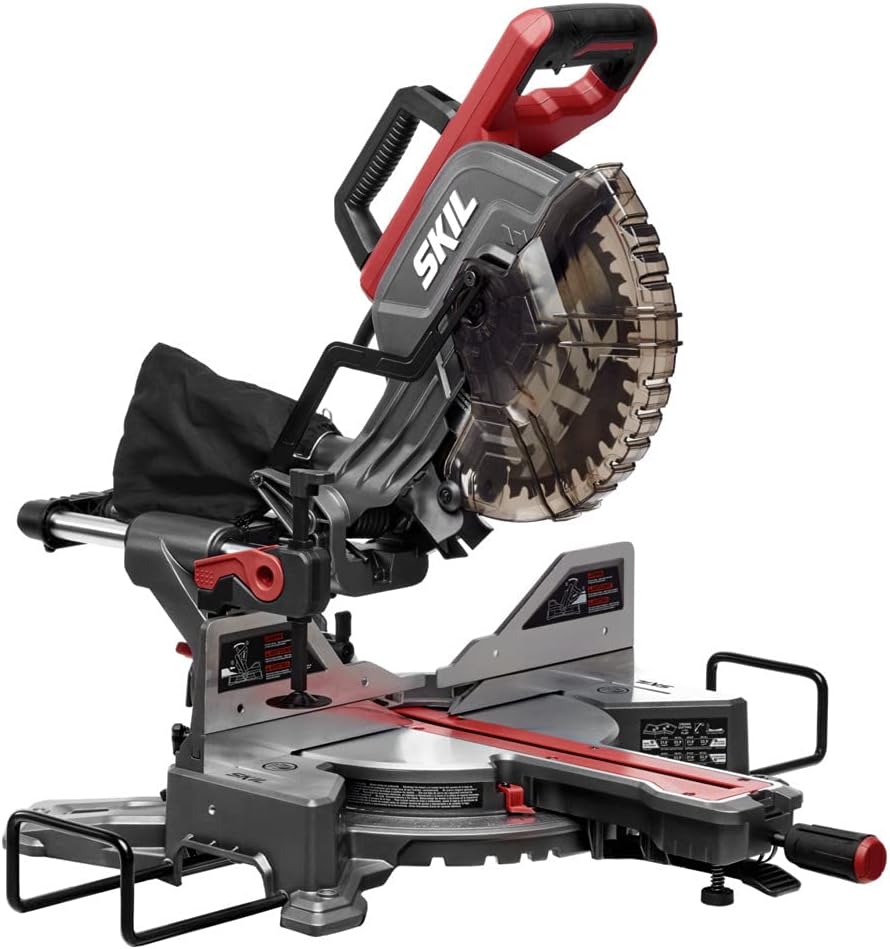
The SKIL MS6305-00 is the pick for home DIY projects because it packs dual bevel cutting and 2×12 crosscut capacity into a 10-inch saw that weighs 39.4 pounds. That weight is light enough to carry from the garage to the deck, which suits shelves, trim and small outdoor builds.
The maker lists a 15 amp motor running at 4,800 RPM. A fast blade speed like that leaves a cleaner edge on trim and plywood, so you spend less time sanding. The dual bevel tilts both ways, with positive stops at 48° and 45° left, 0°, and 45° right. You can cut matching bevels on both ends of a long board without flipping it end for end.
An LED shadow line shows where the blade will cut, and the maker says it is more accurate than a laser. You line up your pencil mark with the shadow instead of making test cuts. The saw crosscuts up to 2×12 at 90° and 2×8 at 45°, and it miters up to 50° left and right with 11 positive stops at the most used angles. In practice it handles stair treads and wide shelf boards, and it snaps to common angles like 45° for picture frames.
Pros
Buyers say it makes accurate cuts, even through hardwood
Buyers report the shadow line works reliably and setup is easy
At 39.4 pounds, it is much lighter than the 12-inch picks (DEWALT DWS779 at 67.7 pounds)
Buyers say it is good value for the money
Cons
Some buyers find the bevel and angle adjustments tricky to use
Some buyers report saws breaking down after a couple of months of use
Its 10-inch blade gives less cutting capacity than the 12-inch picks
If you cut 2×14 framing lumber, the DEWALT DWS779 is the better fit.
Makita LS1019L: Best for tight shops and crown molding

The Makita LS1019L suits you if you work in a garage corner or small shop and cut a lot of crown molding. The maker states it handles crown molding up to 6-5/8 in. nested, the same capacity as a 12-inch miter saw, in a 10-inch saw. That means you can trim tall crown without the bulk and blade cost of a bigger saw.
Most sliding saws push their rails out the back, so you lose a foot or more of floor space behind them. This one uses a 2-steel rail slide with a single slide-glide motion, which shrinks the footprint and lets the saw run flush against a wall. In a one-car garage, you can keep it on a bench pushed back to the wall and still use the full slide.
The maker also lists 5-1/4 in. of vertical cutting capacity from its direct drive gearbox and guard design. That helps when you stand baseboard or tall stock upright against the fence to cut it. The slide rides on a linear ball bearing system built for accurate cuts, which should feel smooth as you pull the blade through a board.
Pros
Crown capacity of a 12-inch saw in a 10-inch body
Sits flush against a wall
Buyers say it runs smoothly and the dust collection works very well
Buyers report accurate cuts and find the laser line helps them cut to the mark
Cons
Some buyers report that 45-degree bevel cuts come out inaccurate and that the carriage and rails do not line up properly
Buyers find the adjustments hard to get exactly right, so plan time for setup
At 57.9 lbs., it is a heavy saw to carry for a 10-inch model
If you mostly cut wide boards or want a lighter saw to move around the house, look at the Makita LS1219L or the SKIL MS6305-00 instead.
Makita LS1219L: Best for wide boards and tall trim

The Makita LS1219L is for you if you cut wide shelving, stair treads or tall trim and want one saw that handles them in a single pass. The maker lists 15-inch crosscuts at 90°, crown molding up to 8 inches nested vertically, and baseboard up to 6-3/4 inches standing vertically. That means a 1×16 shelf board is just out of reach, but most wide boards and tall casing are not.
Cutting crown and baseboard against the fence, the way they sit on the wall, makes trim work simpler, and 8-inch crown covers larger rooms than most saws handle. The extra vertical capacity comes from a direct drive motor and guard system built to clear taller stock.
The saw slides on a 2-steel rail system that keeps the footprint smaller, so it can run flush against a wall. In a garage shop, you can push it back on the bench instead of leaving space behind it for rails to travel. The bevel lock sits in front, so you can change bevel angles without reaching around the back of the saw. Two dust collection ports give you more places to connect a bag or a shop vac.
Pros
15-inch crosscuts and 8-inch nested crown in one saw
Runs flush to a wall
Buyers say it feels solid and cuts accurately right out of the box
Buyers say the laser lines up cuts well
Cons
Buyers report slow cutting, reliability problems and adjustments that are hard to set or keep
At 81.6 pounds it is the heaviest pick here, compared with 67.7 pounds for the DEWALT DWS779, so it is hard to move between job sites
As a 12-inch saw, it takes larger blades, which cost more to replace than 10-inch blades
If you mostly build small projects and want a lighter saw, the SKIL MS6305-00 is the better fit.
DEWALT DWS779: Best for framing lumber

The DEWALT DWS779 is the pick if you cut a lot of framing lumber, like joists, rafters and deck framing. The maker lists crosscuts up to 2×14 dimensional lumber at 90° and 2×10 at 45°, so wide framing stock goes through in one pass. Its 15 amp, 3,800 rpm motor is built for that kind of steady, heavy work.
That 2×14 capacity means you can square-cut stair stringers or wide joists without flipping the board and making a second cut. The 2×10 at 45° helps with angled framing, such as rafter ends or deck corners. The saw miters 60° to the right and 50° to the left and bevels 49° both ways, so you can tilt the blade either direction without turning a long board around.
The tall sliding fences hold crown molding up to 7-1/2 in. nested and base molding up to 6-3/4 in. against the fence, then slide out of the way when you bevel. That lets the same saw handle trim after the framing is done. The stainless-steel miter detent plate has 10 positive stops, which are preset notches where the saw clicks in at common angles so repeat cuts match. The dust system captures over 75% of the dust it makes, with a bag included, so you spend less time sweeping.
Pros
Cuts 2×14 at 90° for wide framing stock
Tall fences for crown and baseboard
Buyers say it makes accurate, clean cuts, including precise 90-degree cuts
Buyers report it is solidly built and holds up over time
Cons
Buyers say it is very heavy and bulky to move, which matters if you carry it between job sites.
At 67.7 pounds it weighs far more than the SKIL MS6305-00 at 39.4 pounds.
If you mostly make precise finish cuts and want a built-in cut-line guide, look at the DEWALT DWS780 instead.
DEWALT DWS780: Best for precise finish cuts

The DWS780 is for you if clean, exact cuts matter most, such as trim, cabinet parts or anything where a gap shows. It pairs a 12-inch blade with two cut-line aids that show where the blade will land before you pull the trigger.
The maker lists a 15 amp, 3,800 rpm motor built for heavy-duty applications. In daily use, that power helps the blade keep its speed through dense hardwood or thick stock, which leaves a smoother edge with less burning.
The saw has an integrated cutline blade positioning system that gives adjustment-free cut line indication, plus XPS LED shadow line technology that projects a shadow for alignment. Because the blade itself casts the shadow, the line stays true when you change blades. A laser can drift out of calibration and need resetting. You line up your pencil mark with the shadow and cut.
The dust collection system captures over 75% of the dust it generates. Less dust means your cut line stays visible and there is less sweeping after a session, though you will still see some on the floor.
Pros
Shadow line that needs no adjustment
Buyers say cuts are precise and accurate
Buyers find it easy to use, even as beginner carpenters
Buyers report it feels solidly built and stable during use
Cons
Some buyers report the saw does not hold up well over time.
At 32.57″ long, 23″ wide and 19.5″ high, the 12-inch saw needs more bench space than a compact 10-inch model.
At 24.8 kg, it is heavier than the 39.4-pound SKIL MS6305-00, which matters if you carry it to job sites.
If you work on a small bench or move your saw often, the lighter SKIL MS6305-00 is a better fit.
What to look for in a sliding miter saw
Start with the widest board you plan to cut, because blade size and slide length set your crosscut capacity. A 10-inch saw like the SKIL MS6305-00 crosscuts up to a 2×12 at 90 degrees, which covers shelving and most deck boards. A 12-inch rail saw like the Makita LS1219L reaches 15 in. crosscuts at 90 degrees, so you can square off wide panels and stair treads in one pass.
If you install trim, look at crown and baseboard capacity next. Crown cut “nested” stands upright against the fence at its installed angle, so the saw’s height limits how tall a piece you can cut. The Makita LS1019L handles 6-5/8 in. crown nested, the capacity of a 12-inch saw in a 10-inch body. For tall baseboard, the DEWALT DWS779’s fences support base molding up to 6-3/4 in. vertically.
A dual-bevel saw tilts both left and right, so you can cut opposing bevels without turning a long board end for end. On a 12-foot piece of crown, that saves you lifting and re-aligning it for every other cut.
Then match the saw to your space. Weights range from 39.4 pounds for the SKIL to 81.6 pounds for the Makita LS1219L, which decides whether you can carry it to the driveway alone. Rails that let a saw sit flush against a wall save several inches of bench depth. For dust, the DEWALT DWS780 system captures over 75% of dust generated, so you still want a shop vac or a mask for the rest.
For safety, keep your hands outside the blade’s path and clamp the workpiece instead of holding it near the cut. Most of these saws come with a clamp; the DWS779 includes a vertical material clamp.
Sliding miter saw questions
Should you get a 10-inch or a 12-inch sliding saw?
Pick the 12-inch if you regularly cut boards wider than a 2×12; otherwise a 10-inch covers most home projects. The Makita LS1219L crosscuts 15 inches at 90°, enough for wide shelving or stair treads in one pass. The 10-inch SKIL MS6305-00 handles lumber up to 2×12 at 90°, which covers deck boards and most framing. A 10-inch saw can still handle tall trim: the Makita LS1019L cuts 6-5/8 inches of crown nested, the same as a 12-inch saw.
Is a laser or an LED shadow line more accurate?
A shadow line shows where the blade itself will cut, so you line up your pencil mark with no calibration. SKIL claims its LED shadow line gives greater accuracy than lasers. The DEWALT DWS780’s cutline system needs no adjustment. Lasers still work well for many owners: buyers of both Makita saws say the laser helps them line up accurate cuts.
Can a sliding saw sit against a wall?
Some can. Both Makita picks use a 2-steel rail design that lets the saw run flush against a wall. That matters in a garage or small shop, where rails that stick out the back would eat several inches of floor or bench depth.
Picking your saw
The SKIL MS6305-00 is the first pick for most home DIYers. It crosscuts lumber up to 2×12 at 90 degrees, so it handles shelving, deck boards and most framing stock in one pass without flipping the board. At 39.4 pounds, it is also light enough to carry from the garage to the driveway for a weekend project.
Before you buy any saw, measure the widest board you expect to cut, then match that width to a saw’s crosscut capacity. If a 2×12 covers your work, a 10-inch saw is enough; if you regularly cut wider stock, move up to one of the 12-inch picks.