The JET JWL-1221VS is the first pick for most home turners, because it handles pens, small bowls and spindles on one bench-size machine. Its lowest speed is 60 RPM, so you can start an out-of-round blank slowly instead of fighting a lopsided chunk of wood at high speed. At 121 lb with a cast iron bed, it is heavy enough to dampen vibration when that blank is still uneven.
The best wood lathe for you depends on the largest piece you plan to turn. The picks below run from the WEN LA3421, a mini lathe with an 8-inch swing and 13 inches between centers for pens and small work, up to the JET JWL-1640EVS, a 16 x 40 in full-size machine for long spindles and big bowls. Each pick comes with what it suits, where it falls short and how to match it to your shop.
As an Amazon Associate we earn from qualifying purchases.
How we picked: from products sold on Amazon for this need, compared by what their makers state and what buyers report in their reviews.
The Picks at a Glance
Product | Best for | Maximum rotational speed | Item weight | Power source | Buyer rating | |
|---|---|---|---|---|---|---|
JET JWL-1221VS | all-round home turning | 3600 rpm | 121 lb | Corded Electric | 4.4 of 5 (667 reviews) | |
WEN LA3421 | pens and small projects | 3200 rpm | — | AC | 4.3 of 5 (272 reviews) | |
VEVOR 12 x 18 Wood Lathe | beginners and classrooms | — | 62.7 lb | ac | 3.9 of 5 (579 reviews) | |
WEN 34035 | wider bowls on a budget bench | 3550 rpm | — | AC | 4.4 of 5 (111 reviews) | |
JET JWL-1640EVS | long spindles and big work | 3200 rpm | 377 lb | Corded Electric | 4.6 of 5 (91 reviews) |
Buyer ratings as shown on Amazon on November 22, 2026; they change.
JET JWL-1221VS: Best for all-round home turning

The JET JWL-1221VS suits home turners who want one benchtop lathe for pens, small bowls and table-top spindles without moving up to a full-size machine. It has variable speed across three belt ranges from 60 to 3,600 RPM, a cast iron bed and a 1 HP motor that runs on household power.
The maker splits the speed into three belt ranges: 60-900, 110-1,800 and 220-3,600 RPM, with a dial for fine control and a digital readout of spindle speed. In daily use, you set the belt for the job, such as the low range for roughing a bowl blank or the top range for a pen, then fine-tune with the dial. The readout shows your actual speed, so you can return to the same setting on the next piece.
The bed, tool support and tool support base are cast iron, and the whole lathe weighs 121 lb, which helps dampen vibration. That weight also means you will want help lifting it onto a bench or the optional stand. The 1 HP DC motor runs on standard 115V power at 6 A, and the maker recommends a dedicated 10 A circuit. You can plug it into a regular garage outlet, though sharing that circuit with a shop vac or dust collector may trip the breaker.
Pros
Heavy cast iron build for steadier turning
Buyers say the variable speed control makes changing speeds easy
Buyers report it runs quietly and feels solidly built
Cons
Switching between speed ranges means opening the pulley doors, releasing the belt tensioner and moving the belt by hand
Buyers report door covers cracking and other parts breaking over time
Some buyers say their unit wobbled badly while running
If you mainly turn pens and want a smaller, lighter machine, look at the WEN LA3421 instead.
WEN LA3421: Best for pens and small projects

The WEN LA3421 suits you if you mostly turn pens, cups, chess pieces and other small work and want a lathe that fits on a bench. It has an 8-inch swing over the bed and 13 inches between centers, with variable speed from 750 to 3,200 RPM.
The maker calls it a lathe for pens, bowls, cups, chess pieces and other small workpieces. An 8-inch swing means the largest blank that clears the bed is just under 8 inches across. The 13 inches between centers is enough for pen blanks, tool handles and candlesticks, but not for table legs.
The 3.2-amp motor has a soft start, so it ramps up gradually instead of jerking the blank to full speed the moment you switch it on. The kit includes a 2.3-inch faceplate, an MT1 spindle and tailstock taper, two interchangeable tool rests and a two-year warranty. MT1 is the smaller Morse taper, so drive and live centers you buy later need to be MT1 sizes. The two rests let you swap between a short rest for pens and a longer one for spindles.
Pros
Soft-start motor eases the blank up to speed
Two tool rests and a faceplate come in the box
Buyers say it feels solidly built and is good value for the money
Buyers find it well suited to beginners and small turning projects
Cons
Some buyers report the motor burning out within a couple of months, and others say the variable speed control stopped working
The 750 RPM low end is fast for spinning a large or out-of-round bowl blank, so you are limited to small bowls
Some owners find it too small for their projects
If you want to turn wider bowls, look at the WEN 34035, and for slow starts on rough blanks the JET JWL-1221VS is the better fit.
VEVOR 12 x 18 Wood Lathe: Best for beginners and classrooms

The VEVOR 12 x 18 is the pick for a first lathe or a school shop, where a wide speed range and low upkeep count most. The maker calls it ideal for beginners, hobbyists and classroom users, and it pairs a 1 HP motor with variable speed from 150 to 3,800 RPM.
That speed range covers both ends of turning. You change speed with the control and make no manual gear adjustments, so a new turner never has to stop and move a belt between steps.
The motor is a brushless DC design, so you never replace carbon brushes. For a classroom running the lathe every day, that is one less wear part to stock and swap. The 12 x 18 in work area suits bowls, pens, cups and small carvings, which matches the projects most beginners start with. It has a cast iron body and metal handwheels to cut vibration, and at 62.7 pounds it is light enough for two people to lift onto a bench. An accessory kit comes in the box, so you can start turning right away.
Pros
No carbon brushes to replace
Buyers say it works well for small projects and as a starter tool
Accessories included
Cons
Buyers report the motor bogs down and can stall to a complete stop, which matters on heavy cuts
Some buyers find it too small for many turning jobs and say the build feels cheaply made
If you plan heavier everyday turning on a sturdier machine, the 121-pound cast iron JET JWL-1221VS is the better fit.
WEN 34035: Best for wider bowls on a budget bench

The WEN 34035 suits turners who want room for wider bowls and longer spindles without stepping up to a floor-standing machine. Compared with an 8-inch mini, that 14-inch swing is the difference between turning a small dish and turning a full serving bowl.
The 250 RPM low end lets you start a lopsided bowl blank slowly, before it is rounded and balanced. The 3,550 RPM top end gives the fast surface speed that small pieces like pens and finials need for clean cuts. Because the speed is variable, you dial it up as the blank trues up, with no belt to move.
The headstock and tailstock take MT2 tapers, and the spindle has a 1″-8 thread, which together fit a wide variety of lathe accessories. In daily use, that means a chuck, drive center or drill chuck you buy later is likely to fit, so you can grow into bowl and hollow work without replacing the lathe.
It comes ready to turn. The box includes a 4-inch faceplate for bowls and cups, an MT2 spur center, an MT2 live center, an 8-inch tool rest and an onboard accessory holder. The spur and live centers cover spindle work between centers, and the faceplate lets you mount a bowl blank right away. The holder keeps those parts at the lathe instead of lost in a drawer.
Pros
Large 14 x 20 in capacity for a benchtop lathe
MT2 tapers and 1″-8 thread fit many accessories
Faceplate, two centers and tool rest included
Cons
The 6 A motor is smaller than a 1 HP machine, so heavy bowl blanks call for lighter cuts.
At 38 x 11.8 x 22.6 inches, it needs a sturdy bench with real room on it.
If you mostly turn pens and small projects in a tight space, the WEN LA3421 mini is the better fit.
JET JWL-1640EVS: Best for long spindles and big work
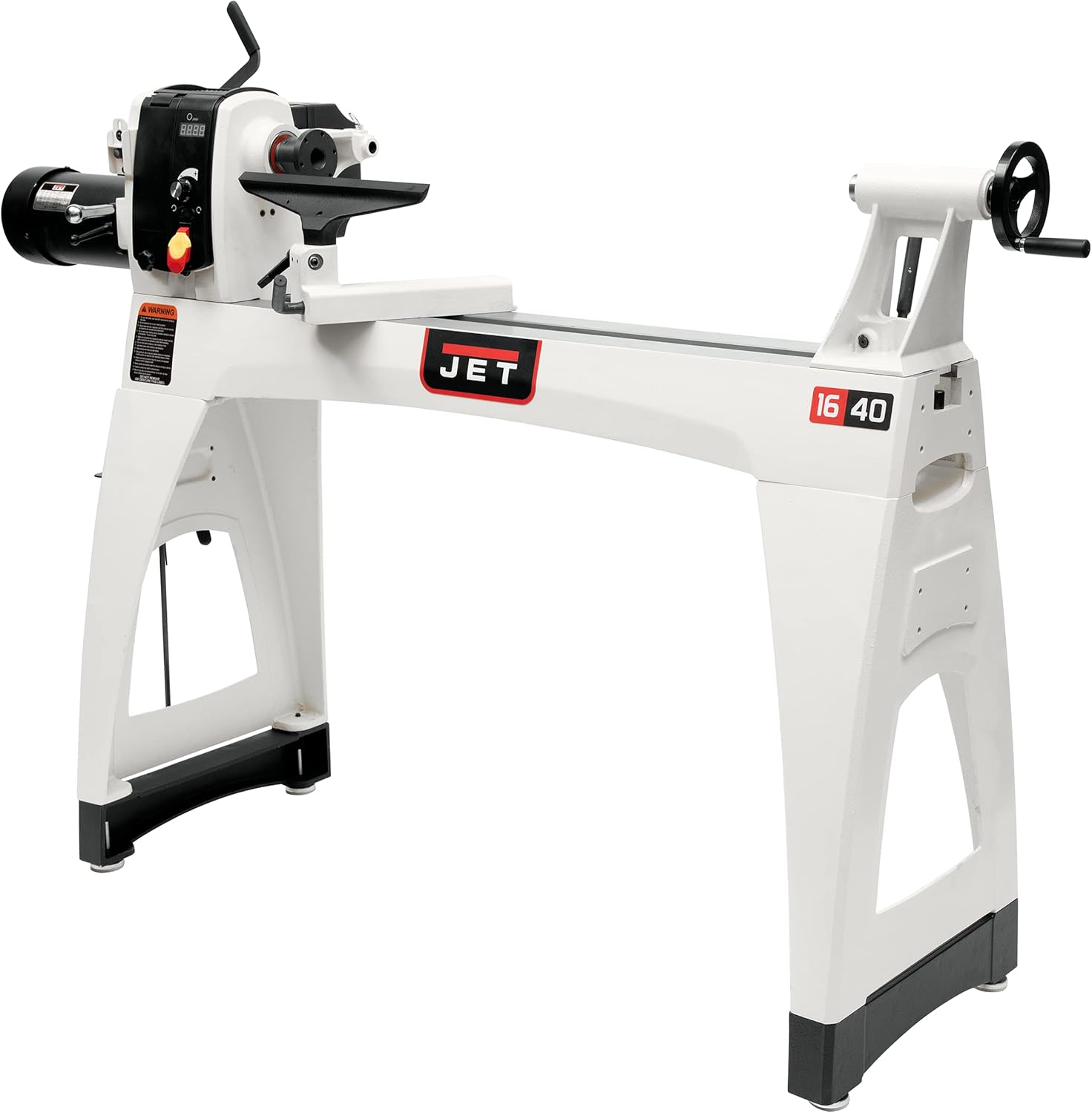
The JET JWL-1640EVS is the pick if you want to turn long table legs, bedposts or large bowls and have room for a full-size machine. It has a 16 x 40 in capacity, a 1-1/2 HP motor on 115 volts, and electronic variable speed from 40 to 3,200 RPM. It is also reversible, so you can run the work backward for sanding and finishing.
The 40 RPM low end lets you start a heavy, out-of-round blank slowly before bringing it up to speed. A spindle lock latch holds the spindle so both of your hands are free when you thread on a chuck or faceplate. The 36 integrated indexing positions let you lock the work at even steps, which helps when you lay out flutes or evenly spaced holes.
The banjo, the sliding base that carries the tool rest, uses a non-marring, positive locking wedge system to hold the tool post securely. The tailstock quill lock has an anti-rotation key, and dual headstock spindle bearings sit in an extended spindle nose. It comes with legs, riser blocks, a tool shelf and MT-2 spindle and tailstock tapers. The warranty runs five years, dropping to two years for commercial or industrial use.
Pros
40 in between centers for long spindle work
Slow 40 RPM start for big blanks
Buyers say it runs smoothly with little vibration
Buyers find the speed control easy to adjust
Cons
Buyers say it is very heavy and hard to move, so plan its spot before it arrives
At 377 pounds it weighs far more than the 121-pound JET JWL-1221VS and needs much more floor space
Some buyers report the headstock does not always rotate properly
If you turn mostly bowls and spindles under 21 in long in a smaller shop, the JET JWL-1221VS fits better.
What to look for in a wood lathe
Start with size: swing (the largest diameter that clears the bed) sets your biggest bowl, and distance between centers sets your longest spindle. A 12-1/2 in swing with 20-1/4 in between spindle faces handles pens, bottle stoppers, small bowls, platters and table-top spindles. If you want table legs or a 14 in wide bowl, that size falls short, so measure your largest planned blank first.
Speed range matters at both ends. A low end of 60 RPM lets you start an out-of-round blank slowly, while the top range suits pens and small spindles. A lathe that bottoms out at 750 RPM spins a lopsided bowl blank much faster at startup, which is why small lathes stick to small work.
Weight and material control vibration. A cast iron bed and stand on a 121 lb lathe dampens vibration, so a heavier machine shakes less when a blank is slightly off balance. Motor power decides whether the cut keeps going under load: buyers of one 1 HP machine report the motor bogging down to a stop.
Spindle thread and taper decide which chucks and centers fit. MT2 tapers with a 1 in-8 spindle thread fit a wide variety of lathe accessories. Mini lathes often use the smaller MT1 taper, so MT2 centers and drill chucks won’t fit them.
Bottom line
The JET JWL-1221VS is the first pick for most home turners, because it covers pens, small bowls, platters and table-top spindles on one benchtop machine that runs on standard 115V household power. For most people turning in a garage or basement shop, that range handles nearly everything without stepping up to a floor-standing lathe.
Your next step is to picture the largest piece you plan to turn, then match it to the lathe’s swing (the widest bowl it can spin) and its distance between centers (the longest spindle it can hold). A 10-inch salad bowl and a 30-inch chair leg call for very different machines, so settle on that size first and the right lathe becomes clear.