Nicpro Mechanical Carpenter Pencils is the first pick for marking in deep holes and tight spots. You get 26 refills, so the set lasts a long time, and the sharpener screws into the top of the pencil, so you are not hunting for it on a cluttered bench.
Both Nicpro sets in this roundup of the best woodworking tools for marking use a 45mm elongated tip. That long tip lets you reach into a small hole or a tight corner and still leave a clear line where you need it. For more detail, see Best Wood Tools for Carving: 3 Whittling Kits for Beginners.
The 11 pack adds an automatic center punch and a carbide scribe. Those help with layout, such as marking a centering spot before you drill. It also gives you two lead sizes, 2.0mm and 2.8mm, so you can switch between fine and bold lines.
As an Amazon Associate we earn from qualifying purchases.
How we picked: from products sold on Amazon for this need, compared by what their makers state and what buyers report in their reviews. For a closer look, read Best Place to Buy Woodworking Tools: Stores Compared.
The Picks at a Glance
Product | Best for | Line size | Additional features | Closure type | Buyer rating | |
|---|---|---|---|---|---|---|
Nicpro Mechanical Carpenter Pencils | marking in tight spots | 2.8 millimeters | Ergonomic | screw | 4.7 of 5 (11,706 reviews) | |
Nicpro 11 Pack Carpenter Pencil Set | a complete layout kit | 2.8mm, 2.0mm | Non-Toxic | Retractable | 4.7 of 5 (2,527 reviews) |
Buyer ratings as shown on Amazon on November 22, 2026; they change.
Nicpro Mechanical Carpenter Pencils: Best for marking in tight spots
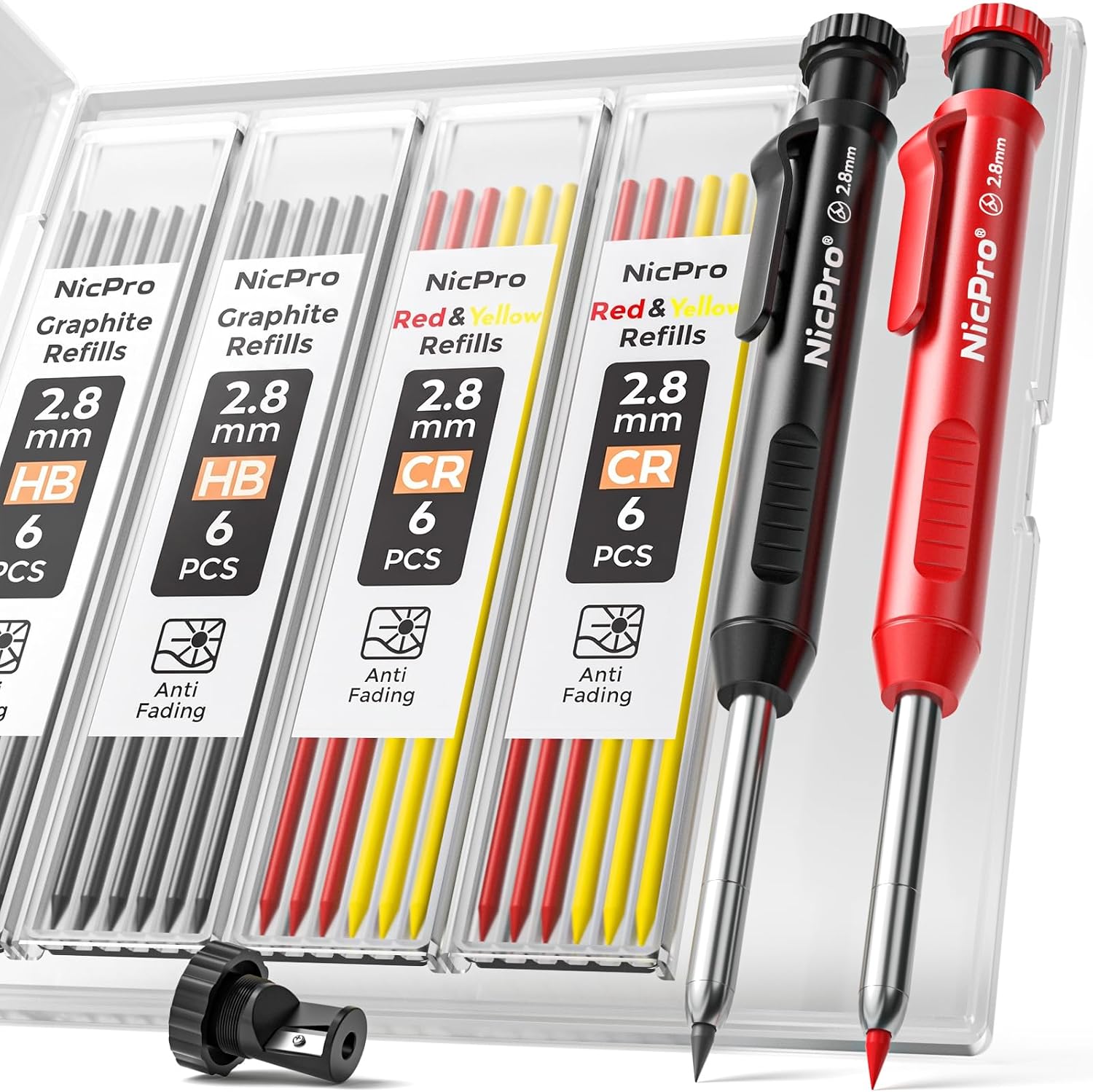
Pick this two-pencil set if most of your marking happens inside holes, behind framing or in corners where a regular carpenter pencil can’t reach. It has two solid carpenter pencils, 26 refills of 2.8 mm lead, a replaceable sharpener and a plastic storage box. That many refills means you can mark a lot of cuts and stud locations before you need to reorder lead.
The maker designed the tip to be 45mm long so you can mark inside small holes and other tight areas. In practice, that helps when you’re marking through a pre-drilled hole in a cabinet back or reaching into a narrow gap between two boards. The sharpener screws into the top of the pencil, so it travels with the pencil instead of getting lost in your apron or toolbox.
The 2.8 mm lead is thick, so it is less likely to snap when you press hard on rough lumber. The lead marks metal, plastic, wood and paper too, which is handy if a project mixes materials, like fastening metal brackets to a wood frame. The set comes in black and red, so you can use one color for cut lines and the other for drill points.
Pros
26 refills keep you marking for a long time
The elongated tip reaches into holes and tight corners
The screw-on sharpener stays attached to the pencil
Buyers say the thick lead holds up well and the built-in sharpener keeps a sharp point with little effort
Cons
You get pencils only, with no scribe or center punch, so you’ll need separate tools for scribing lines or starting drill holes
Every refill is 2.8 mm, which gives you no finer lead for detailed lines
If you want a scribe, a center punch and a finer 2.0mm pencil in the same box, look at the Nicpro 11 Pack Carpenter Pencil Set.
Nicpro 11 Pack Carpenter Pencil Set: Best for a complete layout kit
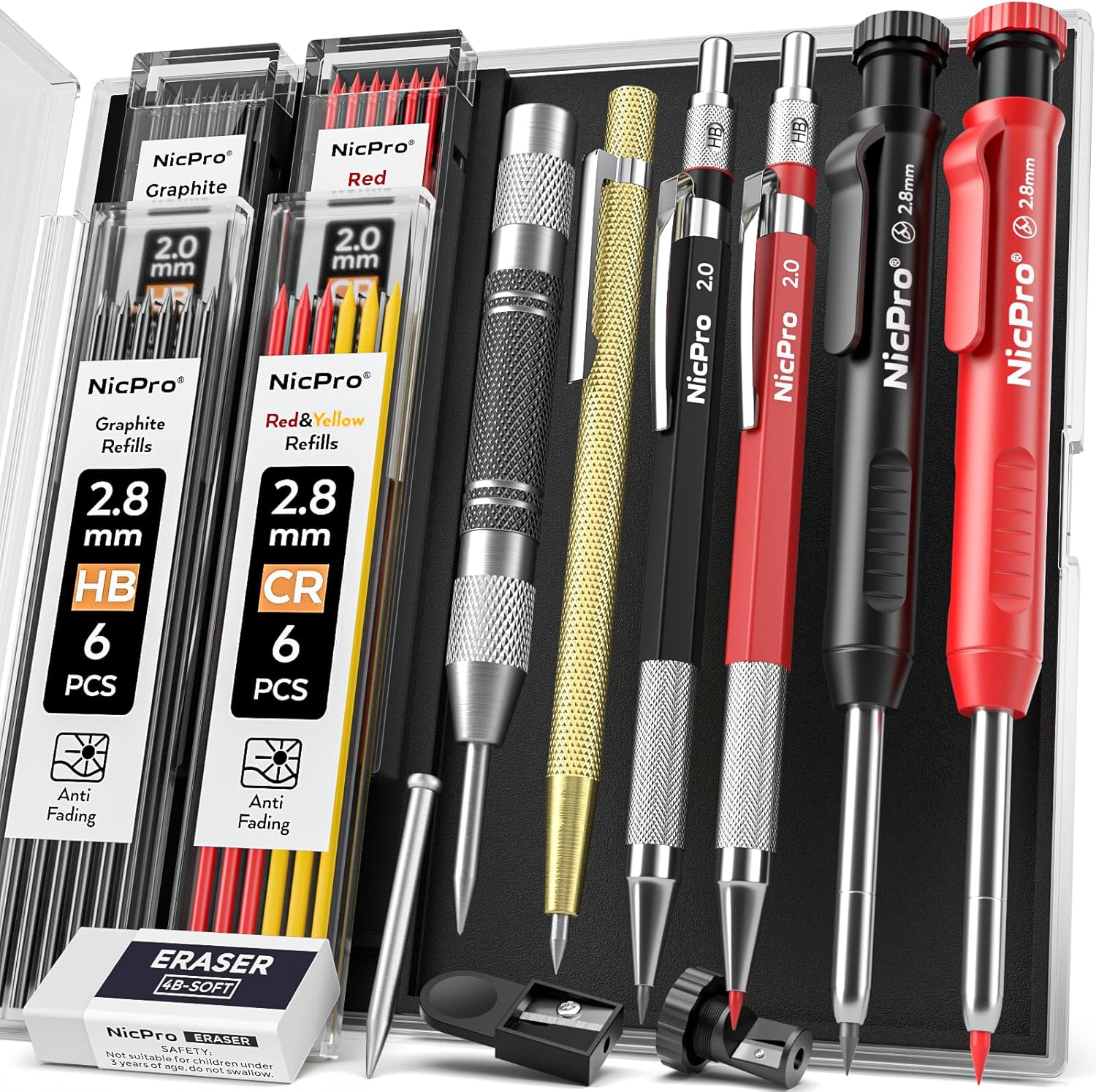
This set is for you if you do more than draw cut lines and want marking, scribing and punching tools in one box. It pairs two lead sizes with an automatic center punch and a carbide scribe, so one purchase covers pencil marks, hard-surface lines and drill starting points.
The maker lists 2 solid 2.8 mm carpenter pencils with 12 refills and 2 mechanical 2.0 mm pencils with 24 refills. In practice, you can reach for the thicker 2.8 mm lead to mark a rough cut on a 2×4, then switch to the 2.0 mm pencil for a fine line on a drawer front or a joinery layout. The refills come in black and colors, 12 colors for 2 mm and 6 for 2.8 mm, so you can use one color for cut lines and another for reference marks.
The kit also holds an automatic center punch with a spare needle, a carbide scribe, an eraser, 3 sharpeners and a plastic storage box. The spring-loaded punch works with one hand and marks a centering spot for drilling, which keeps a bit from wandering when you start a hole. The scribe carves into metal, tile, glass, ceramics and wood, so you can mark surfaces where pencil lead smears or rubs off.
The two deep-hole pencils have a 45 mm elongated tip for marking inside small holes and tight areas, with a sharpener screwed into the top of each pencil. That means you can mark through a hinge hole or inside a cabinet corner and resharpen without hunting for a separate sharpener.
Pros
Center punch and carbide scribe included for layout and drilling
Two lead sizes for bold and fine lines
Buyers say the set has a nice variety of tools and good value for the money
Buyers like the range of colors and find the pencils easy to use
Cons
Buyers report that some pencils break easily, which matters if you work on rough job sites
It comes with 12 refills for the 2.8 mm pencils, fewer than the 26 in the Nicpro Mechanical Carpenter Pencils set, so heavy 2.8 mm users will restock sooner
If you only need bold pencil marks in tight spots and want more 2.8 mm refills, the Nicpro Mechanical Carpenter Pencils is the better fit.
How do you pick a marking tool for woodworking?
Pick a marking tool by where you mark first, then by how thick a line you need. A pencil that reaches into a bored hole is no help if you also need to scratch a line on metal or center a drill bit, so match the tool to the job in front of you.
If you mark inside holes or in cramped corners, look for an elongated tip. A 45mm elongated tip lets you mark in small holes and tight areas that a standard flat carpenter pencil cannot reach. That helps when you’re marking the bottom of a mortise or a spot behind a cabinet face frame.
Lead size decides how your line looks. A 2.8 mm lead is thick and strong, so it holds up during rough construction marking without breaking easily. A 2.0 mm lead draws a finer line and suits writing and drawing. Use the thicker lead for cut lines on framing lumber and the thinner one for joinery layout where a wide line could throw off your cut.
For layout beyond pencil lines, consider a scribe and a center punch. A carbide scribe carves into hard materials such as metal, tile, glass and wood, and a spring-loaded center punch works one-handed to mark a centering spot for drilling. The punch dimple keeps a drill bit from wandering off your mark.
Marking tools are small parts of a starter kit. A workbench, chisels, a measuring square and a drill are must-haves, with a circular saw and sander added early on [1]. A random orbital sander is one common choice for that sanding slot [2].
Which set should you buy?
Nicpro Mechanical Carpenter Pencils is the first pick if most of your marking happens down in holes, inside cabinet corners or other tight spots. Its elongated tip reaches places a flat carpenter pencil can’t, and the thick lead holds up to rough construction work without snapping.
Before you order, decide whether pencils alone will cover your projects. If you also scratch lines into hard materials or mark drill points, a set with a carbide scribe and a spring-loaded center punch saves you from buying those tools separately. If you only need clear pencil lines on lumber, the two-pencil set keeps things simple.


