A Craftsman 10-inch table saw is a solid choice if you build things at home now and then and want a saw you can move around. Its limits show up when you need cabinet-grade precision or run it hard every day. To go further, see Ryobi RTS31 10-Inch Table Saw: Is It Right for Your Shop?
Craftsman sells a 10-in Portable Table Saw with Folding Stand, so you can roll it out of the garage for a deck project and fold it away afterward [1]. The 10-inch model has a 15-amp motor, which is plenty for ripping plywood and cutting common framing lumber [2].
Below you’ll find which models are available, what the specs mean for your cuts, where the saw falls short, how to run it safely and what to check before you buy new, used or borrowed.
Which Craftsman 10-inch table saws can you buy
Craftsman’s current table saw lineup has one 10-inch model: the 10-in Portable Table Saw with Folding Stand [1]. If you want a new 10-inch Craftsman, that is the saw to look at. The other options are a smaller current model and older saws on the used market.
The current 10-inch portable saw
The 10-in Portable Table Saw with Folding Stand is listed alongside Craftsman’s other table saws [1]. Its name tells you its main design goal: you can roll or carry it to the job and set it up on its own stand, so you don’t need a workbench or a permanent spot in the garage.
This suits someone who cuts deck boards in the driveway one weekend and stores the saw against a wall the next. If you plan to leave a saw set up in one place all the time, weigh how much the folding stand is worth to you.
The smaller 8 1/4-inch model for comparison
Craftsman also sells an 8 1/4-in Table Saw, SKU CMXETAX69434510 [1]. A smaller blade means a shallower cut, so it is the one to consider if you mostly rip plywood, trim, and 1x boards.
When you compare the two in a store, use the SKU to make sure you’re looking at the 8 1/4-inch saw and not the 10-inch model. The SKU also helps you match online listings to the exact saw on the shelf.
Older Sears-era saws on the used market
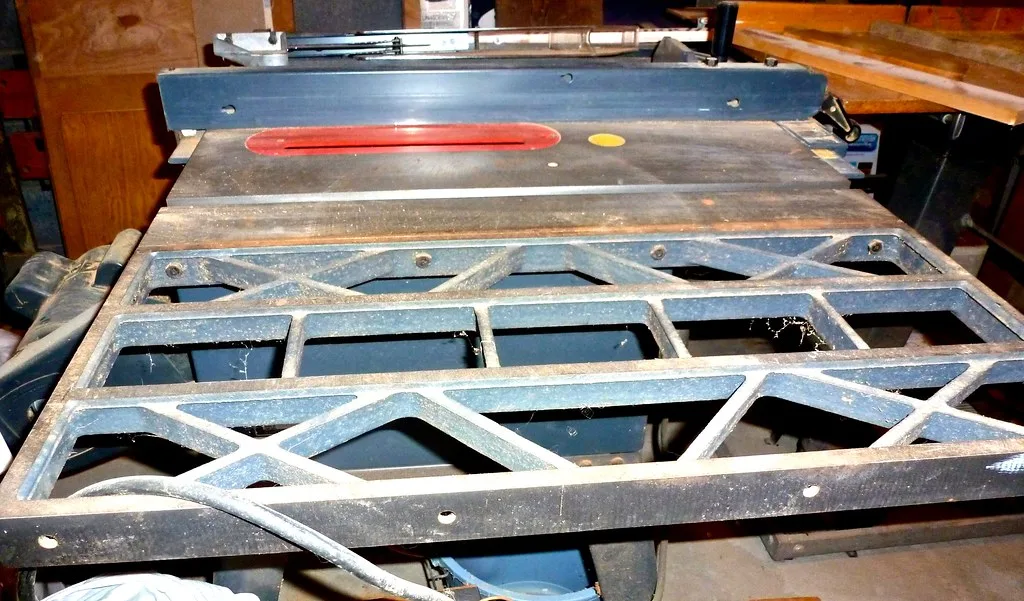
You’ll also find older Craftsman saws from the Sears years, such as the 10 in. Table Saw with Leg Set [3]. This design sits on a set of legs, unlike the newer folding stand.
These saws show up at garage sales, estate sales, and online classifieds. Before you buy one, note the exact model name on the saw so you can track down its operator’s manual and match parts to it.
What the specs mean for your cuts
The Craftsman 10-inch table saw has enough power and depth for the everyday cuts most homeowners make, like ripping 2x4s, cutting plywood shelves and trimming deck boards. Reading the spec sheet as cutting capacity tells you what jobs it can handle.
Motor, voltage and blade speed
The Lowe’s listing gives the saw a 15-amp motor that spins the blade at 5000 RPM. [2] A 15-amp, 120V motor runs from a standard household outlet, so you can set it up in a garage or driveway without special wiring. [4] A blade speed of 5000 RPM helps the saw cut cleanly through common softwoods and sheet goods when you feed the board at a steady pace.
Direct drive
The saw uses a direct drive system. [4] That means the blade mounts on the motor shaft with no belt in between. You get a compact, lighter saw that is easy to carry, and you never have to replace or tension a belt. The tradeoff is that a direct-drive motor usually runs louder than a belt-driven cabinet saw.
What a 3-inch depth of cut handles
With the blade set at 0 degrees, straight up, the saw cuts 3 inches deep. [4] A 2×4 or 2×6 is actually 1 1/2 inches thick, so you can rip or crosscut any 2x board in one pass with depth to spare. Two 2x boards stacked face to face measure 3 inches together, which is right at the limit, so expect a slower, harder cut. A 4×4 post is about 3 1/2 inches thick and is too deep for a single pass.
What owners say
The saw has a 4.1 rating from 860 reviews on Lowe’s. [2] With that many reviews, most buyers are satisfied with it for home projects, though a 4.1 average leaves room for complaints worth reading before you buy.

Where a Craftsman jobsite saw falls short
A Craftsman 10-inch jobsite saw is built to move, and that portability is the source of most of its weak spots. If you plan to cut precise joinery every day, you will feel those limits quickly.
What owners disliked about the older model
The older Craftsman 10-inch saw drew blunt criticism from woodworkers: too small, too light, too sloppy, too loud, too unreliable and too weak. [5] The same review added that it has little resale value and isn’t cost effective to fix or upgrade. [5] That last point matters if you were hoping to buy a cheap one and improve it later with a better fence or motor, because the upgrades can cost more than they return.
Why portable saws give up mass and fence accuracy
A light saw is easy to carry to a driveway or a job site. The trade-off is that less weight means more vibration, and vibration shows up as rougher cuts and blade marks on the edge of your board.
The fence is the other compromise. On a compact saw, the fence often flexes or shifts slightly when you lock it, so a rip that should be exactly 3 1/2 inches wide can drift a little from front to back. For framing, shelving or deck boards, that small drift rarely matters. For cabinet doors or face frames that need tight, square joints, it does.
Occasional projects vs. daily shop work
This kind of saw suits a weekend schedule. Ripping plywood for garage shelves, trimming baseboard or cutting parts for a raised garden bed are all reasonable jobs.
Daily shop use is different. Long sessions, hardwood rips and repeated precision cuts put steady strain on a light motor and a basic fence, and you will spend more time correcting cuts. If your table saw will be the center of a working shop, plan for a heavier saw.
How to use it safely
Every through cut on a Craftsman 10-inch table saw should be made with the blade guard, splitter and anti-kickback pawls installed. The older Sears-era operator’s manual puts it in capital letters: always use the saw blade guard, splitter and anti-kickback pawls for every through-sawing operation [3]. Those three parts work as a set. The guard covers the spinning blade, the splitter keeps the cut (the kerf) from closing and pinching the blade, and the pawls dig into the board if it starts to shoot back toward you.
What counts as a through cut
A through-sawing cut is one where the blade passes all the way through the board [3]. Most of what a homeowner does on this saw falls into that group:
-
Ripping a 2×4 or a strip of plywood lengthwise against the fence
-
Crosscutting a shelf board to length with the miter gauge
-
Trimming a sheet of plywood down to width
Non-through cuts, such as dadoes or grooves where the blade stays buried in the wood, are the exception. If you pick up a used saw with the guard, splitter or pawls missing, find replacement parts before you make any of the cuts above.
Plan for the power draw
The saw’s motor runs on 120V, 60 Hz and draws 15 amps [4]. A 15-amp tool can use the full capacity of a standard 15-amp household circuit, so plug it into an outlet on a circuit where nothing else is running, like a shop vac or space heater.
If the breaker trips mid-cut, the blade stops in the board. Turn off the saw, back the workpiece out carefully, and reset the breaker before you try again. In a garage, choose the closest outlet over a long, thin extension cord, which can starve the motor and make it bog down in thicker stock.
What to check before buying new, used or borrowed
Before you pay for a Craftsman 10-inch table saw, line it up against other saws with the same basic specs, check that a used one still has its safety parts and manual, and test one in person if you can. Those three steps catch most of the surprises that show up after the saw is home.
Compare it with similar benchtop saws
Many 10-inch benchtop saws share the Craftsman’s 15-amp motor, so the motor rating alone won’t separate them. One 15-amp portable 10-inch saw listed online runs at 4600 RPM and ships with a 36T blade (36 teeth), which tells you how its speed and stock blade stack up against the saw you’re considering. [6]
When you compare, look at what you’ll touch on every cut:
-
The fence, and whether it locks parallel to the blade without fiddling
-
The stand, and whether it folds and rolls or has to be lifted
-
The included blade, since a low tooth count cuts fast but leaves a rougher edge
-
The miter gauge and how much play it has in its slot
Check a used older model for its guard and manual
Older Sears-era Craftsman saws turn up often at yard sales and online. Ask the seller whether the blade guard, splitter and anti-kickback pawls are still with the saw, because the operator’s manual calls for all three on every through-sawing operation. [3] A saw missing these parts needs replacements before it’s ready for safe ripping.
Also ask for the manual or the full model number. The operator’s manual for the 10 in. Table Saw with Leg Set is still available as a PDF from Sears PartsDirect, which helps with setup and with ordering parts. [3]
Borrow one from a tool library first
Some tool libraries lend these saws. The Tacoma Tool Library, for example, lists a Craftsman 10-inch table saw with a 120V, 15-amp direct-drive motor. [4] A weekend of cutting shelves or trim tells you more about fence feel, noise and weight than any listing.
Common questions about Craftsman 10-inch table saws
Can it cut 4×4 posts in one pass?
No. A Craftsman 10-inch saw with a direct-drive motor reaches 3 inches deep when the blade is set at 0 degrees, and a 4×4 post is thicker than that [4]. A single pass leaves a strip of wood holding the two pieces together.
If you cut a lot of posts for fences, decks or garden beds, a table saw is the wrong tool for that job. A miter saw or a circular saw used from both sides handles posts more comfortably. Keep the table saw for ripping boards and sheet goods, where its depth is enough.
Is the older Sears model worth fixing?
Usually not, unless the repair is cheap and simple. Woodworkers who have owned the older Sears-era Craftsman 10-inch saw describe it as “too small, too light, too sloppy, too loud, too unreliable, too weak,” with little resale value and not cost effective to fix or upgrade [5].
That doesn’t make every old unit useless. If one came free with a house or from a relative and only needs a new belt or a cleaned-up fence, it can still handle rough cuts for shelves or shop jigs. Paying for a new motor, a new fence system or a pile of replacement parts is where the math stops working, because the money moves you most of the way to a newer saw.
Does it fold for storage?
The current model does. Craftsman sells it as the 10-in Portable Table Saw with Folding Stand, so the legs fold up and you can roll or carry the saw to a corner of the garage or into a truck bed [1].
The folding stand helps most if you share a garage with a car or work on different jobsites. Measure the spot where you plan to store it so you know it fits standing on end or tucked under a bench.
Should you buy one
Buy a Craftsman 10-inch table saw if you mostly rip plywood for shelves, trim deck boards or carry a saw between the garage and a job site. It suits homeowners and hobbyists who want real cutting power in a saw they can fold up and roll away. If you plan to build face-frame cabinets every weekend or need dead-square cuts on large panels all day, a heavier cabinet or hybrid saw with a stiffer fence will serve you better.
Your next step is to see the saw in person at a store that stocks it. Slide the fence back and forth, lock it at a few spots and measure whether it sits parallel to the blade. Then compare its price with the other 10-inch portable saws on the same shelf.