The SKIL MS6305-00 is the first pick for most home DIYers looking for the best compound sliding miter saw. It is a dual bevel saw with four positive bevel stops, so it tilts both ways and locks at common angles without guesswork, and it crosscuts lumber up to 2×12 at 90 degrees. That covers deck boards, shelving and most framing stock in one pass.
A sliding compound saw combines two jobs: the slide lets the blade travel across wider boards, and the compound head lets you set a miter and a bevel at the same time. That combined cut is how crown molding and boxes with equally sloped sides are made [1]. Below are five picks in 10- and 12-inch sizes, from a budget single-bevel saw to a heavy-duty jobsite model.
As an Amazon Associate we earn from qualifying purchases.
How we picked: from products sold on Amazon for this need, compared by what their makers state and what buyers report in their reviews.
The Picks at a Glance
Product | Best for | Item dimensions l x w x h | Item weight | Blade length | Buyer rating | |
|---|---|---|---|---|---|---|
SKIL MS6305-00 | home DIY framing and trim | 35.43″L x 22.44″W x 14.17″H | 39.4 lb | 10 in | 4.6 of 5 (2,288 reviews) | |
DEWALT DWS780 | heavy-duty jobsite use | 32.57″L x 23″W x 19.5″H | 24.8 kg | 12 in | 4.8 of 5 (2,535 reviews) | |
NOVORIK 10-Inch Single Bevel | budget beginners | 28.3″L x 15″W x 18″H | — | 10 in | 4.5 of 5 (103 reviews) | |
DOVAMAN 10-Inch 2-Speed | cutting PVC and soft metal | 34″L x 20″W x 15″H | 17 kg | 10 in | 4.4 of 5 (783 reviews) | |
DOVAMAN 12-Inch Dual-Bevel | wide boards and crown molding | 21″L x 21″W x 34″H | 53.9 lb | 12 in | 4.4 of 5 (245 reviews) |
Buyer ratings as shown on Amazon on November 17, 2026; they change.
SKIL MS6305-00: Best for home DIY framing and trim
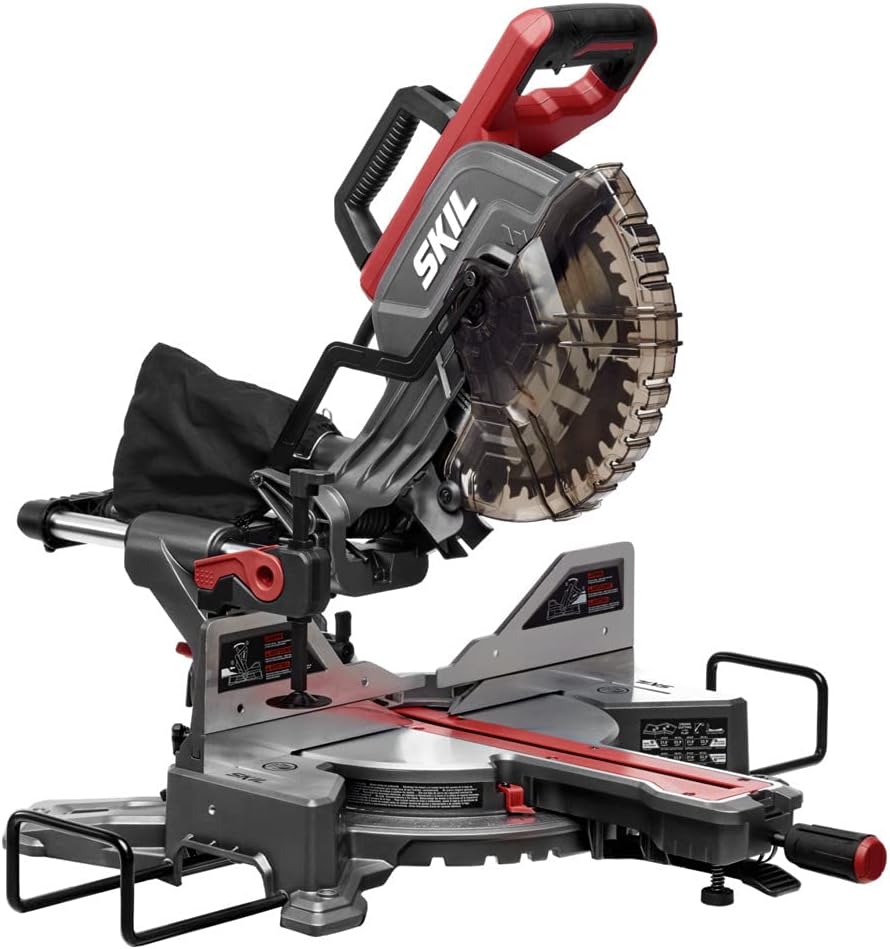
The SKIL MS6305-00 suits homeowners who cut framing lumber and trim in the same weekend and want a 10-inch saw that tilts both ways. It crosscuts lumber up to 2×12 at 90 degrees, so stair stringers, shelving and deck boards fit under one pass. Its dual bevel lets you tilt the head left or right without flipping the board, which speeds up matching trim corners.
That speed helps the 40-tooth blade leave a cleaner edge on trim, where tear-out shows. The bevel has four positive stops at 48 and 45 degrees left, 0, and 45 degrees right. Those detents click into place, so you can reset a common angle without measuring each time. The 48-degree stop gives a little extra tilt for odd corners that are not a true 90.
The miter swings up to 50 degrees left and right, with 11 positive stops at the most used angles. An LED shadow line casts the blade’s own shadow onto your mark, so you line up the cut where the teeth will actually land. At 39.4 pounds, one person can lift it onto a bench or stand and carry it to the driveway.
Bevel stops at 48 and 45 degrees left, 0, and 45 degrees right
Miter to 50 degrees with 11 positive stops
LED shadow line cut guide
Crosscuts 2×12 at 90 degrees and 2×8 at 45 degrees
Pros
Buyers say it makes accurate cuts, even through hardwood
Buyers find it easy to set up and a good value for the money
Shadow line works reliably, according to buyers
Dual bevel with positive stops for repeatable angles
Cons
Some buyers find the bevel and angle adjustments tricky to use
Some buyers report the saw breaking down after a couple of months
At 45 degrees it handles only 2×8 lumber, so wide mitered boards need a larger saw
If you regularly cut wide crown molding or boards past 2×12, the DOVAMAN 12-Inch Dual-Bevel with its 12-inch blade fits that work better.
DEWALT DWS780: Best for heavy-duty jobsite use

The DEWALT DWS780 is the pick for heavy-duty jobsite use, where a saw runs all day and has to stay accurate. It has a 15 amp, 3,800 rpm motor built for heavy-duty applications and a 12-inch blade. If you cut a lot of thick stock or work on job after job, it is the saw on this list built for that load.
The maker states the motor delivers extended power and durability for heavy-duty applications. In daily use, that means the saw is built for long sessions ripping through framing lumber and hardwood trim, where a lighter motor would bog down. The included 12-inch carbide blade has 80 teeth. A high tooth count gives cleaner crosscuts on trim and finish boards.
The XPS LED shadow line projects a shadow of the blade onto your workpiece, and the cutline system needs no adjustment. You line up your pencil mark with the shadow and cut, with no laser to recalibrate after the saw gets bumped around in a truck. The dust collection system captures over 75% of the dust generated. That means less sawdust on the floor of a finished room and less cleanup at the end of the day, though some dust still escapes.
Pros
The 15 amp motor is made for heavy-duty, all-day cutting
The LED shadow line cut guide needs no adjustment
Buyers say the cuts are precise and accurate
Buyers find it solidly built and stable, and easy to use even for beginners
Cons
Some buyers report the saw does not hold up well over time
At 32.57 inches long, 23 inches wide and 19.5 inches tall, it takes up more bench space than a small shop may have room for, and it is taller than the 14.17-inch SKIL
If you mostly cut trim and framing at home and want a more compact saw, the SKIL MS6305-00 is the better fit.
NOVORIK 10-Inch Single Bevel: Best for budget beginners

The NOVORIK 10-inch is a sensible first sliding miter saw for a beginner who wants to cut trim, shelves and small projects without paying for features they won’t use yet. It has a 15 amp motor with a no-load speed of 4,000 rpm, and a 10-inch woodworking blade comes on the saw, so you can make your first cut right out of the box.
The bevel range runs from 0 to 45 degrees in one direction. That covers the angled edges you need for picture frames and simple box corners. The miter table swings to 45 degrees each way, with positive stops at 0, 15, 22.5, 30 and 45 degrees in both directions. A positive stop is a detent the table clicks into, so a common angle like 22.5 degrees for an octagon is repeatable without fussing over the scale.
A laser guide shows where the blade will land, which helps you line up a pencil mark before you pull the saw through. The saw also has a dust extraction port that takes a vacuum hose, and two side supports come in the box to hold longer boards level. It measures 28.3 inches long by 15 inches wide, so it takes up less bench depth than the SKIL MS6305-00 at 35.43″L x 22.44″W. That makes it easier to fit in a garage corner or on a small bench.
Pros
Blade included, ready to cut
Five positive miter stops in each direction
Laser guide for lining up marks
Compact footprint for small shops
Cons
Single bevel only, so for an opposite bevel you flip the workpiece over. That adds a step on crown molding and trim with matching left and right cuts.
If you plan to cut a lot of crown molding, the dual-bevel SKIL MS6305-00 saves you that flipping.
DOVAMAN 10-Inch 2-Speed: Best for cutting PVC and soft metal

The DOVAMAN 10-Inch 2-Speed is the pick if your projects mix lumber with PVC trim, plastic pipe or soft metal. It has two speed settings, 5,000 and 3,200 RPM, for wood, PVC and soft metals. In practice, you can run the faster speed for clean cuts in pine or oak and drop to the slower one so PVC is less likely to melt and aluminum is less likely to grab.
The maker includes three TCT (tungsten carbide tipped) blades: two 40-tooth and one 48-tooth. The 40-tooth blades suit faster, rougher cuts in framing stock, and the 48-tooth blade leaves a smoother edge on trim. Having spares means you can keep one blade for wood and another for PVC or metal, so you swap blades instead of buying them.
A 13-inch sliding rail and extendable side tables give a cutting range up to 4 x 13 inches. That handles a 2×12 shelf board or wide fascia in one pass, and the side tables hold long trim pieces level. The saw also has an ambidextrous design for left- and right-handed operators. If you cut left-handed, that makes reaching the handle and trigger less awkward on every cut.
Pros
Two speeds for wood, PVC and soft metal
Three blades in the box
Ambidextrous handle for lefties
Buyers say it is easy to use and handles many kinds of materials and projects
Cons
Buyers report the motor is slow to spin up to speed, so you wait a moment before each cut.
Buyers say the included blade starts to dull after a number of cuts, which means a sooner blade upgrade if you cut a lot.
Some buyers find it too plastic and not accurate enough, which matters most for tight trim joints.
If you cut mostly wood trim and want dual bevel stops, the SKIL MS6305-00 is the better fit.
DOVAMAN 12-Inch Dual-Bevel: Best for wide boards and crown molding

The DOVAMAN 12-inch is the pick for wide boards and crown molding, because it bevels and miters to 45 degrees in both directions on a sliding rail. The maker lists a maximum cut of 4.2 x 13 inches. That covers wide shelving stock and tall trim that a 10-inch saw struggles with.
Dual bevel means the head tilts both left and right, so you can cut matching crown corners without flipping each piece end for end. The 4.2-inch height is useful when you stand thicker stock or baseboard on edge, and the 13-inch width handles boards about as wide as a 2×12 or a little wider in one pass.
A laser guide marks where the blade will land, so you can line up a pencil mark before the blade comes down. The base has nine angle presets, including 0, 15, 22.5, 30 and 45 degrees on both sides. Those cover the common cuts: 45 for picture frames and square corners, 22.5 for eight-sided frames and bay corners.
The 15-amp copper motor spins at up to 3,800 rpm and is rated for wood. The switch and safety lock work from either hand, and the 40-tooth blade, dust bag and clamp come in the box.
Pros
It cuts both bevel directions for crown and trim
Its 4.2 x 13-inch capacity handles wide and tall stock
Nine angle presets on both sides speed up common angles
Left- and right-hand switch operation
Cons
At 53.9 pounds it is heavy to carry or move off a bench, more than the SKIL’s 39.4 pounds
It is rated for wood, so it is not the saw for PVC or soft metal
If you cut PVC or soft metal, the DOVAMAN 10-Inch 2-Speed fits better.
What to look for in a sliding compound miter saw
Start with the widest and thickest board you cut most often, because cut capacity decides which saw can handle your projects. A saw rated for 2×12 lumber at 90 degrees can square-cut a stair tread or a wide shelf in one pass. If you regularly cut 4-inch-thick stock or 13-inch-wide boards, look at saws in the 4 x 13 inch class.
Next, choose between single and dual bevel. A dual bevel saw tilts both left and right, so you cut opposite bevels on crown molding and trim without flipping the board end for end. Compound saws are what you use for crown molding and boxes with sloped sides, and those jobs depend on getting the miter and bevel angles right together [1]. Related reading: Best Miter Saw: Choose the Right Saw for Your Work.
Blade size affects both reach and footprint. A 12-inch saw like the DEWALT DWS780 measures 32.57 by 23 by 19.5 inches, so plan a dedicated stand or bench for it. A 10-inch saw is easier to fit in a small garage.
Last, compare the extras that make daily cutting easier:
A shadow line shows where the blade will cut using the blade’s own shadow, and a laser projects a line onto the board.
Positive stops let a saw snap to common angles such as 0, 15, 22.5, 30 and 45 degrees, which speeds up repeat cuts.
A dust port that accepts a vacuum hose keeps sawdust off your work area.
A two-speed saw lets you slow the blade for PVC and soft metals.
Common questions about sliding miter saws
Is a shadow line better than a laser?
A shadow line is the more accurate cut guide, according to SKIL, which says its LED shadow line gives greater accuracy than lasers. A shadow line works by lighting the blade so its own shadow falls on the board, which means the mark you line up with comes from the blade itself. When you are trimming a miter by a hair for a tight corner, that direct reference makes it easier to hit your pencil line on the first cut.
Can a sliding miter saw cut metal?
Some can, if you pick a saw built for it. The DOVAMAN 10-inch has two speeds, 5,000 and 3,200 RPM, for cuts in wood, PVC and soft metals. In practice, you switch to the slower speed for soft metal or PVC, which is the setting to use when you cut aluminum angle for a shelf bracket or vinyl trim for a porch.
Do you need a sliding saw?
You need a slider if you cut boards wider than about a 2×8. A sliding 10-inch saw like the SKIL crosscuts lumber up to 2×12 at 90 degrees and 2×8 at 45 degrees. So with a slider you can square-cut a 2×12 stair tread or deck joist in one pass, without flipping the board to finish the cut.
The saw to start with
The SKIL MS6305-00 is the first pick for most home DIYers: it crosscuts lumber up to 2×12 at 90 degrees, which covers shelving, deck boards and most framing you’ll do around the house. Its dual bevel tilts both ways, so you can cut matching trim corners without flipping the board over.
Before you buy any saw, measure the widest board you plan to cut, such as a 2×12 stair tread or a 12-inch shelf. That number tells you whether a 10-inch saw is enough or you need a 12-inch one. Then decide whether you’ll do enough crown or trim work to want dual bevel over single bevel.