The AVID POWER 20V Drill Set is the first pick for most homeowners who drill a few times a month, because it lets you watch the charge on a real-time battery level display and comes with 22 bits in the box. That means you can start hanging shelves or assembling furniture the day it arrives without buying extra accessories, and you won’t run out of power halfway through a screw.
You may not need a 20-volt drill at all. For most household tasks, a 12-volt drill is more than adequate [1]. A smaller drill like that is often lighter and easier to hold overhead when you’re mounting curtain rods.
The five cordless picks below cover light drilling and driving, from occasional fixes to frequent DIY projects.
As an Amazon Associate we earn from qualifying purchases.
How we picked: from products sold on Amazon for this need, compared by what their makers state and what buyers report in their reviews.
The Picks at a Glance
Product | Best for | Maximum chuck size | Maximum rotational speed | Maximum torque | Buyer rating | |
|---|---|---|---|---|---|---|
AVID POWER 20V Drill Set | occasional home users | 0.38 in | 550 rpm | 280 in-lb | 4.6 of 5 (23,701 reviews) | |
DEWALT DCD771C2 | frequent DIY projects | 0.5 in | 1500 rpm | 650 in-lb | 4.8 of 5 (50,028 reviews) | |
COMOWARE 20V Drill | everyday household fixes | 10 millimeters | 1300 rpm | 266 in-lb | 4.4 of 5 (9,184 reviews) | |
DEKOPRO 20V Drill | easy carrying | 0.5 in | 1350 rpm | 40 N m | 4.4 of 5 (7,966 reviews) | |
FADAKWALT 12V Drill | light screw driving | 0.38 in | 650 rpm | 180 in-lb | 4.5 of 5 (1,910 reviews) |
Buyer ratings as shown on Amazon on November 14, 2026; they change.
AVID POWER 20V Drill Set: Best for occasional home users
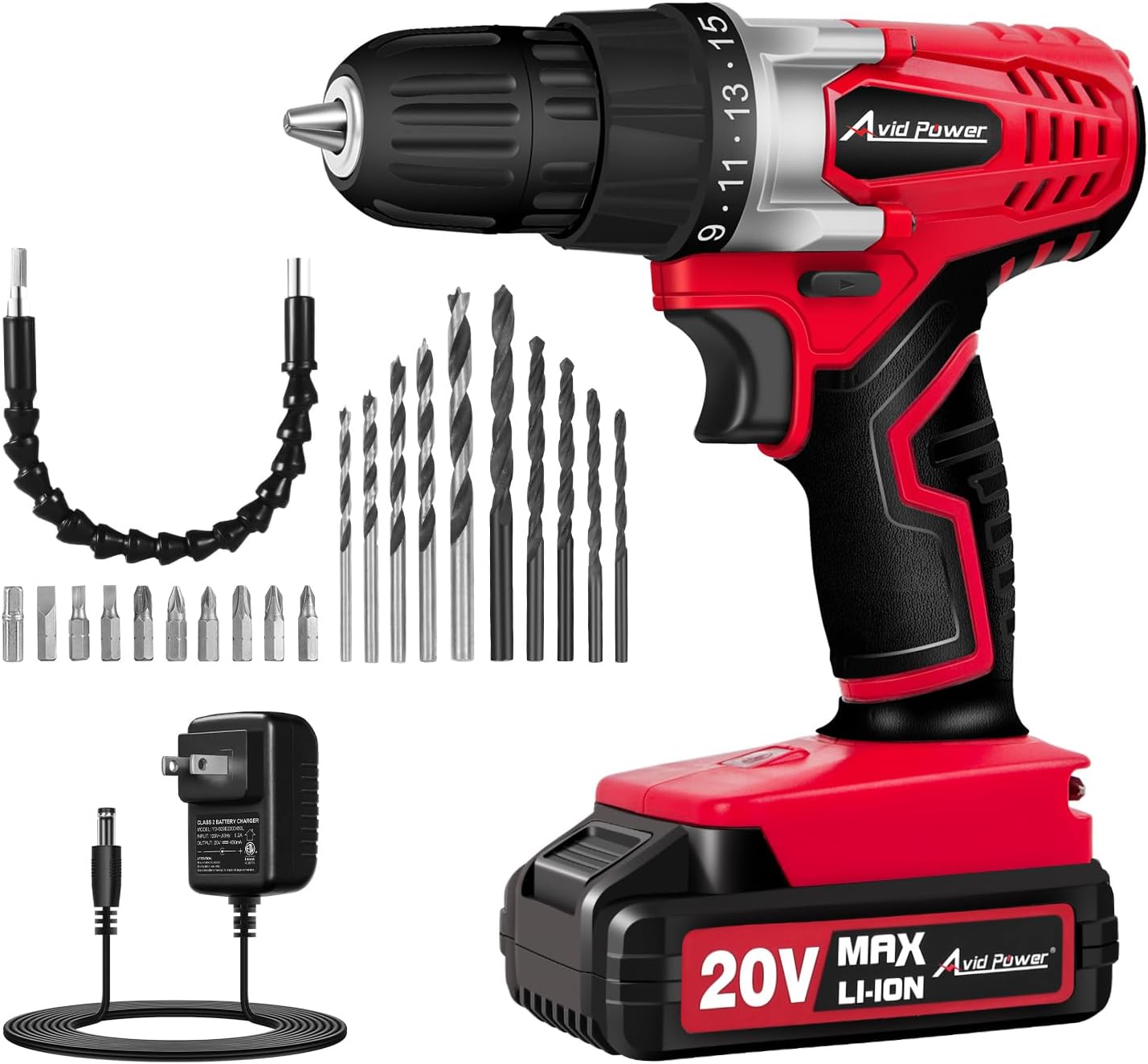
The AVID POWER 20V drill set suits a homeowner who reaches for a drill a few times a month to hang shelves, assemble furniture or tighten loose hinges. The maker builds it for exactly that use, pairing a 20V lithium-ion battery with a 3/8 inch keyless chuck and a kit of 22 bits.
The battery has a real-time level display, so you can see how much charge is left before you start a job. That matters for an occasional user: when a drill sits in a closet for weeks, you know at a glance whether it is ready or needs charging before you climb the ladder.
The 3/8 inch keyless chuck lets you swap bits by hand, without a chuck key. The 22 accessories include 10 drill bits, 10 driver bits, a flexible shaft and an extension bar. For a first drill, that means you can drive screws, drill pilot holes and reach into a cabinet corner without buying extras on day one.
When the box arrives, charge the battery fully even if you don’t plan to use the drill right away. If it then sits unused, take the battery out and recharge it every 3 months to keep it healthy for longer.
Pros
The battery display shows charge at a glance
It comes ready to use with 22 accessories
Buyers say it is lightweight and easy to handle
Buyers say it has plenty of power for household projects
Cons
Buyers report that some included drill bits break on first use, so you may want a few spare bits
It works only with AVID POWER batteries and not with larger-capacity packs, so you can’t upgrade to a longer-running battery
Its top speed of 550 rpm is lower than the 1500 rpm of the DEWALT DCD771C2, so drilling goes slower
If you drill most weekends or tackle bigger holes, the DEWALT DCD771C2 fits you better.
DEWALT DCD771C2: Best for frequent DIY projects

The DEWALT DCD771C2 is the pick for DIYers who reach for a drill often and want more power and a bigger chuck than a basic starter set. It has a 300 unit watts out (UWO) motor, two speeds and a 1/2 inch ratcheting chuck.
The motor rating means it has power to spare for a wide range of jobs, from driving deck screws to boring holes for cable runs. The two speeds, 0-450 and 1,500 rpm, split the work cleanly: use the low setting for driving screws without stripping heads, and switch to high when you drill holes.
The 1/2 inch single sleeve ratcheting chuck grips bits tightly, so a spade bit is less likely to slip when it bites into a stud. A 1/2 inch chuck also accepts larger-shank bits than the 3/8 inch chucks on smaller drills. The lightweight design fits into tight areas, and the ergonomic handle adds comfort and control on long sessions, such as assembling a run of cabinets.
Pros
Two speeds for driving and drilling
Up to 650 in-lb of maximum torque, more than any other pick here
Wood drilling capacity of 30 millimeters, the largest in this lineup
Buyers say it packs surprising power for its compact size and stays comfortable during long jobs
Cons
Buyers report that some batteries develop problems and do not hold up well
At 3.6 pounds, it is heavier to hold overhead than the DEKOPRO
The 1.3 battery capacity is lower than the 1.5 amp-hour packs on the AVID POWER and FADAKWALT, so expect fewer screws per charge
If you only drill a few times a month, the AVID POWER 20V Drill Set covers those jobs with less tool than you need here.
COMOWARE 20V Drill: Best for everyday household fixes

The COMOWARE 20V is a good fit if most of your drilling is quick fixes around the house: assembling furniture, hanging curtains and making holes in wood, drywall, plastic and light metal. The maker lists 266 in-lbs (30 Nm) of torque for that kind of everyday drilling and driving.
Two speed ranges cover the two halves of the job. Low speed (0-350 RPM) drives screws with control, and high speed (0-1300 RPM) powers through holes. In practice, you keep it on low when you’re sinking cabinet screws, so the bit stays seated in the screw head, and switch to high when you’re boring a pilot hole through a pine shelf.
The 25+1 position clutch helps prevent sinking a screw too deep, stripping out the head of a screw or breaking a screw shaft. A clutch is a slip setting that stops the drill from turning once the screw meets a set resistance. That matters when you drive screws into soft materials like particleboard furniture panels or drywall, where an overdriven screw loses its grip.
The kit also has a built-in LED for dim spots like cabinets and closets, and a 3/8-inch keyless chuck that tightens by hand.
Pros
Two speed ranges for driving and drilling
25+1 clutch for control over screws
LED light for dark corners and closets
Hand-tightened keyless chuck, so there’s no chuck key to lose
Cons
It is not intended for concrete, masonry or heavy-duty industrial jobs, so it won’t handle anchors in a brick wall or a basement slab.
Its 266 in-lbs of maximum torque is below the DEWALT DCD771C2’s 650 in-lb, so long screws into hardwood will be harder work.
If you plan frequent projects with bigger holes or tougher material, the DEWALT DCD771C2 is the better pick.
DEKOPRO 20V Drill: Best for easy carrying

The DEKOPRO 20V is the pick if you want a drill that is easy to carry up a ladder or around the house. It weighs 2.5 pounds, and the set comes with a battery, charger and bits, so you can start small jobs right away.
The maker lists two speed ranges, 0-350 and 0-1350 rpm, plus 18+1 torque settings. The low range gives you control when you drive screws into a cabinet hinge, and the high range is for drilling pilot holes. The torque settings let you dial back the force so a screw stops before it sinks too deep or strips the head.
The drill runs on a 20 V 1.5 AH lithium-ion battery. A 1.5Ah pack is small, so expect fewer screws per charge than with a larger battery and plan a recharge between bigger sessions like assembling several pieces of furniture. The set also includes 10 bits, a 60 mm magnetic bit holder and 10 screwdriver bits. That covers common slotted and Phillips screws without buying extras.
Pros
Light at 2.5 pounds for overhead or one-handed work
Two speed ranges and 18+1 torque settings for control
Buyers say it is good value for basic household projects and easy to handle
Buyers report the battery lasts a long time between charges
Cons
Buyers complain it lacks power for some jobs
Some buyers say it breaks easily and does not feel sturdy
The 1.5Ah battery means shorter run time per charge on long sessions
If you take on frequent or tougher DIY projects, the DEWALT DCD771C2 is the better fit.
FADAKWALT 12V Drill: Best for light screw driving

The FADAKWALT 12V drill is for you if most of your jobs are driving screws: hanging shelves, assembling furniture, tightening hinges. The maker lists 180 in-lbs of torque, a top speed of 0-650 RPM and a 21+1 position clutch. That mix favors control over raw power.
The 21+1 clutch gives you 21 torque settings plus a drill mode. In daily use you can dial it low for small cabinet screws so the drill stops before the head strips or sinks too deep, then raise it for longer wood screws. The 0-650 RPM range is variable speed, so you can start a screw slowly and keep it straight.
The 3/8 inch keyless chuck lets you swap bits by hand without a chuck key. The built-in LED light helps when you work inside a dark cabinet or under a sink. The set also includes 3 wood bits, 3 masonry bits, 10 screwdriver bits, a magnetic flexible shaft and a screw anchor set, so you can start small jobs right away.
Pros
Fine clutch control for screw driving
Comes with a wide mix of bits and accessories
Buyers say it is compact, light and easy to carry
Buyers report the battery lasts a long time between charges
Cons
Buyers say it is not strong enough for heavy-duty work
Some buyers report it does not hold up well over time
Its 180 in-lbs and 650 RPM fall well below the DEWALT DCD771C2’s 650 in-lb and 1500 rpm, which limits larger holes
If you plan to bore bigger holes or drill often, the DEWALT DCD771C2 is the better fit.
What to look for in a home drill
Start with voltage, then look at the clutch, speed range, chuck, battery and weight, because these decide whether a drill handles your jobs comfortably. A drill that matches your projects is easier to control than the strongest one on the shelf.
A 12-volt drill is more than adequate for most household tasks like hanging shelves or assembling furniture [1]. A 20V model adds headroom for bigger holes and tougher materials, so it is worth it if you expect occasional larger projects.
The clutch is the numbered collar that stops the drill once a screw meets a set resistance. More positions give you finer control: a 25+1 clutch helps prevent sinking a screw too deep, stripping its head or breaking the shaft. That matters when you drive small screws into soft pine or particleboard furniture.
Two speed ranges let one tool do two jobs. A low range such as 0-350 RPM drives screws with control, while a high range such as 0-1300 RPM powers through holes. Use the low setting for screws and switch up when you bore a hole.
The chuck is the clamp that holds the bit. A 1/2 inch ratcheting chuck provides tight bit gripping strength, while a 3/8 inch keyless chuck lets you change bits by hand without a key.
Battery capacity and weight trade off against each other. A 2.5 pound drill is easier to carry around, and a compact 2.5 lb build with a rubberized grip reduces fatigue during longer jobs. Small 1.5Ah packs keep that weight down but run out sooner on long sessions.
Picking your drill
Start by deciding how often and how hard you will use a drill, because that answer narrows the choice faster than any spec. If you assemble a bookcase one weekend and hang curtains the next, you need a light, easy drill with a charged battery when you reach for it. If you build projects every weekend, extra speed and a tighter-gripping chuck earn their place.
For occasional home use, the AVID POWER 20V is the first pick. It is made for homeowners who use a drill a few times a month, and its battery level display shows the charge before you start a job. That means fewer half-finished shelf brackets while the battery charges.
