The QYQRQF 14 in. Pro Hand Saw is the first pick for mixed DIY cuts, because one 11 TPI fine-cut blade handles wood, plywood, wallboard and plastic pipe. If you’d rather not keep a separate saw for each material, that range covers most small jobs around the house, from trimming a shelf board to cutting a drain pipe to length.
The blade cuts on both the push and the pull stroke. Every stroke removes material, so you spend less effort per cut than with a saw that only bites one way.
The best handsaw for you still depends on what you cut most. The picks below cover a multi-blade saw for odd jobs, a coarse saw for fast rough wood cuts, a hacksaw for metal and a fine-finish panel saw for long, clean cuts.
As an Amazon Associate we earn from qualifying purchases.
How we picked: from products sold on Amazon for this need, compared by what their makers state and what buyers report in their reviews.
The Picks at a Glance
Product | Best for | Item dimensions l x w x h | Item weight | Blade length | Buyer rating | |
|---|---|---|---|---|---|---|
QYQRQF 14 in. Pro Hand Saw | general DIY cutting | 5.3″L x 1.35″W x 17″H | 343 g | 14 in | 4.5 of 5 (1,505 reviews) | |
TOOLAN 8-in-1 Multi Blade Saw | odd jobs around the house | 1.6″L x 2.6″W x 6.8″H | 8.48 ounces | 6 in | 4.4 of 5 (2,492 reviews) | |
Jorgensen 15-Inch Hand Saw | fast rough wood cuts | — | 0.61 kg | 15 in | 4.8 of 5 (325 reviews) | |
Craftsman CMHT20138 Hacksaw | cutting metal and plastic | 15.7″L x 5.8″W x 1.2″H | — | 12 in | 4.6 of 5 (4,818 reviews) | |
Craftsman CMHT20881 20-Inch Saw | long, clean wood cuts | 276″L x 1.4″W x 6.3″H | 14.4 ounces | 20 in | 4.7 of 5 (1,347 reviews) |
Buyer ratings as shown on Amazon on November 20, 2026; they change.
QYQRQF 14 in. Pro Hand Saw: Best for general DIY cutting
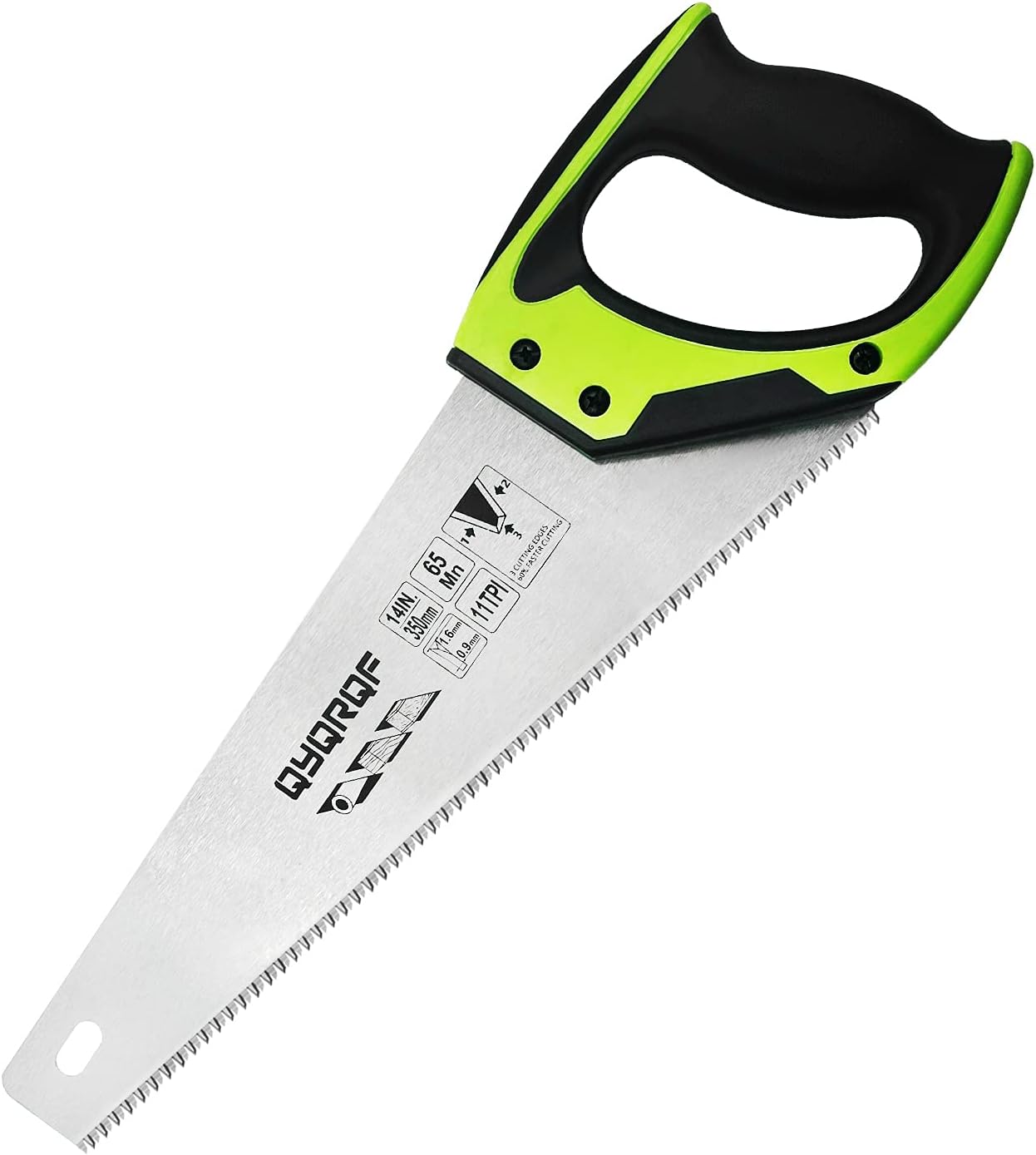
This saw suits you if most of your cuts are everyday DIY jobs on boards, plywood, drywall or plastic pipe and you want one saw that handles all of them. It has a 14-inch blade, 0.9 mm thick, made of 65Mn steel that is heat treated. That mix gives you a blade stiff enough for steady strokes while staying light and easy to carry around the house.
The maker builds the blade with three cutting surfaces and says it cuts on both the push and pull strokes. In practice, every stroke removes material, so you spend less effort cutting a 2×4 to length or trimming a shelf. Deep gullets, the gaps between the teeth, clear chips quickly. That keeps the saw from clogging with sawdust partway through a cut.
The handle is soft, non-slip TPR (a rubbery thermoplastic). It gives you a firmer grip when your hands are sweaty or dusty. The blade has a low-friction coating, and the saw ships with plastic protection on the teeth and a hard paper sleeve around the blade. You can toss it in a toolbox without dulling the teeth or nicking other tools.
Pros
It cuts on push and pull strokes for faster work
The non-slip TPR handle grips well
Buyers say it is easy to handle and simple to use
Buyers find it versatile for many small cutting jobs
Cons
Buyers report the blade is not sharp enough and struggles through thick lumber
Some buyers say it feels flimsy rather than sturdy
The 14-inch blade is short for long rip cuts down wide boards, so you take more strokes per cut
If you mostly cut long boards, the Craftsman CMHT20881 with its 20-inch blade is the better fit.
TOOLAN 8-in-1 Multi Blade Saw: Best for odd jobs around the house

The TOOLAN 8-in-1 is for the homeowner who wants one small saw that handles drywall patches, a stuck bolt, a PVC pipe and a bit of trim. It comes with one handle and 8 blades, and it is made for cutting drywall, metal, wallboard, plywood, plastic and PVC. That makes it a handy drawer or toolbox saw for quick repairs.
The maker lists 8 blades made of high speed steel (HSS) with a hardened blade. A lockback clamp holds the blade, and it takes both large and small blades. Day to day, that means you can fit a narrow blade to start a cut in the middle of a drywall sheet, like a jab saw, then switch to a longer blade for wood. The clamp takes reciprocating blades, which are sold anywhere tools are sold. A broken blade is an easy part to replace from the hardware store.
The saw weighs 8.48 ounces and has a 6-inch blade. That is light and short enough to reach behind a cabinet or into a wall opening. The TPR non-slip handle is shaped to cut down hand fatigue during longer jobs.
Pros
One handle with 8 blades covers drywall, metal, plastic and wood
Small enough to save space in a toolbox
Takes common reciprocating blades as spares
Buyers say the blades are quick and easy to swap
Cons
You swap blades for each type of cut, which slows you down when a job mixes materials
Buyers report that blades do not always stay locked in the handle
Buyers say some blades break soon after they start using them
The 6-inch blade is much shorter than the 14-inch blade on the QYQRQF Pro Hand Saw, so long cuts across boards take more strokes
If you mostly cut lumber and plywood, the QYQRQF 14 in. Pro Hand Saw fits that work better.
Jorgensen 15-Inch Hand Saw: Best for fast rough wood cuts

The Jorgensen 15-inch hand saw is for you if speed matters more than a smooth edge, like cutting 2x4s to rough length, trimming deck boards or pruning branches. It has 8 TPI (teeth per inch) with triple-ground teeth, and the maker claims 50% faster cuts. Fewer, bigger teeth take a larger bite on each stroke, so you get through lumber with less effort.
The blade is SK5 high-carbon steel, which the maker says holds its edge and resists bending during repeated use. In practice, that means fewer wobbly, wandering cuts when you push hard through thick stock. A black Teflon coating reduces friction and material buildup, and it helps protect the blade from moisture and rust. That helps if your saw lives in a damp garage or goes out to the yard for pruning.
A plastic edge protector comes with the saw for transport and storage. You can toss it in a toolbox without dulling the teeth or nicking your hands. The aluminum-framed handle has a TPE and ABS grip with 45° and 90° angle guides built in, so you can mark a quick square or miter line without grabbing a separate square.
Pros
Buyers say it cuts through lumber quickly and smoothly
Buyers report the blade is very sharp out of the box
Teflon coating fights rust and buildup
Edge protector included for safe storage
Cons
The coarse 8 TPI teeth leave a rougher cut than a fine-tooth saw, so plan on sanding if the edge will show
At 0.61 kg, it is heavier than the 14 in. Pro Hand Saw at 343 g, which you may notice over a long day of cutting
If you want a cleaner finish on visible wood, the Craftsman CMHT20881 20-Inch Saw is the better fit.
Craftsman CMHT20138 Hacksaw: Best for cutting metal and plastic
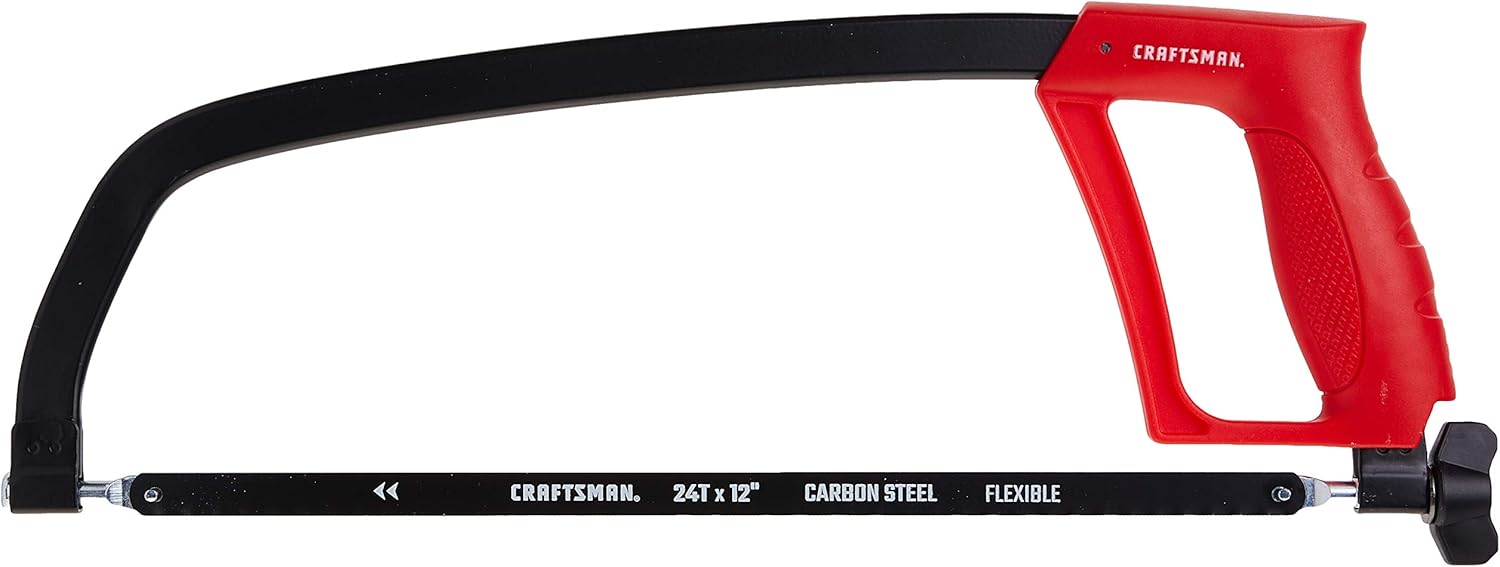
The Craftsman CMHT20138 is the pick when the job is cutting metal or plastic, like trimming a threaded rod, a bolt or a length of plastic pipe. The maker recommends it for metal and plastic surfaces, and it has a 12-inch blade in a solid metal frame.
The frame is designed for blade tension up to 225 lbs. A tight blade flexes and wanders less, so your cut stays straighter through hard material. The 4.375-inch cutting depth means the frame clears stock up to that size, enough for most pipe, conduit and tubing around the house.
The blade sets at 90-degree and 180-degree angles, which lets you make flush cuts. In practice, you can cut a bolt or pipe off close to a wall or surface instead of leaving a stub. A large tension knob and a full-grip handle make it easier to tighten the blade and hold the saw steady.
Pros
Up to 225 lbs of blade tension for straighter cuts
Adjustable blade angle for flush cuts
Lifetime warranty
Buyers say it feels solidly built, has a comfortable handle and is easy to use for small jobs around the house
Cons
Some buyers report the saw breaking during use.
It is made for metal and plastic, so it is no substitute for a wood saw on boards or plywood.
If most of your cutting is lumber, the QYQRQF 14 in. Pro Hand Saw or the Jorgensen 15-Inch Hand Saw fits that work better.
Craftsman CMHT20881 20-Inch Saw: Best for long, clean wood cuts

The Craftsman CMHT20881 suits you if you cut long boards and want a smooth edge without a lot of sanding afterward. It has a 20-inch fine finish blade made for wood, which gives you long strokes through wide stock like shelving boards or plywood panels.
The maker says the saw has an exclusive tooth geometry for a fast, clean cut, and induction-hardened teeth for long-lasting sharpness. For you, that means fewer passes to get through a board and a saw that keeps cutting well across many projects before the teeth dull. The handle is a bi-material, ergonomic design with a built-in square and miter feature at 45 and 90 degrees. You can set the handle against a board’s edge to mark a square crosscut or a 45-degree miter line, so you may not need to grab a separate square for quick layout.
The saw weighs 14.4 ounces and has a high speed steel blade. That is light for a 20-inch saw, which helps on long cuts where your arm tires. It also comes with a full lifetime warranty.
Pros
Long 20-inch blade covers more wood per stroke
Square and miter marks on the handle for quick layout
Buyers say it cuts wood smoothly, leaves a fine finish and stays sharp with continued use
Buyers also say it handles many jobs, including 2×4 lumber, and is good value
Cons
The 20-inch blade is harder to maneuver in tight spaces, such as inside cabinets or between studs
It is made for wood, so it is not the saw for drywall, pipe or metal
If you mostly work in cramped spots or cut several materials, the shorter QYQRQF 14 in. Pro Hand Saw fits better.
How do you pick the right handsaw for your project?
Start with what you cut most often, because a saw built for wood will struggle on metal, and a hacksaw is the wrong tool for framing lumber. Wood, drywall, plastic pipe and metal each call for a different blade, so match the saw to the job before you look at anything else.
Teeth per inch (TPI) is the next thing to check. A higher TPI gives you smoother cuts, while a lower TPI cuts faster but leaves a rougher edge [1]. For example, a fine-tooth saw suits trim and plywood where the cut shows, and a coarse saw suits rough cuts in lumber that will be hidden or sanded.
For most wood cutting, a crosscut saw is the type to reach for. Its teeth are angled in two directions and cut across the grain [2]. That covers the most common DIY job: cutting a board to length.
After that, look at the details that affect comfort and upkeep:
Blade length, since a longer blade covers more wood per stroke and a shorter one fits tight spots better
Blade steel and any coating, since a coating can reduce friction and help protect the blade from moisture and rust
The handle, where a grip with 45-degree and 90-degree angle guides lets you mark square and miter lines without a separate square
Which handsaw should you buy first?
Buy the QYQRQF 14 in. Pro Hand Saw first if your projects mix materials. It is made for precise cuts in wood, plywood, wallboard and plastic pipe. That means one saw can trim a shelf board on Saturday and cut a PVC drain pipe on Sunday without a trip back to the store.
Before you add a second saw, look at what you cut most often. If most of your work is metal, framing lumber or long finish cuts in wide boards, that material decides your next purchase. A saw matched to your main material will do that job faster and cleaner than any all-rounder.