The DEWALT DWS780 is the first pick if you want a 12-inch sliding miter saw that cuts accurately right out of the box. Its XPS LED shadow line casts the blade’s shadow onto your workpiece, so you see exactly where the cut will land. Because the integrated cutline blade positioning needs no adjustment, you skip the calibration fiddling that lasers often require. To go further, see Best Miter Saw: Choose the Right Saw for Your Work.
A sliding saw is the tool to reach for when your boards are too wide for a chop saw, such as shelving or deck stock. A double bevel saw tilts both ways, so you cut a matching angle on the other end without flipping a long board around. Below are five picks, each matched to a kind of shop, plus what to weigh before you buy. If you buy through our links, we may earn a commission at no extra cost to you.
As an Amazon Associate we earn from qualifying purchases.
How we picked: from products sold on Amazon for this need, compared by what their makers state and what buyers report in their reviews.
The Picks at a Glance
Product | Best for | Item dimensions l x w x h | Item weight | Blade length | Buyer rating | |
|---|---|---|---|---|---|---|
DEWALT DWS780 | precise finish cuts | 32.57″L x 23″W x 19.5″H | 24.8 kg | 12 in | 4.8 of 5 (2,545 reviews) | |
SKIL MS6305-00 | smaller workshops | 35.43″L x 22.44″W x 14.17″H | 39.4 lb | 10 in | 4.6 of 5 (2,288 reviews) | |
DOVAMAN 12-Inch Dual-Bevel | budget-minded DIYers | 21″L x 21″W x 34″H | 53.9 lb | 12 in | 4.4 of 5 (246 reviews) | |
DEWALT DWS779 | crown and base molding | 32.5″L x 23″W x 19.78″H | 67.7 lb | 12 in | 4.8 of 5 (9,068 reviews) | |
VEVOR 12-Inch Sliding Miter Saw | tight garage spaces | 33.46″L x 22.4″W x 29.92″H | 46.4 lb | 30.5 centimeters | 4.4 of 5 (173 reviews) |
Buyer ratings as shown on Amazon on November 20, 2026; they change.
DEWALT DWS780: Best for precise finish cuts

If your projects need clean, accurate cuts on trim, shelving or furniture parts, this DEWALT saw suits you. It has a 15 amp, 3,800 rpm motor built for heavy-duty work, and it shows exactly where the blade will cut without any setup on your part.
The XPS LED shadow line projects the blade’s shadow onto your workpiece, so you line up your pencil mark with the shadow itself. The integrated cutline blade positioning gives that cut-line indication with no adjustment. Unlike a laser, there is nothing to calibrate, so the line stays put after you change blades or bump the saw.
The dust collection system captures over 75% of the dust the saw makes. In a garage or basement shop, that means less sawdust on the floor and on your finished parts. The saw comes with a 12-inch carbide blade, a blade wrench, a vertical material clamp and a dust bag. The included blade has 80 teeth. A high tooth count like that leaves smoother edges on trim and plywood.
Pros
Shadow line and cutline positioning need no adjustment
Buyers say cuts are precise and accurate
Buyers find it easy to use even as beginner carpenters, and solid and stable in use
Cons
Some buyers report it does not hold up well over time, which matters if you cut daily for years
At 24.8 kg, it is heavier than the SKIL MS6305-00 at 39.4 pounds, so it is more work to carry to a jobsite
About a quarter of the dust still escapes, so you will still sweep up after big jobs
If you want a lighter saw for a smaller workshop, the SKIL MS6305-00 fits better.
SKIL MS6305-00: Best for smaller workshops
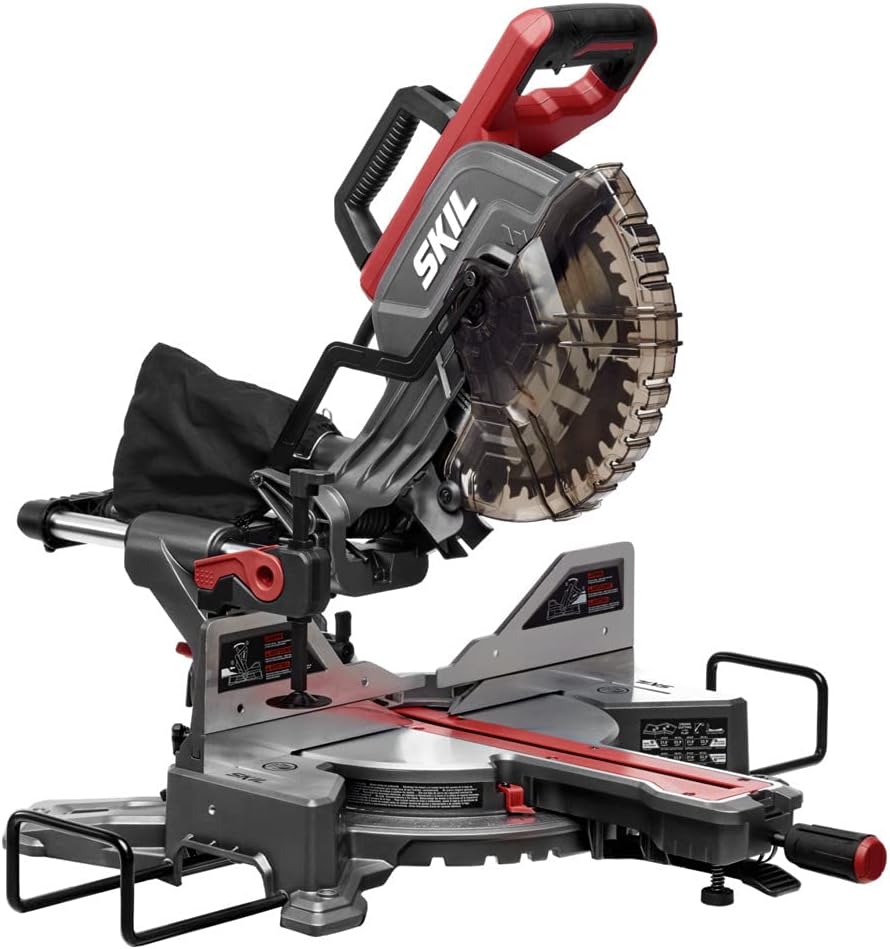
The SKIL MS6305-00 suits you if you work in a smaller shop and mostly cut dimensional lumber and trim rather than extra-wide stock. It is a 10-inch dual bevel slider that still crosscuts a 2×12 at 90 degrees, and at 14.17 inches tall it is the lowest-profile saw in this roundup. That lower height makes it easier to tuck under a shelf or onto a crowded bench.
SKIL lists a 15 amp motor that spins at 4,800 rpm, with an LED shadow line to show where the blade will cut. A shadow line casts the blade’s actual edge onto your mark, so you line up the board without first calibrating a laser. On a 2×8 at 45 degrees, the stated capacity, you get rafter-style or deck-framing angle cuts in one pass.
The bevel has positive stops at 48° and 45° left, 0°, and 45° right, and the miter swings to 50 degrees each way with 11 positive stops. The extra 48° stop helps when crown or corner angles land a little past 45. Because the bevel tilts both ways, you can cut matching left and right angles without flipping a long board end for end.
Pros
Compact 14.17-inch height fits smaller benches
Shadow line cut guide with no laser to adjust
Buyers say it makes accurate cuts even in hardwood and is easy to set up
Buyers find it good value with a solid build
Cons
Some buyers find the bevel and angle adjustments tricky to use
Some buyers report saws breaking down after a couple of months
The 10-inch blade gives less capacity than the 12-inch picks, so wide stock beyond 2×12 is out of reach
If you need wider crosscuts or the most precise finish work, the 12-inch DEWALT DWS780 is the better fit.
DOVAMAN 12-Inch Dual-Bevel: Best for budget-minded DIYers

The DOVAMAN 12-inch is the pick for budget-minded DIYers who want a dual-bevel slider with a 12-inch blade and preset angles for common cuts. The maker lists a 15-amp copper motor at up to 3800 rpm, 45° bevels both ways on sliding rails, and a laser guide. That covers framing trim, shelving and deck boards without paying for features a weekend user may not need.
The saw bevels 45° to the left and to the right, and the head slides on rails. With a double bevel you tilt the blade either way and leave the board where it sits, which helps on long trim pieces that are awkward to flip end for end. Its maximum cut is 4.2 in. x 13 in.. A 13-inch crosscut takes a 2×12 shelf board in one pass.
The base has nine angle presets at 0°, 15°, 22.5°, 30° and 45° on both sides. Presets let the table drop into a set angle, so a 45° picture-frame corner or a 22.5° octagon cut is quick to repeat. The switch has a safety lock and works from either hand, and the box includes a pre-installed 40T blade, a dust bag, a clamp and two spare carbon brushes. You can start cutting soon after unboxing, and spare brushes extend motor life when the originals wear.
The saw weighs 53.9 pounds and measures 21″L x 21″W x 34″H. That is heavy to carry to a job site, but the 21-inch depth is short for a 12-inch slider.
Pros
Bevels 45° both ways on sliding rails
13-inch crosscut handles wide boards
Nine angle presets for repeat cuts
Spare brushes, clamp and blade included
Cons
Uses a laser line rather than a shadow line, so the mark depends on laser alignment instead of the blade’s own shadow
Its 53.9-pound weight is a lot to lift onto a stand or move around a garage
If precise finish cuts are your priority, the DEWALT DWS780 is the better fit.
DEWALT DWS779: Best for crown and base molding

The DWS779 is the pick if you cut a lot of crown and base molding, because its tall sliding fences hold the trim upright instead of forcing awkward workarounds. The fences support crown molding up to 7-1/2 in. nested and base molding up to 6-3/4 in. vertically, then slide out of the way for bevel cuts. For a trim job in a living room or hallway, that covers most common profiles without a jig.
The saw also cuts dimensional lumber, up to 2×14 at 90° and 2×10 at 45°. That means a deck stair tread or a wide shelf board goes through in one pass, and you can still miter a 2×10 for a frame corner. The 15 amp, 3,800 rpm motor gives you steady power through thicker hardwood trim.
Dust is easier to manage than with a bare saw. The collection system captures over 75% of the dust it generates, and a dust bag comes in the box. That leaves less to sweep after a run of cuts, though you will still want a vacuum nearby for the rest.
An adjustable stainless-steel miter detent plate has 10 positive stops. Positive stops are notches the saw clicks into at common angles, so you can repeat a 45° cut on every piece of a room’s trim without fiddling with the scale.
Pros
Tall fences for upright crown and base molding
Crosscuts up to 2×14 at 90°
Dust bag included
Buyers say it makes accurate, clean cuts, even through thicker trim
Cons
Buyers find it very heavy and bulky to move, which matters if you carry it between job sites or store it on a shelf
At 67.7 pounds, it weighs more than the VEVOR (46.4 pounds) or the SKIL (39.4 pounds)
If you mostly cut framing and want a lighter saw to move around, look at the SKIL MS6305-00 instead.
VEVOR 12-Inch Sliding Miter Saw: Best for tight garage spaces

The VEVOR 12-inch slider is the pick for a cramped garage because its axial sliding system lets you push the saw against a wall, saving workspace. You still get the forward-and-back slide for wider crosscuts, so a small shop doesn’t mean giving up board width.
A rail-style slider needs open space behind it for the rails to travel. With the axial design, the saw head glides forward and back on its arm, so you can park it against the garage wall and keep the floor in front clear for your car or a workbench. That same slide is what lets you crosscut boards wider than a fixed-head saw could handle in one pass.
An LED guide projects the cut line onto your stock, and the angle scale has a locking system to hold your setting. In practice, that means you line up your pencil mark with the projected line instead of making a test cut, and a locked angle stays put when you cut a stack of matching pieces. The bevel goes from 0° to 45° both left and right, so you can tilt the head either way without flipping long boards around in a tight space. At 46.4 pounds with an aluminum base, it’s also light enough to move off the bench when you need the room back.
Pros
It sits against a wall thanks to the axial slide
The LED cut-line guide and locking angle scale cut down on guesswork
Buyers say it’s easy to set up and makes precise, square 90° cuts
Buyers report it holds up well over months of use
Cons
Buyers complain that the lock for the sliding mechanism gives trouble, which matters if you lock the slide often for chop cuts
Buyers find the bevel adjustment knob hard to work, so frequent bevel changes take more effort
If you cut a lot of crown or base molding, the DEWALT DWS779 fits that job better.
What to look for in a 12-inch sliding miter saw
Start with crosscut capacity: pick a saw that handles the widest board you cut regularly. If you mostly cut deck boards and 2x10s, a saw rated for 2×12 at 90° is enough, and that rating is common even on a 10-inch slider. If you build stair stringers or cut wide shelving, look for a 2×14 rating at 90°, which some 12-inch sliders reach.
Double bevel means the head tilts both left and right, so you cut a mirrored angle without flipping a long board end for end. Positive stops are notches that click the saw into common angles. One saw, for example, stops at 0°, 15°, 22.5°, 30° and 45° on each side. That 22.5° stop matters when you join two pieces into a 45° corner.
A cut-line guide shows where the blade will land. An LED shadow line casts the blade’s own shadow on the wood, so it needs no calibration, and one maker states it is more accurate than a laser. A laser is a separate beam that you may need to realign over time.
Footprint decides where the saw fits. Rail sliders push the rails out behind the saw, while an axial slide lets the saw sit against a wall. Look for a dust bag or port too, since the cuts throw a lot of sawdust.
If you cut crown or base molding, check fence height. Tall fences let you stand molding upright against them, and one model holds base up to 6-3/4 in. vertically. That covers most standard baseboard without special jigs.
Common questions about sliding miter saws
Is a 10-inch slider enough instead of a 12-inch?
A 10-inch slider is enough if your widest boards are 2x12s. The SKIL MS6305-00 crosscuts 2×12 lumber at 90 degrees, so it covers most shelving, stair treads and framing cuts. If you build with 2x14s or cut thick trim often, a 12-inch saw gives you more room. The DEWALT DWS779 crosscuts 2×14 lumber at 90°. For more detail, see Makita 10 Inch Cordless Miter Saw: Is It Enough or Do You Need 12?
Shadow line or laser: which is easier to use?
A shadow line is usually easier because it shows exactly where the blade will cut. SKIL says its LED shadow line gives more accurate cuts than lasers, and buyers repeat that the shadow line guide works reliably. A shadow line is cast by the blade itself, so you line up your pencil mark with the shadow and don’t have to calibrate a separate beam. A laser still helps when you are learning to place your mark, but the shadow line is the simpler choice for repeat finish work.
Does a sliding saw need space behind it?
A saw with rear slide rails needs clearance behind it for the rails to travel. The DWS779 uses dual horizontal steel rails, and DEWALT designed it to stay compact. If your bench sits flush against a garage wall, an axial slide design such as the VEVOR’s is the better fit, since it moves forward and back without rails sticking out behind it.
Which saw to pick first
The DEWALT DWS780 is the first pick if you want accurate everyday cuts without fiddling with setup. Its integrated cutline blade positioning system shows where the blade will land with no adjustment needed, so you line up a mark and cut instead of calibrating a laser first.
Before you buy any saw on this list, measure the widest board and the tallest molding you plan to cut. A deck builder ripping through 2×12 joists needs different capacity than someone trimming out a room with tall base molding. Match the saw to those two numbers, and the right model from the picks above becomes obvious.