The SKIL TS6307-00 is the first pick if you want your first table saw to be a full 10-inch model that folds away when you’re done. Its legs fold in for storage, so it fits a garage or shed corner between projects. Learn more in SKILSAW 8 1/4 Inch Worm Drive Table Saw: Is It a Good Starter Saw?
For a beginner, the best starter table saw is one that makes straight, predictable cuts easy. The SKIL’s rack and pinion fence rails keep the fence parallel to the blade, which means fewer wandering rips and less fiddling before each cut. It also cuts material up to a 4×4 at 90 degrees, so it handles posts as well as boards.
The four other picks cover compact storage, wide plywood rips and lower-cost benchtop saws, followed by the features to weigh before you buy.
As an Amazon Associate we earn from qualifying purchases.
How we picked: from products sold on Amazon for this need, compared by what their makers state and what buyers report in their reviews.
The Picks at a Glance
Product | Best for | Item weight | Handle material | Speed | Buyer rating | |
|---|---|---|---|---|---|---|
SKIL TS6307-00 | first-time woodworkers | 51.2 lb | Plastic or Wood | 15 rpm | 4.5 of 5 (3,077 reviews) | |
DEWALT DWE7485 | small shops | 54 lb | Metal | 5800 rpm | 4.8 of 5 (5,828 reviews) | |
DEWALT DWE7491RS | wide sheet goods | 110 lb | Plastic | 4800 rpm | 4.7 of 5 (5,814 reviews) | |
MarvTool 10-Inch Portable Saw | carrying around | — | Aluminum or Plastic | 4600 rpm | 4.4 of 5 (99 reviews) | |
Prostormer 10-Inch with Stand | a basic home shop | — | Plastic | 5000 rpm | 4.3 of 5 (67 reviews) |
Buyer ratings as shown on Amazon on November 20, 2026; they change.
SKIL TS6307-00: Best for first-time woodworkers

The SKIL TS6307-00 is the first pick for first-time woodworkers because it pairs a full 10-inch blade with a fence that stays parallel to the blade and a stand that folds away when you’re done. The maker lists a 15 amp motor, a 2-47° bevel range and a cut capacity up to a 4×4 at 90 degrees. That covers most beginner projects, from shelf boards to fence posts.
The rack and pinion fence rails keep the fence parallel to the blade. In daily use, that means you slide the fence to 12 inches and it sits square at both ends without fiddling, so your rips come out the same width front to back. The blade also has a micro-adjustment so you can set it parallel to the rip fence and miter slot. If a cut starts to drift or burn, you can correct the blade instead of living with it.
The legs fold in for portability and storage. You can roll the saw against a garage wall when you need the car space back. Bevel cuts run with positive stops at 0 and 45 degrees and a quick release lever, so the two angles you’ll use most snap into place. A dust port elbow sends dust toward a container, which keeps more sawdust off the floor than an open port would. The box includes a blade guard, riving knife, anti-kickback pawl, push stick, miter gauge, rip fence and a 24T blade, so you can start cutting without extra purchases.
Pros
Rack and pinion fence for straight, repeatable rips
Folding stand that tucks away in a small garage
Cuts through a 4×4 in one pass
Safety gear and miter gauge come in the box
Cons
At 51.2 pounds, it’s a real lift for one person if you load it into a car often.
Only 0 and 45 degrees have stops, so angles like 22.5 degrees take careful setup by hand.
If you’ll mostly carry your saw from job to job, the MarvTool 10-Inch Portable Saw fits better, and for wide plywood rips, look at the DEWALT DWE7491RS.
DEWALT DWE7485: Best for small shops

The DEWALT DWE7485 suits you if your shop is a corner of the garage or a spare room and the saw has to be put away after each project. Its 8-1/4 in. blade keeps the saw compact for easy transportation and storage, and it still offers 24.5 in. of rip capacity for ripping 4×8 plywood or OSB sheets.
That rip capacity is the key number for a small-shop saw. It means you can split a full sheet of plywood down the middle for cabinet sides or shelves without a second saw. The rack & pinion telescoping fence rails make fence adjustments fast, smooth, and accurate, so the fence slides out to that width and stays square to the blade.
The maker lists several features that make daily use easier. The Site-Pro Modular Guarding System lets you adjust the guarding without tools, so you are less tempted to leave the guard off because it is a hassle. Power-loss reset prevents accidental restarts after a power disruption when the switch was left on, which matters if you share a circuit that trips. On-board storage holds the guard, fence, wrenches and miter gauge, so the parts stay with the saw when it goes on a shelf. A metal roll cage base protects the saw when it gets bumped or carried around.
The saw weighs 54 pounds, a bit more than the SKIL TS6307-00’s 51.2 pounds, so carrying it is a lift rather than a quick grab.
Pros
Compact footprint that stores easily
Rips full 4×8 sheets down the middle
Tool-free guard adjustments and power-loss reset
Accessories store on the saw
Cons
The 8-1/4 in. blade cuts shallower than the 10-inch picks, so thick stock may need two passes
At 54 pounds it is heavier than the SKIL TS6307-00, which matters if you move it often
No stand is included, so you need a sturdy bench or a separate stand
If you want deeper cuts or a stand that folds with the saw, the SKIL TS6307-00 fits better.
DEWALT DWE7491RS: Best for wide sheet goods
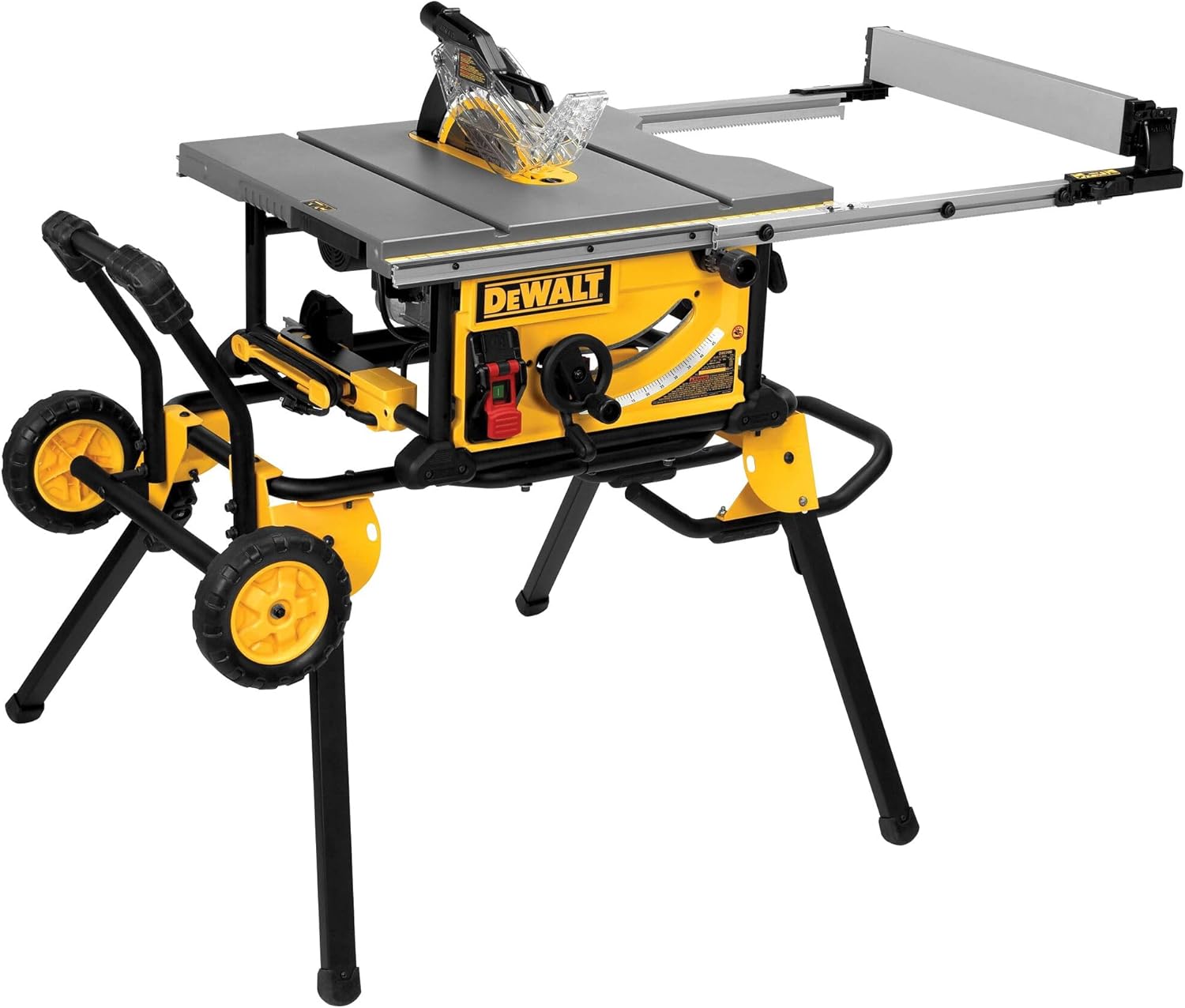
The DEWALT DWE7491RS is the pick for you if your projects involve wide shelving, cabinet sides or long trim boards. It has a 10-inch blade, a 15 amp motor and a 32-1/2″ rip capacity, so you can cut wide panels without flipping them or switching tools.
That 32-1/2″ rip capacity means you can set the fence far from the blade and rip a wide shelf blank in one pass. The rack and pinion telescoping fence moves smoothly and stays accurate as you adjust it, so a measurement you set on one side holds on the other. A patented material support and a flip-over ripping fence handle narrow rips, which keeps your hands farther from the blade when you cut thin strips for trim or edging.
The rolling stand sets up and breaks down easily, and the telescoping fence rails retract into a smaller package. You can roll the saw out of a garage corner and fold it away when you’re done. Onboard storage holds the blade guard assembly, fence, riving knife, miter gauge, wrenches, push stick and cord wrap. You won’t lose the guard or push stick between projects. A 2-1/2″ dust port connects to a shop vacuum. The saw cuts 3-1/8″ deep at 90 degrees and 2-1/4″ at 45. At 90 degrees it goes through a 2×4 laid flat with room to spare.
Pros
32-1/2″ rip capacity for wide panels
Folding rolling stand
Storage for the guard, riving knife and push stick
3 year limited warranty
Cons
At 110 pounds, it is about twice as heavy as the SKIL TS6307-00 (51.2 pounds), so lifting it into a truck or up stairs is a two-person job.
The included blade has 24 teeth, which suits fast rips more than smooth finish cuts.
If you mostly cut boards and smaller panels in a tight space, the lighter DEWALT DWE7485 is the better fit.
MarvTool 10-Inch Portable Saw: Best for carrying around

The MarvTool 10-inch saw is the pick for you if your saw has to travel between the garage, the driveway and a friend’s project. It weighs 28.3 pounds, light enough to lift into a car trunk or carry to a job site in one trip. The SKIL pick lists 51.2 pounds, so the MarvTool asks much less of your back on every move.
The maker lists a 15 amp motor with a 36-tooth blade running at about 4600 RPM. A 36-tooth blade sits in the middle of the range. It rips boards at a reasonable pace and still leaves a cleaner edge than a coarse ripping blade, which makes it a sensible single blade for a first saw. The saw runs on a standard 120-volt outlet, so a regular household circuit will power it.
The saw cuts hardwoods, plywood, OSB, thin aluminum sheets and PVC pipe. With that range you can build a shelf from plywood and then trim PVC pipe for a garden project without switching saws. The blade cuts boards up to 3.4 inches thick at 90 degrees and up to 2.1 inches at 45 degrees. That covers 2x lumber with room to spare at 90 degrees. Thicker stock at a bevel would need a second pass or a different tool.
Pros
At 28.3 pounds it is easy to carry and store
It handles wood, thin aluminum and PVC
It has a clear blade guard and a dust port that connects to a vacuum
Buyers say it is simple to operate and good value for the money
Cons
It is a benchtop saw with no stand, so you need a sturdy bench or table that stays put while you cut
Bevel cuts top out at 2.1 inches of thickness, which limits angled cuts on thick stock
If you want a saw that folds onto its own stand and never needs a separate bench, the SKIL TS6307-00 fits better.
Prostormer 10-Inch with Stand: Best for a basic home shop

The Prostormer 10-inch saw is for a beginner setting up a basic home shop who wants a full-size blade on its own stand at a budget level. It runs a 15 A motor on a 10-inch blade and comes with a stand, so you can set it up in a garage corner without hunting for a sturdy bench.
The maker lists a no-load speed of 5000 RPM, which it says lets the saw cut most wood with ease. In practice, a fast blade gives you smoother cuts in common lumber like pine 2x4s and plywood for shelves. A rear port lets you hook up a dust collector, but the collector is sold separately. Without one, plan on sweeping sawdust after each project, or budget for a shop vac or collector later.
The saw has a clear blade guard that lets you see the blade while it protects against accidental contact, and it comes with a push stick. Storage on the left and right sides holds the wrenches and push stick, so they stay with the saw instead of getting lost on a cluttered bench. The stand sits on four metal brackets meant to keep the saw from moving while you cut. It crosscuts at 90 degrees and bevels from 0 to 45 degrees, enough for basic trim and box joints.
Pros
Buyers say it cuts as they expect and is good value at a budget level
Comes with its own stand
Onboard storage for the push stick and wrenches
Clear blade guard keeps the cut line visible
Cons
Some buyers report problems with how some features and functions work
No dust collector included, so cleanup takes more work until you add one
If you want a full 10-inch saw with a folding stand that tucks away and a fence that stays parallel to the blade, look at the SKIL TS6307-00 instead.
What to look for in your first table saw
Start with safety gear, because it is what keeps your hands clear while you learn. Look for a saw that ships with a blade guard, a riving knife and a push stick: the SKIL TS6307-00 includes all three, plus an anti-kickback pawl. The riving knife sits behind the blade and keeps the cut from pinching shut, and the push stick lets you feed the last few inches of a board without your fingers near the blade.
A power-loss reset is worth having too. On the DEWALT DWE7485, it stops the saw from restarting on its own after a power outage if the switch was left on. That matters when a breaker trips mid-cut and you reach in to clear the board.
Next, look at the fence, the guide your board slides along. Rack and pinion fence rails move both ends together, so the fence stays parallel to the blade. A fence that drifts out of parallel gives tapered rips and can bind the wood.
Match rip capacity and blade size to your projects. Rip capacity is how far the fence sits from the blade, which sets the widest board you can cut. A 32-1/2 in. capacity handles larger shelving and trim materials. A 10-inch blade cuts 3-1/8 in. deep at 90 degrees, enough for most 2x lumber.
Finally, think about space. A heavier saw on a folding rolling stand is easier to move than to lift, while a lighter benchtop saw needs a sturdy bench. For dust, a 2-1/2 in. port connects to a shop vacuum.
Picking your saw
The SKIL TS6307-00 is the first pick for most beginners: you get a full 10-inch blade and a fence that stays parallel to it, so your first rips come out straight without fiddling. Its legs fold in when you’re done, which matters if the saw shares a garage with your car.
Before you buy, measure the widest board or panel you plan to rip. If you’ll mostly cut 1×6 shelving or 2x4s, nearly any of these saws will do. If you plan to break down 4×8 sheets of plywood for cabinets, that one measurement decides which saw fits your projects.