The SKIL SR211601 is the first pick for your everyday DIY sanding. It pairs a 2.8 amp motor with 13,000 OPM, so it has enough speed to smooth boards, cabinet doors and furniture without stalling on medium jobs. Variable speed lets you slow it down for softer materials, and the transparent cyclonic dust box shows you when it needs emptying.
If you work away from outlets, want finer dust capture or prefer a corded DeWalt, the other four picks cover those needs. A palm sander is the tool for detail work and lighter sanding tasks, while a larger random orbital sander suits heavier stock removal [1]. Below you’ll find each pick’s strengths and drawbacks, plus what to look for before you buy.
As an Amazon Associate we earn from qualifying purchases.
How we picked: from products sold on Amazon for this need, compared by what their makers state and what buyers report in their reviews.
The Picks at a Glance
Product | Best for | Amperage capacity | Item dimensions l x w x h | Item weight | Buyer rating | |
|---|---|---|---|---|---|---|
SKIL SR211601 | everyday DIY sanding | 2.8 A | 7.87″L x 4.8″W x 5.51″H | 3.4 lb | 4.5 of 5 (7,793 reviews) | |
DeWalt DCW210B | cordless work away from outlets | 1 A | 8.81″L x 6.38″W x 5.75″H | 2.5 lb | 4.7 of 5 (14,068 reviews) | |
Bosch ROS20VSC | swirl-free finishes | 2.5 A | 9″L x 5″W x 6″H | 3.5 lb | 4.6 of 5 (5,018 reviews) | |
DeWalt DWE6421 | steady single-speed sanding | 3 A | 10.31″L x 5.69″W x 6″H | 3.4 lb | 4.8 of 5 (3,184 reviews) | |
DeWalt DWE6423 | shop vacuum dust control | 3 A | 10.25″L x 5.44″W x 6.38″H | 3.4 lb | 4.6 of 5 (3,702 reviews) |
Buyer ratings as shown on Amazon on November 20, 2026; they change.
SKIL SR211601: Best for everyday DIY sanding

The SKIL SR211601 is the first pick for everyday DIY sanding, from smoothing a tabletop to prepping trim for paint. It runs on a 2.8 amp motor at 13,000 orbits per minute, with variable speed so you can slow it down for softer materials. A transparent cyclonic dust box and a low-vibration grip make it easy to live with on longer weekend projects.
The maker lists an X-flow dust collector that uses cyclone force to spin dust into an easy-to-empty transparent container. Because you can see through it, you know when it is full before suction drops off, and emptying it means popping it off and tapping it into a trash can. The sander has a soft rubber grip and counterweight balance to reduce hand fatigue from vibration. That matters when you are sanding a whole dresser or a stack of cabinet doors and your hand would otherwise go numb.
Its compact size lets it reach into tight spaces, such as the inside corners of a bookshelf. The dust-sealed on/off switch keeps grit out of the switch, so it keeps flipping cleanly after dusty jobs. It is corded at 120 volts, weighs 3.4 pounds and comes with the dust box and three sanding sheets, so you can start on the first day.
Pros
Variable speed for wood, paint and other materials
See-through dust box that is easy to empty
Buyers say it works well, especially on drywall, and is good value for the money
Buyers find it well made with plenty of power
Cons
Buyers report the dust box does not catch all the sanding dust, so plan on a mask and some cleanup.
Some buyers report units breaking down after about a month of use.
Its 2.8 amp motor is lower than the 3 A of the DeWalt DWE6421 and DWE6423, which matters if you sand hard, heavy stock for long stretches.
If you want more motor and a direct shop-vacuum connection, look at the DeWalt DWE6423 instead.
DeWalt DCW210B: Best for cordless work away from outlets

The DeWalt DCW210B is the pick for sanding where there is no outlet nearby, like a deck railing, a fence or furniture you are refinishing out in the yard. It runs on a 20V lithium-ion battery and weighs 2.5 pounds, so you can carry it anywhere without dragging a cord along. That makes it a natural fit if you already own DeWalt 20V MAX tools.
The maker lists a brushless motor for runtime and efficiency, with variable speed from 8,000 to 12,000 OPM. In practice, you can drop to the low end for thin veneer or between coats of finish, then turn it up to strip old paint faster. The low-profile height keeps your hand close to the work surface for more precise sanding. You feel the surface better, and the sander is less likely to tip at the edge of a board.
Paper changes are quick on the replaceable 8-hole hook-and-loop pad (DWE64233). You press a new disc on and peel it off when it wears out, with no clamps involved. The dust-sealed switch protects against dust getting inside, which helps the switch last longer. That matters on a tool whose whole job is making dust.
Pros
No cord, and at 2.5 pounds it is the lightest of the five picks
Buyers say the cordless design keeps a cord from getting in the way while sanding
Buyers find the adjustable speed control works well across a useful range
Cons
This is the bare tool, so you need a 20V MAX battery and charger if you don’t already own them
Buyers report it drains a battery quickly, sometimes in about fifteen minutes, so long jobs call for a spare battery
Buyers say the dust bag does not capture sanding dust very well
If you sand mostly indoors near an outlet and want strong dust pickup, the DeWalt DWE6423 with its vacuum-ready dust port suits you better.
Bosch ROS20VSC: Best for swirl-free finishes

The Bosch ROS20VSC is the pick if a smooth, mark-free surface matters more to you than raw power. Its pad dampening system is designed to eliminate swirl marks on both flat and contoured surfaces, so it suits furniture refinishing, cabinet doors and curved trim that will take a clear finish.
Swirl marks are the small looping scratches that show up under stain or varnish. A damped pad helps keep them out of a tabletop or the rounded edge of a chair rail, which saves you a round of resanding before you finish. Discs attach with a hook-and-loop system that works like Velcro, so swapping from 80 to 120 grit takes seconds.
The 2.5 amp motor runs at 7,500 to 12,000 OPM with variable speed control. The low end lets you ease into softwoods or veneer without gouging, and the top end is there for faster stock removal on hardwood. Dust goes through a micro filter that traps particles as small as 1/2 micron, into a canister that shows the dust level and detaches for emptying. You can see when it is full before suction drops, and fine dust stays out of the air in a garage shop. The kit includes a vacuum adapter if you prefer to hook up a shop vac.
Pros
Pad dampening for swirl-free sanding on flat and curved work
Fine-dust micro filter with a see-the-level canister
Buyers say it runs remarkably quietly
Buyers say the variable speed is easy to fine-tune for different tasks
Cons
Some buyers report units breaking down early, even after the first use
Its 2.5 A motor is smaller than the 3 A DeWalt corded picks, so heavy stock removal goes slower
If you mostly strip old paint or flatten rough boards, the 3-amp DeWalt DWE6421 gives you more motor for that work.
DeWalt DWE6421: Best for steady single-speed sanding
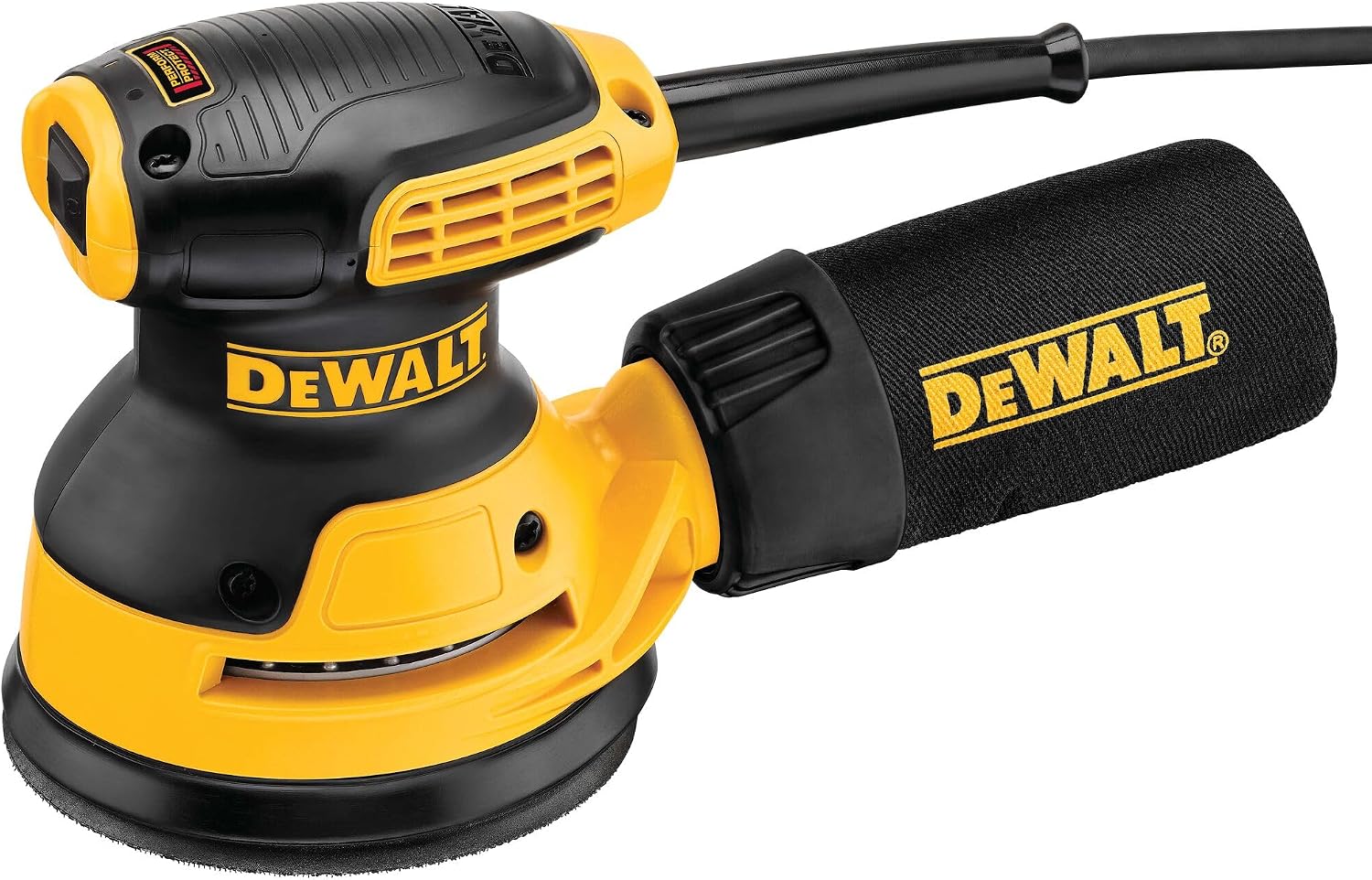
The DeWalt DWE6421 is the pick if you want one steady speed and plenty of power for general sanding. It has a 3.0-amp motor that spins the pad at 12,000 OPM, and it runs on 120 volts from a standard outlet. That combination suits jobs like knocking down rough boards, smoothing deck rails or prepping cabinet doors for paint.
On the motor’s power, the 3 A rating is higher than the SKIL pick’s 2.8 A. For you, that means a sander that is less likely to bog down when you lean into a stubborn patch of old finish. Because it is corded, you never stop to swap or charge a battery, though your range depends on your cord.
On comfort, the maker lists a shorter height that brings your hand closer to the workpiece, and a separate counterweight that reduces vibration. Sitting lower gives you better control on edges and narrow stock, and less buzz means your hand tires more slowly on a long session. Rubber over-mold covers the critical grip areas. An improved dust-sealed switch keeps dust out of the switch for longer switch life, which matters because a clogged switch is a common failure point on sanders that see heavy use.
Pros
Lower height and a counterweight for control and less vibration
Buyers say it is comfortable to hold and does not tire their hands during long use
Buyers report it holds up through lots of sanding and handles many different jobs
Cons
Some buyers say dust escapes while sanding and the dust bag does not attach properly
It has a single speed, so you cannot slow it down for delicate veneers or thin finishes
It is 10.31 inches long, longer than the SKIL at 7.87 inches, which matters in tight spots
If you need to slow down for delicate work, look at the variable-speed DeWalt DWE6423 instead.
DeWalt DWE6423: Best for shop vacuum dust control

The DeWalt DWE6423 suits you if you already run a shop vacuum or DeWalt dust extractor and want the sander to plug straight into it. Its dust port fits the DWV010 or DWV012 dust collectors directly, and a 3-amp motor drives the pad at 8,000 to 12,000 OPM. That makes it a good match for a garage shop where you sand at the bench and want less dust on everything else.
The maker lists a few details that matter on a long sanding day. The variable speed range lets you slow down for thin veneer or soft pine and speed up to flatten a rough tabletop. If your vacuum hose is not a DeWalt, the DWV9000 Universal Quick Connector attaches the port to other systems with 1-1/4 in. hoses, so you can still use the shop vac you own.
When you sand without a vacuum, the one-handed locking dust bag clicks on and off while you keep your other hand on the workpiece. A separate counterweight reduces vibration, and a rubber overmold improves grip, which helps your hand stay steady through a full set of cabinet doors. The shorter height puts your palm closer to the work for better control.
Pros
Direct fit to DWV010 and DWV012 dust collectors
Variable speed for different woods and grits
Buyers say dust collection works well and keeps the work area clean
Buyers report quick, simple sanding sheet changes
Cons
It is corded, so your reach depends on the cord and the nearest outlet
Some buyers report units that stopped working within two years
No carrying bag comes with it, which matters if you haul tools to job sites
If you sand far from outlets, the cordless DeWalt DCW210B fits better.
What to look for in a palm sander
Start with the power source, because it decides where you can work. A corded sander runs as long as you need on a 120-volt outlet, while a cordless one goes anywhere but runs only as long as its battery. If you already own batteries for a platform such as DeWalt 20V MAX, a tool-only cordless sander saves you buying a new pack. Buyers of that model repeat that it can drain a battery in about fifteen minutes, so plan on a spare for bigger jobs.
Next, look at speed. OPM (orbits per minute) is how fast the pad moves, and a variable-speed dial lets you slow down for thin veneer or soft paint. A range like 8,000 to 12,000 OPM gives you room to match the speed to the job. A fixed-speed model such as one that runs at 12,000 OPM is simpler but has no slow setting.
Dust collection varies more than most buyers expect:
A cyclonic box with a clear container shows you when to empty it.
A micro filter traps particles as small as 1/2 micron, which helps when fine dust bothers you.
A vacuum port connects to a shop vac for the cleanest air.
Buyers of several models say the built-in box or bag misses some dust, so a port is worth having if you sand indoors.
For long sessions, look for a counterweight and rubber grip to cut vibration. A hook-and-loop pad lets you swap paper in seconds, like pressing on Velcro.
Palm sander questions
What’s the difference between a palm sander and a random orbital sander?
A random orbital sander is the better all-rounder for flat panels and furniture, and a palm sander is the better fit for small, fiddly areas. Random orbital sanders are favored for their versatility and smooth finish, while palm sanders excel at detail work and lighter sanding tasks. [1] In practice, you might use the random orbital model to flatten a tabletop, then switch to the palm sander for the edges of a drawer front or the inside of a cabinet face frame.
What does OPM mean on a sander?
OPM stands for orbits per minute: how many times the pad circles in one minute. Higher OPM removes wood faster, which helps on rough boards or old finish. For example, the DeWalt DWE6421 runs at a single 12,000 OPM. That suits steady work on one material where you never need to change pace.
When should I slow the sander down?
Lower the speed when you need control more than stock removal. Variable speed lets you match the sander to the work, such as delicate materials, thin veneer or a final pass before finishing. The Bosch ROS20VSC adjusts from 7,500 to 12,000 OPM, so you can drop to the low end for that last light pass and go faster on rough stock. The DeWalt DWE6423 covers 8,000 to 12,000 OPM for the same reason.
Picking your sander
The SKIL SR211601 is the first pick for most DIYers: its variable speed lets you ease off for thin veneer and push harder on rough pine, and the transparent dust box shows you when it’s time to empty it before dust starts escaping. It is also compact enough to reach into tight spots on furniture and trim.
Your next step is to decide corded or cordless before you compare anything else. If you already own 20V MAX batteries, the DeWalt DCW210B lets you sand on a deck or in a yard with no cord to drag, though it ships as the tool only. If you work near an outlet, a corded sander like the SKIL runs as long as you need on 120 volts.