For most plastic repairs, the best plastic glue is a clear super glue made for plastic, and SWIFFAR Plastic Glue is the first pick for models and 3D prints. Its formula is designed specifically for plastic, and the maker lists models, miniatures, acrylic and PLA among its uses. That covers the jobs most hobbyists and homeowners run into, from a snapped figurine arm to a cracked printed bracket. To go further, see Best Way to Glue Plastic to Wood: 4 Adhesives That Hold.
The exception is slick plastics such as polyethylene (PE) and polypropylene (PP), the waxy kind used in many tubs and containers. Ordinary super glue struggles on them, and a kit with an activator that primes the surface is the better choice.
All five picks below are clear cyanoacrylate super glues, so they dry fast and leave a neat joint. You’ll see what each one suits best and how to match a glue to your part.
As an Amazon Associate we earn from qualifying purchases.
How we picked: from products sold on Amazon for this need, compared by what their makers state and what buyers report in their reviews.
The Picks at a Glance
Product | Best for | Compatible material | Container type | Material type | Buyer rating | |
|---|---|---|---|---|---|---|
SWIFFAR Plastic Glue | models and 3D prints | Plastic | Bottle | Ethyl Cyanoacrylate | 4.5 of 5 (475 reviews) | |
ARKA Super Glue 1.75 oz | big repair jobs | Aluminum, Glass, Plastic | Tube | Cyanoacrylate | 4.6 of 5 (25,439 reviews) | |
Gorilla Super Glue Brush and Nozzle | precise household fixes | Ceramic, Metal, Paper, Plastic, Rubber | Tube | Cyanoacrylate | 4.5 of 5 (27,445 reviews) | |
Loctite Plastics Bonding System | hard-to-bond plastics | — | Kit | Ethyl cyanoacrylate | 4.2 of 5 (4,399 reviews) | |
Gorilla Super Glue 3 g Tubes | small one-off repairs | Fabric, Metal, Paper, Plastic, Rubber | Tube | Cyanoacrylate | 4.7 of 5 (9,662 reviews) |
Buyer ratings as shown on Amazon on November 18, 2026; they change.
SWIFFAR Plastic Glue: Best for models and 3D prints
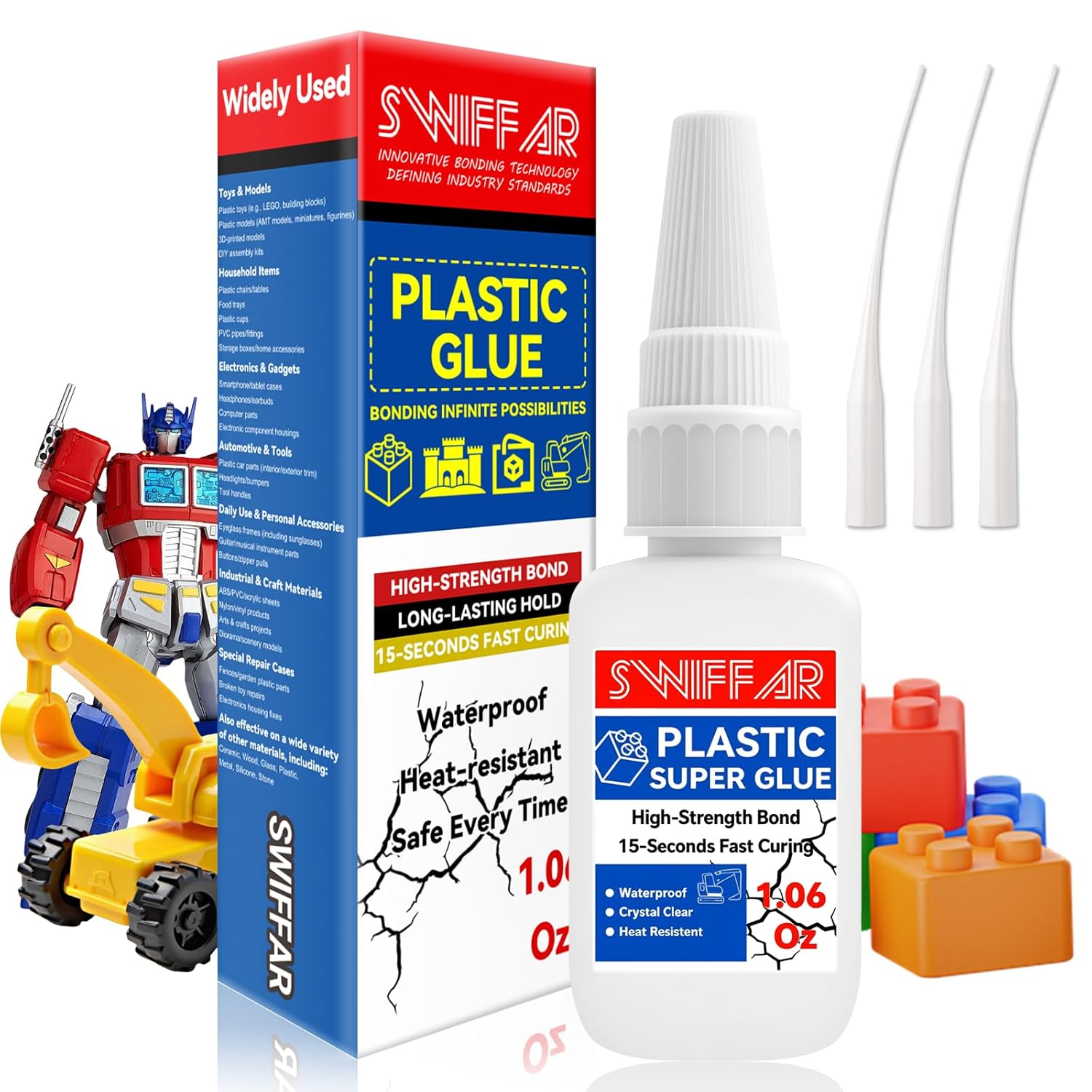
SWIFFAR Plastic Glue is the pick for model builders and 3D printing hobbyists who want a glue made for plastic first. The maker says it is specially designed for plastic and dries to a crystal-clear bond, and it names models, miniatures, acrylic, PLA, metal and car parts among its uses.
The clear finish matters most on visible joints. A reglued arm on a painted miniature or a seam on a clear acrylic display case won’t show a yellow or white line. PLA is the most common filament for home 3D printers, so the PLA mention means you can join printed parts that came off the bed in sections, such as a helmet printed in halves.
The maker also says the bond resists pulling, bending and daily wear, and that it is waterproof and heat-resistant. In practice, that makes it a reasonable choice for small car trim pieces or a vent blade that sees sun, rain and cold, as well as for shelf models. The bottle comes with a fine-tip applicator and three droppers, which helps you place glue in tight seams. The formula is ethyl cyanoacrylate, the standard super glue chemistry.
Pros
Made for plastic and dries clear
Covers PLA prints, miniatures and acrylic
Buyers say it holds strongly and dries fast
Buyers find the precise tip easy to apply with
Cons
Buyers complain that it is very thin and runny, so it can spread past the joint on vertical or porous surfaces
The 1.06 fl oz bottle runs out sooner than the 1.75 oz ARKA bottle on big jobs
If you are gluing slick plastics such as PE or PP, the Loctite Plastics Bonding System with its activator fits better.
ARKA Super Glue 1.75 oz: Best for big repair jobs

ARKA Super Glue suits you if you take on large or repeated repair jobs and want one bottle that lasts. The maker sells it as a 50 g professional supply meant to outlast standard adhesive brands on your largest DIY projects. It is an all-purpose cyanoacrylate, so it fits mixed jobs better than plastic-only work.
The big volume is the main reason it is on this list. At 50 ml, you can glue a whole run of trim pieces, cracked bins or craft parts without opening a new tube halfway through. The maker states it reaches maximum handling durability in seconds and dries crystal clear. In practice, you can hold a joint briefly and move on, and a clear line of glue stays hard to spot on decorative pieces. Full cure takes 3 hours, so give a repaired part that long before you put real load on it.
A large bottle only pays off if it stays usable between projects. The airtight precision tip has an anti-clogging safety cap meant to keep the flow steady and prevent dry-outs in long-term storage. That matters when a bottle sits in a drawer for weeks between jobs. The maker lists aluminum, glass and plastic as compatible materials, and rates it waterproof.
Pros
Large 50 g supply for big or repeated jobs
Sets in seconds and dries clear
Buyers say the bottle lasts longer than others before drying out
Buyers say it holds 3D printed parts well
Cons
Some buyers report it sticks to many surfaces but does not bond to plastic, which matters if plastic is your main job
It is an all-purpose formula and is not made for plastic specifically
If most of your work is plastic models or 3D prints, the SWIFFAR Plastic Glue is a closer fit.
Gorilla Super Glue Brush and Nozzle: Best for precise household fixes

This Gorilla Super Glue suits you if you fix a mix of small household items and want control over where the glue goes. Its two-way applicator gives you a fine brush or a precision tip, and it bonds glass, plastic, wood, metal, ceramic, rubber, leather, paper and more.
The brush helps when a joint is wider, like a cracked plastic bin lid or a split edge, because you can spread a thin, even coat across the surface. The precision tip is the better choice for a snapped toy part or a tiny chip, where a drop too much would squeeze out and show. Because it is a gel with medium viscosity, it is less likely to run down a vertical break than a thin liquid.
The maker designed it for impact resistance, which matters for things that get knocked around, such as a remote control or a kid’s toy. A special cap helps keep the bottle from drying out and clogging, so the 0.42 fluid ounce tube stays usable between repairs. It dries in 10-45 seconds with no clamping, so you need to line the parts up before you press them together; you get little time to adjust. Full cure takes 24 hours, so let a repaired item sit a day before you put real stress on it.
Pros
Brush and precision tip in one tube
Bonds many household materials, plastic included
Built to resist impact
Anti-clog cap keeps the glue fresh
Cons
It is not water resistant, so skip it for parts that sit in water or get washed often.
The fast set leaves little room to reposition a crooked part.
It is not made for plastic specifically, unlike SWIFFAR’s plastic formula.
If your repair gets wet, the SWIFFAR Plastic Glue, which is listed as Waterproof and Heat Resistant, fits better.
Loctite Plastics Bonding System: Best for hard-to-bond plastics

Pick the Loctite Plastics Bonding System when the part is made of a slick plastic that regular super glue slides off. It is a two-part kit, glue plus an activator that primes the surface, and Loctite lists polyethylene (PE), polypropylene (PP) and PTFE among the plastics it bonds. Those are the plastics in many storage bins, bottle caps and outdoor containers, so this kit fits the repairs the other picks may not handle.
You brush the activator on first, then add the glue, and it sets in seconds and dries transparent. There is no clamping or mixing, so you can hold a cracked lid together by hand for a moment without rigging up clamps. Full cure takes 24 hours, so give a repaired part a day before you load it.
Loctite also calls it weatherproof, resistant to water, most chemicals and freezing temperatures. That suits a fix on a garden tool handle or a cooler latch that sees rain and winter cold. The catch is size: the kit holds 0.21 fl oz. That covers a few small repairs, and you will run out quickly on anything bigger.
Pros
The activator lets it grip PE, PP and PTFE
No clamping or mixing
Resists water, most chemicals and freezing
Buyers say the glue is easy to apply and sets up quickly
Cons
Buyers report the activator is often dried out, so the kit may not work as intended
Some buyers find the bond weak on certain plastics and feel the kit is not worth the money
The 0.21 fl oz kit is small, so it runs out fast on larger jobs
For big projects on ordinary hard plastics, the ARKA Super Glue 1.75 oz gives you far more glue to work with.
Gorilla Super Glue 3 g Tubes: Best for small one-off repairs

Pick this four-pack if you fix small things now and then and hate opening a crusty, half-used bottle. You get four separate sealed 3 g tubes, so each one starts fresh. The maker also lists plastic among the materials it bonds, along with glass, wood, metal, ceramic and rubber.
The sealed tubes are the main reason this pick is on the list. You can glue a cracked toy clip in March and still open a fresh tube for a broken knob in September, instead of fighting a tube that hardened in the drawer. Each tube also has a metal-pin anti-clog cap that seals airtight, so a single tube can last through a few small jobs before you open the next one.
The glue is reinforced to handle bumps and drops. For you, that suits parts that get knocked around, like a remote’s battery cover or a plastic latch on a storage bin. It bonds in 10 to 45 seconds and reaches full cure in 24 hours, so give the part a day before you put it back into hard use. It also dries crystal clear with no yellowing, which keeps a fix on a light-colored part from showing.
Pros
Four sealed tubes mean a fresh start for each repair
Metal-pin cap keeps an opened tube usable
Buyers say it bonds strongly and is easy to apply
Buyers like that one small tube covers several jobs
Cons
Buyers say it does not dry as quickly as they expected, so plan to hold parts a little longer
It is not water resistant, so skip it for parts that sit in water
The tiny tubes are a poor fit for large jobs, where you would open tube after tube
If you have a big project or lots of repairs lined up, the 50 g ARKA Super Glue 1.75 oz is the better fit.
How do you pick a glue for your plastic part?
Start with the plastic itself, because slick plastics like polyethylene (PE) and polypropylene (PP) shed ordinary super glue. For those, use a kit that pairs the glue with an activator that primes the surface, such as the Loctite Plastics Bonding System. A cracked storage tote or a PP lawn chair falls in this group, so check the recycling code or the maker’s label on the part before you buy.
Bendy parts need a glue that bends with them. Loctite recommends its Loctite Vinyl, Fabric & Plastic for flexible plastics [1]. That suits a torn pool float or a vinyl shower curtain, where a hard super glue line would crack the first time the part flexes.
When the joint carries real load, reach for epoxy. Loctite names Loctite Epoxy Plastic for permanent, high-strength plastic repairs [1]. In Bob Vila’s comparison of six glues for plastic, Gorilla Clear Epoxy came out on top [2]. Use epoxy for a snapped mower handle bracket or a cracked bin hinge that takes weight every day.
Last, match the applicator and size to the job. A fine-tip bottle that flows like a pen reaches hairline seams on models and 3D prints. A brush covers wider joints, while a precision nozzle handles small ones. A 50 g bottle carries you through a weekend of repairs. Four sealed 3 g tubes mean a fresh tube for each small fix.
Plastic glue questions
Does super glue work on all plastics?
No. Standard super glue struggles on slick plastics such as polyethylene (PE) and polypropylene (PP), which is why the Loctite Plastics Bonding System pairs its glue with an activator that primes the surface first. Even with that kit, buyers report weak bonds on some plastics, so a container lid or lawn chair part may still give way. All-purpose glues can let you down too: some buyers of the ARKA bottle say it sticks to many surfaces but not to plastic.
Is epoxy better than super glue for plastic?
For a permanent, high-strength plastic joint, Loctite names Loctite Epoxy Plastic as its best glue [1]. Super glue fits small, quick repairs where you want the parts to hold in seconds without mixing two parts. For flexible plastics, Loctite points to Loctite Vinyl, Fabric & Plastic instead [1].
Will these glues hold up outdoors or in water?
Some will and some won’t. The Loctite kit is weatherproof and resists water, most chemicals and freezing temperatures, so it suits a cracked outdoor bin or a garden fixture. ARKA rates its glue as waterproof and weatherproof. Both Gorilla Super Glue products are rated not water resistant, so keep them for indoor items that stay dry.
Which plastic glue should you buy?
SWIFFAR Plastic Glue is the first pick for general plastic repairs, because its formula is made for plastic and it bonds in seconds. For a cracked toy, a loose trim piece or a snapped 3D print, it is the bottle to keep in your drawer.
Before you buy, figure out what plastic you are gluing. Look for the recycling code molded into the part: a 2, 4 or 5 usually means polyethylene or polypropylene, which need a kit with an activator such as the Loctite Plastics Bonding System. For most other hard plastics, the SWIFFAR bottle will handle the job.