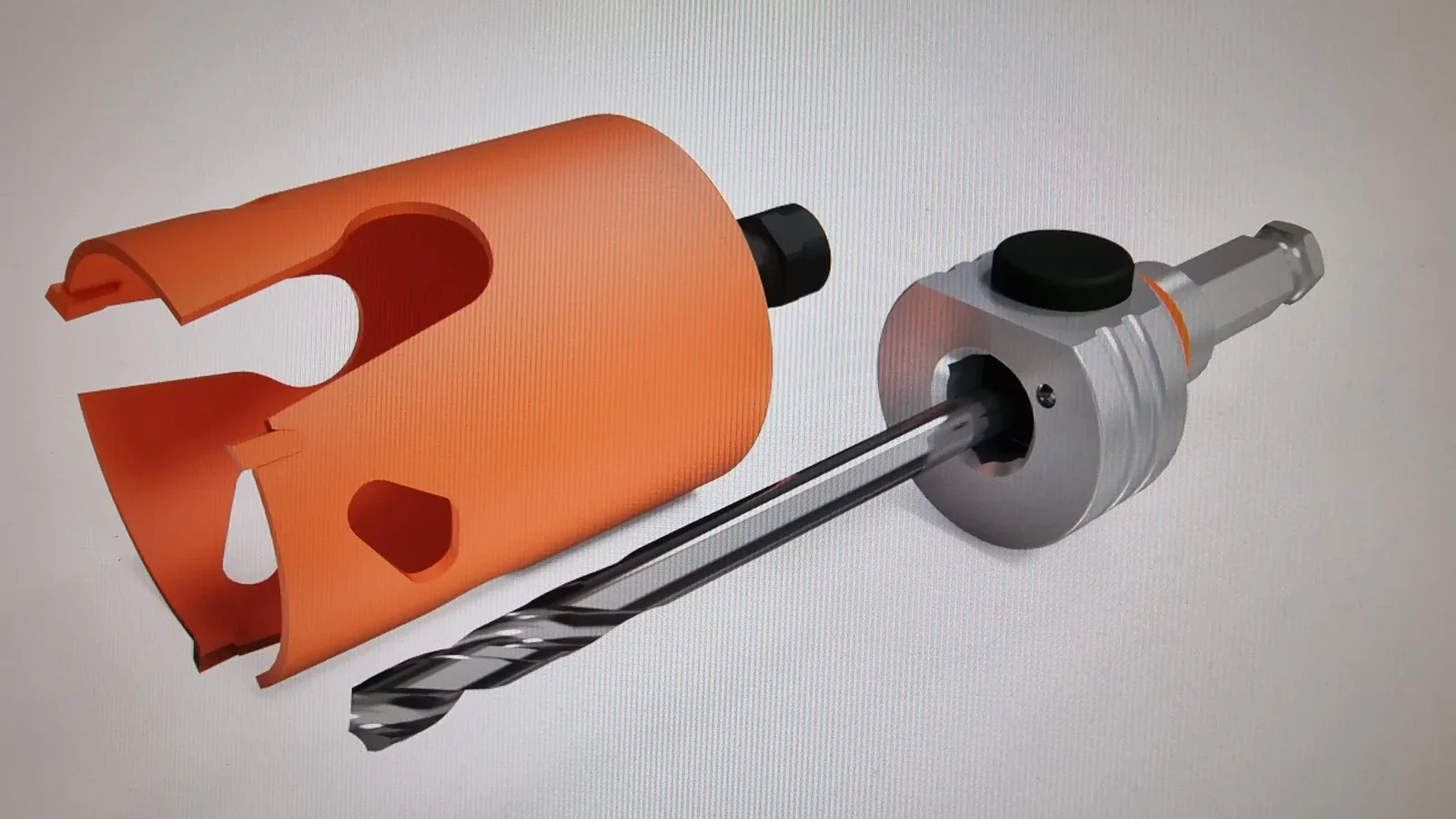
Yes, if you regularly bore big holes through wood that may hide nails, your Milwaukee Big Hawg carbide hole saw is worth the money. Milwaukee builds it for nail-embedded wood and abrasive material, where a standard wood bit dulls or chips fast [1]. If you only cut clean lumber now and then, you can skip it and save the cost.
The payoff comes on jobs like running drain lines or HVAC ductwork through old framing, where you drill one large-diameter hole after another and can’t see what’s buried in the studs [2]. Hitting a nail halfway through a joist stalls a weaker cutter, so the tougher teeth matter most when you make lots of these cuts.
Below you’ll find what the carbide version cuts, how it compares with bi-metal and standard Hawg bits, which kit or size to buy, its limits, and who gets the most from it.
What is the Big Hawg with carbide teeth built to cut
The carbide-tooth Big Hawg is made for the cuts that dull ordinary hole saws: wood with nails buried in it, plus abrasive material. Milwaukee calls it its best hole saw solution for nail-embedded wood and abrasive material applications. [1] If your holes go through lumber that has been nailed, patched or reworked over the years, this is the saw designed for that job.
Nail-embedded wood and abrasive material
Nail-embedded wood is any board with steel fasteners inside where you can’t see them. Think of a top plate with toenails from the original framing, or a joist that took a few extra nails when someone added blocking decades ago. Abrasive material wears down cutting edges faster than clean softwood does.
In both cases you want a saw that keeps cutting when it meets metal partway through a hole. A standard wood-cutting edge can chip or round over on the first nail. The carbide version is aimed at getting through that contact and continuing to the next hole.
Large holes through framing
Big Hawg cutters are built for drilling large-diameter holes through wood framing for plumbing drain lines and HVAC ductwork. [2] These are the holes that run through studs, plates and joists so pipe or duct can pass from one space to the next.
A few common examples:
-
A hole up through a bottom plate for a new sink drain
-
A run of holes across several studs for a drain line in a wall
-
A pass through a top plate or joist to route ductwork
Each of these may be one hole or a dozen in a row, and every one is a fresh chance to hit a nail.
Typical remodel scenarios with hidden nails
Remodels are where the carbide teeth earn their place, because old framing rarely stays clean. A bathroom gut might mean moving a drain through a plate that held baseboard nails, drywall screws and old plumbing straps. Relocating a kitchen sink can put your new hole right where a previous installer nailed in backing.
In new construction with fresh lumber, you usually know what’s inside the wood. In a 50-year-old house, you often don’t, and that uncertainty is the situation this saw is designed for.
How the carbide teeth make a difference
Bigger carbide teeth and fewer of them are what let this hole saw keep cutting after it hits a nail. Milwaukee lists the Big Hawg with Carbide Teeth with 10X larger carbide teeth. [1] In practice, that means more cutting material at each tip, so a tooth has more to give before a nail or abrasive material dulls it.
Larger teeth hold up to hidden metal
A standard tooth on a hole saw is small, and one hit on a framing nail can round it off. A larger carbide tooth is harder and has more mass, so it can chew through the nail and keep going. Milwaukee pitches the saw for heavy-duty wood and abrasive material for this reason. [3]
Picture drilling a 2-1/2 in. hole through an old top plate for a vent line. You can’t see the nail until you’re into it. With a toothier, softer saw, you might stop to swap blades. The carbide teeth are meant to let you finish the hole.
Three teeth for an aggressive bite
The saw uses a 3-tooth design for fast, aggressive cuts. [4] Fewer teeth means each one takes a bigger bite, and the gaps between them give chips room to clear out of the kerf (the slot the saw cuts).
That bite is what makes it fast in thick framing lumber. It also means the saw feels more forceful in your hands than a fine-toothed saw, especially as it breaks through.
Life and speed claims
Milwaukee and its retailers list some big numbers for this saw:
These are manufacturer marketing figures. The listings don’t say what saw they’re compared against or how the tests were run. Treat them as a sign that the carbide version lasts much longer in nail-heavy work, and expect your own results to depend on the material, your drill and how hard you push the saw.
Carbide Big Hawg vs bi-metal and standard Big Hawg
Choose the carbide Big Hawg when your cuts will hit nails or abrasive material, and save the standard or bi-metal saws for cleaner work. Milwaukee positions the carbide version as its best hole saw for nail-embedded wood and abrasive material applications [1]. The other two make sense when you rarely hit metal or want to spend less per hole saw.
|
Criteria |
Big Hawg with Carbide Teeth |
Standard Big Hawg |
Bi-metal hole saw |
|---|---|---|---|
|
Best material |
Nail-embedded wood, abrasive material |
Clean wood framing |
Mixed general use |
|
Teeth |
Large carbide teeth, 3-tooth design |
Hawg cutter teeth |
Many small toothed edges |
|
Hitting a nail |
Built for it |
Can damage the teeth |
Can cut through, wears faster |
|
Typical job |
Remodels, old framing, plaster-backed studs |
New construction plumbing and HVAC runs |
Occasional holes in wood, thin metal, plastic |
|
Relative cost |
Highest |
Middle |
Lowest |
The carbide version is the one built for jobs where metal hides inside the wood [1]. Think of a 1920s house where you drill a drain line hole through a stud and find a nail someone drove in decades ago. Carbide teeth keep cutting after a hit like that.
Standard Big Hawg for clean framing
Big Hawg cutters are made for large-diameter holes through wood framing for plumbing drain lines and HVAC ductwork [2]. In new lumber with no buried nails, the standard Hawg gives you that capacity without paying for carbide. A new-build plumber boring a row of joists is a good fit.
Bi-metal for mixed, occasional use
A bi-metal hole saw is the budget all-rounder. It handles a doorknob hole, a hole in a plastic box and the odd thin sheet of metal. It cuts slower through thick framing, so it suits a few holes a year better than a day of drilling.
Pick by how often you hit nails
Nail frequency decides it. If most of your holes go through old or reworked framing, buy carbide. If you mostly drill clean new lumber, the standard Hawg is enough, and if you drill large holes only now and then, a bi-metal saw covers it at the lowest cost.
Which kit or size should you buy
Buy the single saw if you only ever cut one hole size, and buy a kit if your work calls for several diameters. The carbide Big Hawg comes as individual saws and as boxed sets, so you can match the purchase to the jobs you actually do.
Single saw: 1-3/8 in. (49-56-9200)
The 1-3/8 in. Big Hawg with Carbide Teeth is sold on its own as part number 49-56-9200. [1] A single saw makes sense when you repeat the same hole over and over. For example, you might be running one size of supply line through a row of old joists, or replacing a single drain run during a remodel.
Buying one saw also lets you try the carbide teeth on your own framing before you commit to a full set. If it earns its keep, you can add other sizes later.
8-piece plumber’s kit (49-56-9285)
That price covers several saws in one case, so it suits someone who drills holes for different pipe sizes on the same job. A plumber roughing in a bathroom, for instance, may need one size for supply lines and a larger one for the drain.
If you’d buy three or four single saws anyway, compare that total against the kit price. The case also keeps the sizes organized in a truck or on a jobsite.
10-piece kit (49-56-9290)
The 49-56-9290 is a 10-piece Big Hawg carbide hole saw kit. [3] It is the larger set, aimed at trades who need the widest range of diameters on hand, such as remodelers who handle both plumbing and HVAC openings.
How to choose
-
Pick the single 1-3/8 in. saw if you need one hole diameter and only a handful of holes.
-
Pick the 8-piece plumber’s kit if you cut several pipe sizes regularly.
-
Pick the 10-piece kit if you want the most sizes in one case for varied trade work.
Retail prices on tool kits shift often, so check the current price at a few U.S. sellers before you order.
Limits and how to keep the teeth cutting
The carbide Big Hawg has two real downsides. It costs more than a bi-metal hole saw, and its teeth bite hard enough to wrench the drill if you aren’t ready. Both are manageable once you know what to expect.
Cost versus how often you cut
If you only bore a handful of holes a year in clean lumber, the carbide version is hard to justify. A bi-metal saw handles that work for less money, and you won’t use up the carbide’s extra durability.
The math changes when you cut through old framing week after week. Say you’re running drain lines through a remodel where every stud might hide a nail. One carbide saw that keeps cutting is cheaper than a stack of bi-metal saws with stripped teeth.
Why the teeth grab
The saw uses a 3-tooth design for fast, aggressive cuts [4]. That aggressive bite makes it fast. It also means the saw can catch on a knot, a nail or the far edge of a stud and stop suddenly while the drill motor keeps turning.
Control the cut this way:
-
Install the drill’s side handle and keep both hands on the drill.
-
Brace the drill body or your forearm against the framing so the twist goes into the wood, not your wrist.
-
Start at low speed until the teeth have cut a groove, then add speed.
-
Ease off the pressure as you break through the back of the board, where binding is most common.
Safety: kickback and binding
When a large hole saw binds, the drill can spin hard in your hands. Kickback is the term for this, and a big-diameter cutter amplifies the force. Use a drill with a clutch or bind-sensing feature if you have one, and never cut from a ladder position where a sudden twist could throw you off balance.
Wear eye protection for every cut. Carbide teeth that hit nails throw metal chips and wood shards, often straight back toward your face.
Touching up the teeth
Milwaukee sells a matching file for this cutter line, the Milwaukee 48-09-5055 Big Hawg Diamond File [2]. Use it to dress chipped or dulled edges between jobs. Light passes along each tooth face are enough. The goal is to restore the edge without changing the tooth shape.
Who should buy one
Buy the carbide Big Hawg if you cut big holes through old framing for a living or on a large remodel. It is built for nail-embedded wood and abrasive material [1], which is what plumbers running drain lines, HVAC installers routing ductwork and electricians working through 1950s studs hit every day [2]. If one buried nail would ruin a cheaper saw, the carbide teeth pay for themselves.
If you drill a few holes a year in new, clean lumber, a standard or bi-metal hole saw does the job for less. Your next step: measure the outside diameter of the pipe or duct you’re running, then pick the Big Hawg size that clears it.