The Milwaukee M12 HAMMERVAC dust extractor is a cordless attachment that clips onto your rotary hammer and pulls concrete dust away as you drill. It works with any SDS Plus rotary hammer, so you are not tied to one Milwaukee model [1]. Your hammer’s chuck has to be SDS Plus, though; a standard drill/driver won’t pair with it. You may also find this useful: Milwaukee M12 Vacuum: Which Model Fits Your Shop, Truck or Home.
The unit catches debris with HEPA-standard filtration [2]. It runs on an M12 REDLITHIUM battery, the same pack used across Milwaukee’s M12 line [3]. That matters if you’re drilling anchor holes in a basement slab or a brick wall inside your home, where fine dust spreads fast and is hard to clean up.
Below you’ll find how it collects dust, which tools it fits, which kit to buy, how the filter holds up, and whether it earns a spot in a DIY toolbox.
How does the HAMMERVAC catch dust while you drill?
The HAMMERVAC rides on your rotary hammer and pulls dust away right where the bit enters the wall, so most of it never reaches the air or the floor. It works with any SDS Plus rotary hammer, which means you attach it to the hammer you already use instead of holding a separate vacuum hose near the hole. [1]
Collection at the hole
When you drill into concrete or brick, the bit throws fine powder out of the hole as it spins and hammers. Because the extractor sits on the hammer, its intake stays at the drilling spot the whole time, whether you’re drilling into a basement floor or overhead into a masonry ceiling. You hold and aim one tool, and the dust pickup follows the bit.
This is handy for jobs like anchoring a TV mount to a brick wall or setting wedge anchors for a shelf bracket in a garage slab. Without collection, that work leaves a cone of dust on the floor and a haze in the room. With the extractor running at the hole, cleanup is mostly a matter of emptying it afterward.
Auto On/Off mode
In Auto On/Off mode, the extractor starts suction on its own when you start drilling. [4] You don’t have to reach for a second switch before each hole, which speeds things up when you’re drilling a row of anchor holes along a wall.
The mode also helps your battery last. Milwaukee describes it as saving both time and battery life, because the vacuum runs only while you drill. [4] For you, that means a charged pack goes further across a day of setting anchors, since the motor isn’t spinning while you measure, mark or move the ladder.
Automatic shutdown
When you stop drilling, the extractor powers down by itself. [3] Say you finish one hole, pull the bit out and step to the next pencil mark: the suction stops in between and comes back on with the next trigger pull.
That start-and-stop pattern matches how most DIY masonry jobs go, with short bursts of drilling and plenty of pauses. It keeps the work area quieter between holes, and your attention stays on the bit and the depth of the hole.
Which drills and bits does it work with?
The HAMMERVAC is built for SDS Plus rotary hammers, and it is meant to work with any of them [1]. If your hammer takes SDS Plus bits, the extractor is designed to fit it, whatever brand the hammer is.
What SDS Plus means
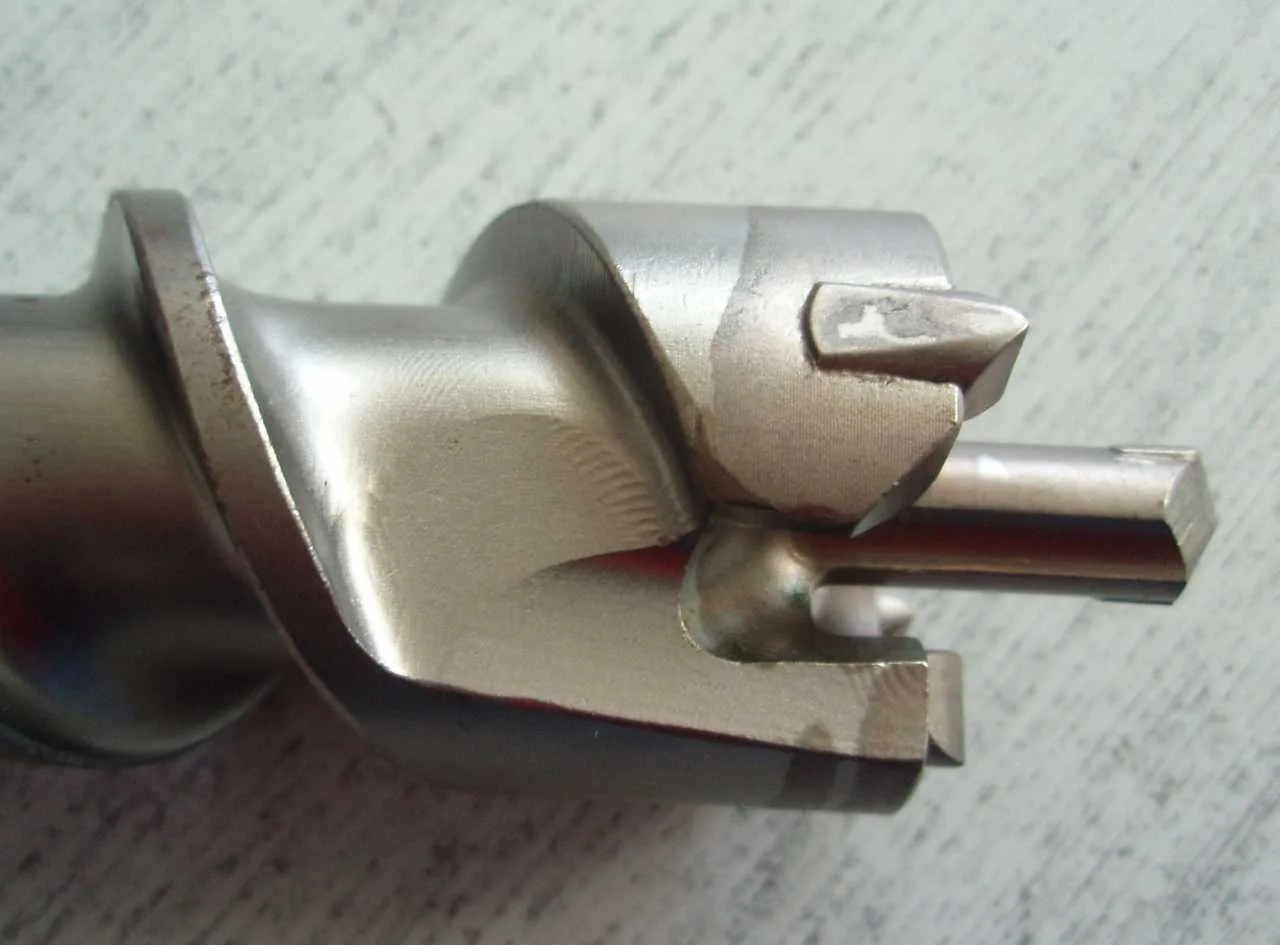
SDS Plus is a chuck and bit-shank system used on light and medium rotary hammers. The bit shank has grooves that slide and lock into the chuck, so the bit can move back and forth while the hammer pounds it into concrete.
You can spot an SDS Plus bit by its shank. It has two open slots at the very end and two closed grooves a little farther up. A regular round or hex-shank drill bit has none of these.
Drill/drivers and hammer drills are a different tool
A standard cordless drill/driver uses a keyless chuck with three jaws that clamp a round or hex shank. Many “hammer drills” use the same kind of chuck and add a light hammering action. Neither one is an SDS Plus rotary hammer, so the HAMMERVAC isn’t designed to pair with them.
Say you own a drill/driver combo kit and plan to drill a few anchor holes in a basement wall. The HAMMERVAC alone won’t help you. You’d need an SDS Plus rotary hammer first, and then the extractor would make sense as an add-on.
How to tell what you have
A quick look at the front of your tool usually settles it:
-
A chuck with jaws you tighten by twisting the collar means a drill/driver or hammer drill.
-
A collar you pull back to drop a slotted bit in means an SDS-style chuck.
-
A model name or spec sheet listing “SDS Plus” confirms it.
The chuck type and model name are on the tool or on the manufacturer’s spec sheet, so you can sort this out in a minute before you order.
Bits
Because the extractor is matched to SDS Plus hammers, the bits you use with it are SDS Plus bits [1]. Those are the masonry bits for concrete, brick and block that most DIYers buy for anchors, conduit holes and similar jobs.
Which kit or model number should you buy?
Buy the 2306-22 kit if you don’t own any M12 batteries yet, and the 2306-20 bare tool if you do. The kit is listed as coming with two batteries [5], while the 2306-20 is sold as the extractor alone [3]. A third number, 2509-22, also shows up at U.S. retailers as an M12 HAMMERVAC Universal Dust Extractor Kit [4].
|
Model number |
What it is |
Batteries included |
Best for |
|---|---|---|---|
|
2306-22 |
Universal Dust Extractor Kit |
Two [5] |
First-time M12 buyers |
|
2306-20 |
Bare tool [3] |
None |
Owners of M12 REDLITHIUM batteries |
|
2509-22 |
Universal Dust Extractor Kit [1] |
Check the listing |
Buyers comparing kit stock and price |
The main difference is whether you pay for batteries. The kit gets you drilling straight out of the box, and the second battery lets you swap packs on a longer job. The bare tool skips that cost, so it makes sense when you already have M12 packs from a drill, impact driver or light.
The 2306-22 kit
This is Milwaukee’s own listing for the HAMMERVAC kit [2]. Retail listings describe it as the kit “W/2 Bat”, meaning it ships with two batteries [5]. If the HAMMERVAC is your first M12 tool, start here so you aren’t buying batteries separately.
The 2306-20 bare tool
The 2306-20 is the extractor only and runs on an M12 REDLITHIUM battery [3]. You supply the battery and charger. For example, if you already run an M12 drill/driver, its battery fits, and you keep the extra money for bits or anchors.
The 2509-22 kit
The 2509-22 is listed as an M12 HAMMERVAC Universal Dust Extractor Kit for use with any SDS Plus rotary hammer [1]. One retailer listing shows a 4.6 rating across 1,397 reviews [1], so plenty of buyers have used this version. Before you order, read that listing’s “what’s included” line to see which batteries and charger come in the box.
Kit prices and stock change often, so check current prices with the retailer before you buy. Compare the kit price against the bare tool plus any batteries you’d still need.
How good is the filtration?
The HAMMERVAC filters what it collects to a HEPA standard, which is the main reason to use it indoors instead of drilling and sweeping up afterward. Milwaukee describes the kit as delivering “HEPA-standard debris filtration at the lowest cost of ownership.” [2]
What HEPA-standard filtration means for you
HEPA is a filtration standard built to trap very fine particles, the kind that drift out of a vacuum’s exhaust and settle on shelves and floors. Concrete and masonry drilling throws off exactly that sort of powdery dust, so the filter matters more than raw suction here.
In practice, picture drilling a row of anchor holes in a basement wall for a storage rack. Without collection, the dust coats the floor below and hangs in the air. With a filter that holds fine particles, more of that dust ends up in the dust box and less of it ends up in your workspace.
The cost-of-ownership claim
Milwaukee pitches the HAMMERVAC as having the lowest cost of ownership. [2] That wording is the manufacturer’s own marketing claim. It does not come with a breakdown of filter prices or replacement intervals.
The parts you’ll keep paying for over time are filters and batteries, so those are the costs to compare against a shop vac setup you might already own. If you rarely drill masonry, a dedicated extractor’s long-term savings matter less than whether it saves you cleanup on each job.
Keep the filter working
A full dust box or a clogged filter cuts suction, and weak suction means dust escapes at the hole. Get in the habit of emptying the collection box before it fills, especially on jobs with many holes or larger bits that produce more debris.
Tap or clean the filter between sessions so fine dust doesn’t cake on its surface. A good rhythm is to empty the box after every few holes on a big job and clean the filter when you pack up. If suction feels weaker than when you started, a loaded filter is the usual cause.
Is it worth it for DIY concrete and masonry work?
The HAMMERVAC makes the most sense if you drill holes into concrete, brick or block indoors, where the dust has nowhere to go. It is a poor fit if you don’t own an SDS Plus rotary hammer or don’t want another battery platform.
Where it earns its place
Picture anchoring a TV mount to a brick fireplace, setting shelf brackets into a poured concrete basement wall, or drilling a row of holes for a ledger board on a block foundation. Each hole throws fine gray powder onto the floor, your furniture and the air you breathe. The HAMMERVAC is built to remove that dust while you drill with any SDS Plus rotary hammer. [1]
Indoors, that saves you a cleanup round with a shop vac and keeps dust off finished floors and walls. Outdoors, on a patio or a fence post footing, the payoff is smaller because the wind carries most of the dust away.
It also suits jobs with many holes. Drilling one hole a year for a mailbox post doesn’t justify the cost, but setting 20 anchors for a basement storage rack does.
It only pairs with SDS Plus hammers
The attachment is designed around SDS Plus rotary hammers. [1] SDS Plus is a chuck style where the bit slides in and locks with grooves, so it can hammer without slipping. If your concrete drilling tool is a regular hammer drill with a keyed or keyless chuck, the HAMMERVAC won’t serve you.
That makes it a second purchase for most DIYers. If you rent a rotary hammer once or twice a year, you would need to own the hammer as well before this extractor pays off.
The bare tool needs a battery and charger
The HAMMERVAC runs on an M12 REDLITHIUM battery. [3] If you buy the bare tool, nothing is in the box to power it, so you need at least one M12 pack and a charger.
This is easy if you already use Milwaukee M12 drivers or lights, since the same packs fit. If you don’t, the kit version with two batteries included [5] avoids a second trip to the store, and you start with a spare pack to swap in when the first one runs down mid-job.
Deciding on the HAMMERVAC
Get the HAMMERVAC if you drill into concrete or masonry often with an SDS Plus rotary hammer and want the dust caught at the hole instead of swept up afterward. It works with any SDS Plus rotary hammer, so it moves with you if you upgrade the hammer later [1]. If you only drill a hole or two a year, or you use a regular drill/driver, it adds cost without much payoff.
Pick the version that matches your batteries. The 2306-20 is the bare tool and runs on an M12 REDLITHIUM battery, so it makes sense if you already have M12 packs and a charger [3]. If you don’t, the 2306-22 kit comes with two batteries [5].