The Milwaukee Packout 2-Wheel Cart is worth buying if you already keep your tools in Packout boxes and move several of them at once. If your storage is a different brand, it does far less for you, because the cart is built around Packout’s locking system.
The cart is model 48-22-8415, with attachment points for stacking or hanging Packout products [1]. It carries up to 400 lb on 10-inch industrial wheels [2]. In practice, that means you can roll a stack of loaded boxes from your truck to the job in one trip instead of three.
Below, you’ll see how the cart holds a stack, how much it can realistically haul, where two wheels become a drawback, and who should skip it.
How does it hold Packout boxes
The cart holds Packout boxes the same way the boxes hold each other: the base and frame have built-in Packout mounting, so boxes click on instead of sitting loose. That lets you either stack boxes on the base or hang Packout products on the frame. [3]
The base locks the bottom box
The base has integrated Packout mounting, so your bottom box latches to the cart the way it would latch to another Packout box. [3] Set a large rolling box or a deep organizer on the base, press it down until the latches engage, and it becomes part of the cart rather than cargo riding on it.
The frame takes hanging products
The upright frame also has integrated attachment points, so you can hang Packout products on it as well as stacking them. [1] In practice, that means a smaller Packout piece can ride on the frame while your main stack sits on the base, which frees up the top of the stack for the box you open most often. For a closer look, read Milwaukee Packout Customizable Work Top: What It Adds to Your Stack.
The stack stays put while you roll
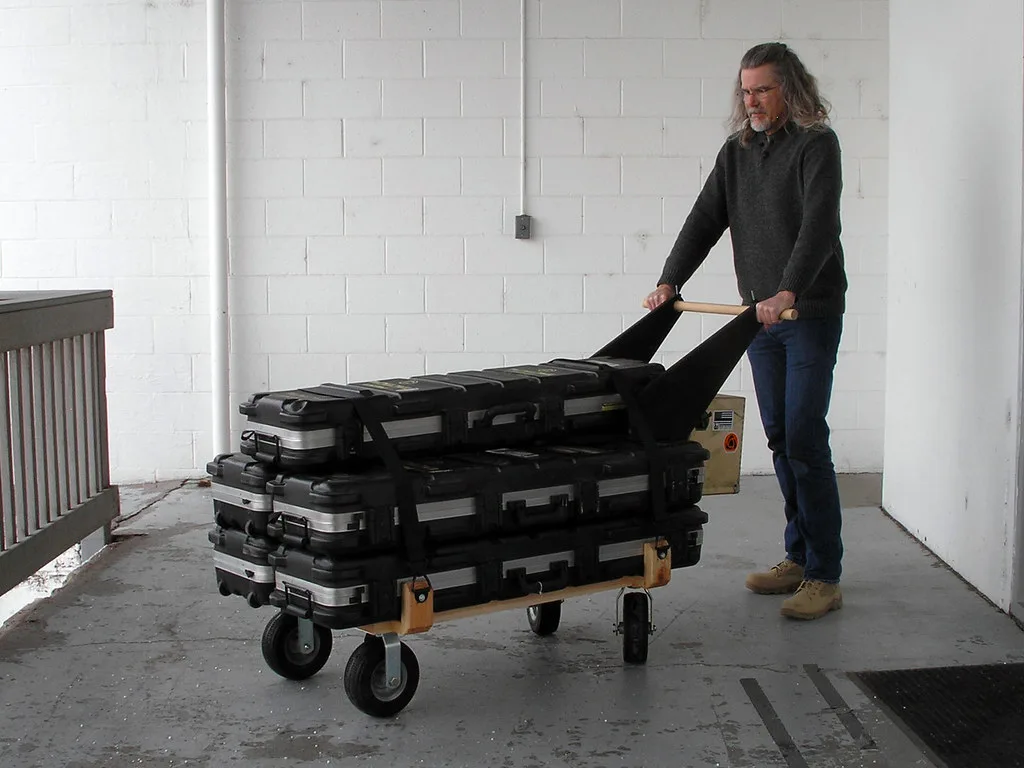
Each box latches to the one below it, and the bottom box latches to the base, so the whole stack moves as one unit. [3] When you tip the cart back to roll it over a threshold or across a driveway, the boxes don’t slide off the base or shift against each other. A three-box stack with a drill kit, a fastener organizer and a tool box goes from the truck to the job as a single load.
How much weight can it carry
The cart is rated to carry 400 lb, so for most people the limit is how much they can tip back and steer rather than what the frame can hold [1]. In practice that means you can roll a tall stack of loaded Packout boxes on it, such as a large tool box on the bottom, a mid-size box with drills and drivers above it, and an organizer of fasteners on top, and still be well inside the rating.
A full stack of boxes holding cordless tools, batteries and hardware adds up fast. The 400 lb figure gives you room for a heavy setup without loading the cart near its stated capacity.
Wheels built for rough ground
The cart rolls on 10-inch industrial wheels, which the maker pitches for moving gear on and off the jobsite [2]. Large wheels like these climb a curb edge, cross a gravel driveway and go up a truck or trailer ramp with far less effort than the small casters on a typical shop cart. On packed dirt or a cracked sidewalk, the bigger diameter keeps the load from catching on every bump.
Size on the shelf
Home Depot lists it as the Milwaukee PACKOUT 20 in. 2-Wheel Utility Tool Cart, model 48-22-8415 [3]. That 20-inch figure helps when you’re planning space in a truck bed, a van or a crowded garage corner.
Where the cart falls short
The cart only makes sense if your tools already live in Packout boxes, and even then it has a few habits you should know before you load it. Its mounting points on the base and frame are built to stack or hang Packout products [3]. A plastic tote, a toolbag or another brand’s box has nothing to lock into, so you end up strapping it down like you would on any hand truck.
Balancing on two wheels
A two-wheel cart rolls only when you tip it back and hold the load at an angle. That means part of the weight sits in your hands the whole time. Across a driveway that is fine, but pushing a full stack the length of a big jobsite or a parking lot wears out your arms and lower back faster than a four-wheel cart you just push.
Tall stacks and stairs
The higher you stack, the more the weight shifts toward you when you tilt the cart. Three or four loaded boxes can feel top-heavy, and on stairs the stack can swing or tip if a wheel catches an edge. Keep the heaviest box at the bottom and take a box off before you tackle steps.
What owners report
Buyers rate it well overall without calling it flawless. It averages 4.0 out of 5 across 461 ratings at one retailer [3] and 4.1 across 19 at another [2]. Expect a share of reviews pointing out these same trade-offs.
Should you buy one
Buy the cart if you already own several Packout boxes and move them together often, such as from the truck to a jobsite or from the garage to a backyard project. The base and frame have Packout mounting, so your existing boxes stack or hang on it and roll as one load instead of three separate trips. [3]
Skip it if your tools live in other brands’ boxes, bags or loose bins. You would pay for a frame built around Packout mounting and get little use from it. If you are ready to buy, look up the current price on the retailer’s page for model 48-22-8415 before you order.