The WEN BA3959 is the first pick for most people starting out with a band saw for woodworking: it’s a compact 9-inch benchtop saw that comes ready for straight and angled cuts. It cuts stock up to 3-1/2 inches deep, which handles curves in boards and small project parts but not resawing thick lumber. For more detail, see How to Choose the Best Saw for Woodworking.
Its table bevels up to 45 degrees, so you can cut angled edges without extra jigs, and a rip fence and miter gauge come in the box. That means you can make straight rips and crosscuts on day one without buying accessories.
If your projects call for slicing wide boards into thinner panels, you need more height under the blade guides. The five picks below run from 9-inch benchtop saws up to a 14-inch machine that resaws boards up to 13 inches tall in one pass. To go further, see Best Jig Saw for Woodworking: Five Picks and How to Choose.
As an Amazon Associate we earn from qualifying purchases.
How we picked: from products sold on Amazon for this need, compared by what their makers state and what buyers report in their reviews.
The Picks at a Glance
Product | Best for | Item dimensions l x w x h | Item weight | Blade length | Buyer rating | |
|---|---|---|---|---|---|---|
WEN BA3959 9-inch | beginners on a benchtop | 11″L x 7″W x 4″H | 40 lb | 59.5 in | 4.4 of 5 (1,414 reviews) | |
SKIL BW9501 9-inch | quick blade setup | 24.02″L x 15.16″W x 12.4″H | — | 9 in | 4.4 of 5 (309 reviews) | |
WEN BA3962 10-inch | thicker stock on a budget | 26.5″L x 21″W x 58.5″H | — | 10 in | 4.4 of 5 (363 reviews) | |
JET 14-inch 1.75 HP | resawing thick boards | 75.5″L x 27″W x 37″H | 272 lb | 116 in | 4.4 of 5 (195 reviews) | |
Woodskil 9-inch 3-amp | wood and soft metal | 17.9″L x 12.2″W x 27.4″H | 40 lb | 59.5 in | 4.4 of 5 (523 reviews) |
Buyer ratings as shown on Amazon on November 15, 2026; they change.
WEN BA3959 9-inch: Best for beginners on a benchtop

If you want a compact saw for small woodworking projects and don’t want a steep learning curve, the WEN BA3959 is a sensible place to start. The maker lists a 2.8-amp motor that spins the blade up to 2500 feet per minute, with cuts up to 3-1/2 inches deep and 9 inches wide. That covers curves in 3/4-inch boards, scroll-style cutouts and small parts on a bench that’s already crowded.
It runs 59-1/2-inch blades from 1/8 to 3/8 inch wide. A narrow 1/8-inch blade handles tight curves like toy wheels or ornaments, and a wider 3/8-inch blade tracks straighter on longer cuts. The 12-1/4 x 11-7/8-inch table bevels up to 45 degrees, so you can cut angled edges for boxes or chamfered trim without a second tool.
The box includes a 1/4-inch-wide blade, a 2-1/2-inch dust port, a rip fence, a miter gauge, an adjustable blade guard with ball-bearing supports and a 2-year warranty. You can make straight rips and crosscuts on day one, and the dust port takes a shop vac hose to keep sawdust off the bench. At 40 pounds, it matches the Woodskil 9-inch at 40 pounds and is far lighter than the JET 14-inch at 272 pounds, so you can lift it onto a bench and store it when you’re done.
Pros
Fence and miter gauge come in the box
Table bevels to 45 degrees for angled cuts
Buyers say setup is easy and adjustments are simple to set
Buyers find it good value for small projects
Cons
Buyers report parts wearing out over time, including a tension knob that can crack
Some buyers find the blade guides fiddly to adjust
The 3-1/2-inch cut depth limits resawing, so slicing wide boards into thin stock is out
If you plan to resaw thick boards, the JET 14-inch 1.75 HP is the better match.
SKIL BW9501 9-inch: Best for quick blade setup
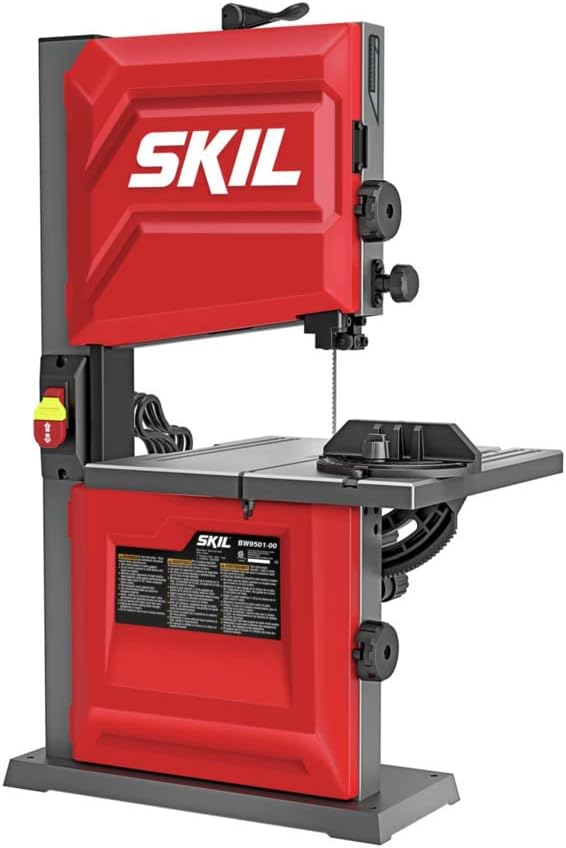
The SKIL BW9501 suits you if you want a small benchtop band saw you can tune quickly and keep running without fuss. Its quick blade tension setting and tool-free belt tensioning cut down the fiddly setup steps that slow down a first project.
The 2.8 amp induction motor is made for ripping a range of wood materials, which fits the scrollwork, curves and small-part cutting a 9-inch benchtop saw handles. A 2-speed drive lets you move to a slower or faster blade speed without reaching for a wrench to retension the belt. The quick blade tension setting gets the blade snug and accurate fast, so a blade swap takes less of your shop time.
The ball bearing and lower blade guides keep the blade tracking consistently, which helps a curve follow your pencil line. A blade-tracking sight window lets you see the blade’s position while you cut. Rack and pinion table adjustment makes angle changes quick, the 2-1/2 inch dust port takes a standard shop vacuum hose, and a miter gauge guides crosscuts. The steel base keeps the saw steady on your bench, and the saw has a 3 year limited warranty.
Pros
Quick blade tension and tool-free belt changes
Fits a standard 2-1/2 inch vacuum hose for less dust on your bench
Buyers say it is well built and cuts smoothly
Buyers report quick setup, ready to use out of the box
Cons
Buyers complain that the blade wobbles in use, which can make cuts less steady
Some buyers doubt it will hold up well over years of regular use
If you want a 9-inch benchtop saw with a bevel table, the WEN BA3959 lists bevel capability.
WEN BA3962 10-inch: Best for thicker stock on a budget
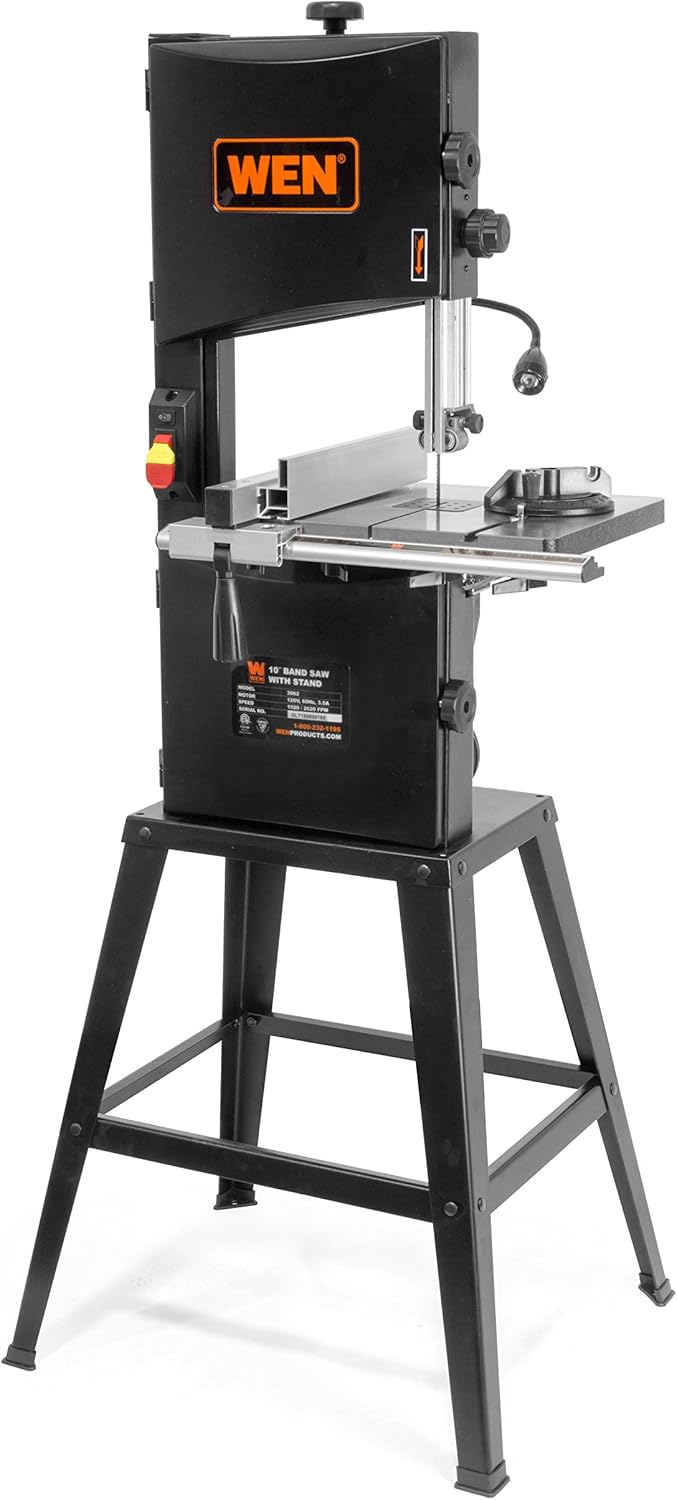
The WEN BA3962 is for woodworkers who want deeper cuts than a 9-inch benchtop saw gives, without stepping up to a big floor machine. Its 3.5 amp motor cuts up to 6 inches deep and 9-3/4 inches wide, and it comes with its own stand. That depth lets you slice a 4×4 post or resaw a thick board into thinner pieces for box sides.
You get two speeds, 1520 or 2620 FPM. The faster speed suits general wood cutting, and having a slower option gives you more control on tight curves or denser material. The saw takes 72-inch blades from 1/8 to 1/2 inch wide. A 1/8-inch blade handles scrollwork and small curves, and a 1/2-inch blade tracks straighter when you resaw.
The 14-1/8 x 12-1/2 inch cast aluminum table bevels up to 45 degrees. That gives you room to support wider boards and to make angled cuts for chamfers or tapered legs. A work light, a 3-in-1 dust port, a fence, a miter gauge, a 3/8-inch 6 TPI blade and a 2-year warranty come in the box. You can start making straight rips and crosscuts right away without buying extra accessories.
Pros
Cuts up to 6 inches deep for thicker stock
Stand included, so you don’t need a bench
Buyers say it is quick and easy to set up
Buyers call it good value and solidly built
Cons
Buyers report blade wobble during cuts
Some buyers find the adjustments hard to set and keep accurate
At 26.5″L x 21″W x 58.5″H, it takes up more floor space than the 9-inch benchtop picks
If you mainly resaw wide hardwood boards, the JET 14-inch with its 13 in resaw capacity is the better fit.
JET 14-inch 1.75 HP: Best for resawing thick boards

The JET 14-inch is the pick for woodworkers who want to slice thick boards into thinner ones, a job called resawing. Its 1.75 HP motor and 116-inch blade loop resaw stock up to 13 inches tall in one pass. That means you can split a wide slab into bookmatched panels or shave off your own veneer without a second machine.
The maker lists a 360 sq. in. ground cast-iron table that tilts 0–45° right for bevel cuts. A table that size gives long boards solid support as you feed them, and cast iron’s weight helps damp vibration. The saw runs 116-inch blades from 1/8 inch wide for tight curves to 3/4 inch wide for fast resawing, with a 13-1/2 inch throat capacity. You can swap to a narrow blade for scrollwork and back to a wide one for slabs on the same machine.
It comes with a steel stand and a machined-aluminum resaw fence, but the blade is sold separately, so budget for at least one before your first cut. JET backs the saw with a 5-year warranty, which drops to 2 years for commercial or industrial use.
Pros
13-inch resaw capacity in one pass
Blade range covers tight curves and wide resaw blades
Buyers say it cuts smoothly and is solidly built
Buyers find it easy to adjust and set up
Cons
Buyers report the blade drifts out of alignment and needs readjusting.
At 272 pounds it is far heavier than the 40-pound WEN BA3959, so moving it needs help.
The cast-iron table needs an occasional coat of paste wax to keep stock sliding and prevent surface rust.
If you only cut curves in thin stock on a benchtop, the WEN BA3959 is the lighter, simpler choice.
Woodskil 9-inch 3-amp: Best for wood and soft metal

The Woodskil 9-inch band saw suits a hobbyist who mostly cuts wood but wants the option to trim soft metal on the same benchtop machine. The maker rates it for different types of wood and soft metal, and pairs a 1/2 HP motor with a 2500 FPM blade speed. That makes it a small, all-round saw for curves, straight rips and angled cuts on modest stock.
The maximum cut is 3-1/2 inches deep and 9 inches wide. In practice, you can cut shapes from a 2×4 or slice a wide pine board into curved brackets, but you won’t resaw thick lumber into veneer. It takes 59-1/2-inch blades from 1/8 to 3/8 inch wide. A 1/8-inch blade handles tight scrolls for toys or signs, and a 3/8-inch blade tracks better on straighter cuts.
The cast aluminum table tilts from 0 to 45 degrees, and the saw comes with a 120-degree miter gauge and a rip fence. The tilt lets you cut beveled edges, and the fence and gauge mean you can make straight and angled crosscuts without buying extra accessories first. The saw weighs 40 pounds, so you can lift it onto a bench, but you’ll want it bolted down rather than moved every session.
Pros
Rated for both wood and soft metal
Fence and miter gauge come in the box
Buyers say setup and assembly are quick and easy
Buyers report clean cuts and good value for the money
Cons
Buyers complain that blades wear out or break sooner than expected, so budget for spares
Some buyers report units arriving with poor build quality
Buyers find the table hard to adjust or say it doesn’t hold its setting, which matters if you cut a lot of bevels
If you plan to resaw thick boards, look at the JET 14-inch instead.
What to look for when buying a band saw
Start with cut depth, because it sets the thickest board you can slice on edge. That edge-on slicing is called resawing, and it is how you turn one thick board into two thinner ones. A 9-inch benchtop saw cuts up to 3-1/2 inches deep, so it handles 2x stock and small craft parts. A 14-inch machine resaws material up to 13 inches tall in one pass, which is enough to split a wide slab into bookmatched panels.
Motor power is the next thing to weigh. Look at 1.5 HP to 2 HP or more if you plan to cut hardwoods or resaw [1]. A smaller motor works for thin softwood and curves, but it slows down in thick oak or maple.
The blade range decides what kind of cuts you can make. A saw that takes blades from 1/8 inch wide for tight scroll cuts up to 3/4 inch wide for fast resawing covers both detail work and straight rips. Two speeds, such as 1520 or 2620 FPM, let you slow the blade down for tougher material. A table that tilts 0 to 45 degrees lets you make bevel cuts.
Finally, look at the accessories. A 2-1/2-inch dust port fits a standard shop vacuum hose. An included rip fence and miter gauge mean you can make straight rips and crosscuts right out of the box.
Picking your band saw
WEN BA3959 is the first pick for a compact benchtop start: it gives you a bevel table, a rip fence and a miter gauge in the box, so you can make curves, rips and crosscuts on day one. Its 3-1/2-inch cut depth handles most craft and small-furniture parts.
Your next step is to settle on the cut depth you need before you compare anything else. Measure the thickest board you plan to slice on edge. If it fits under 3-1/2 inches, a 9-inch benchtop saw covers you. If you want to resaw wide boards into thin panels, the 13-inch capacity of the JET 14-inch saw is what makes that possible in one pass.


